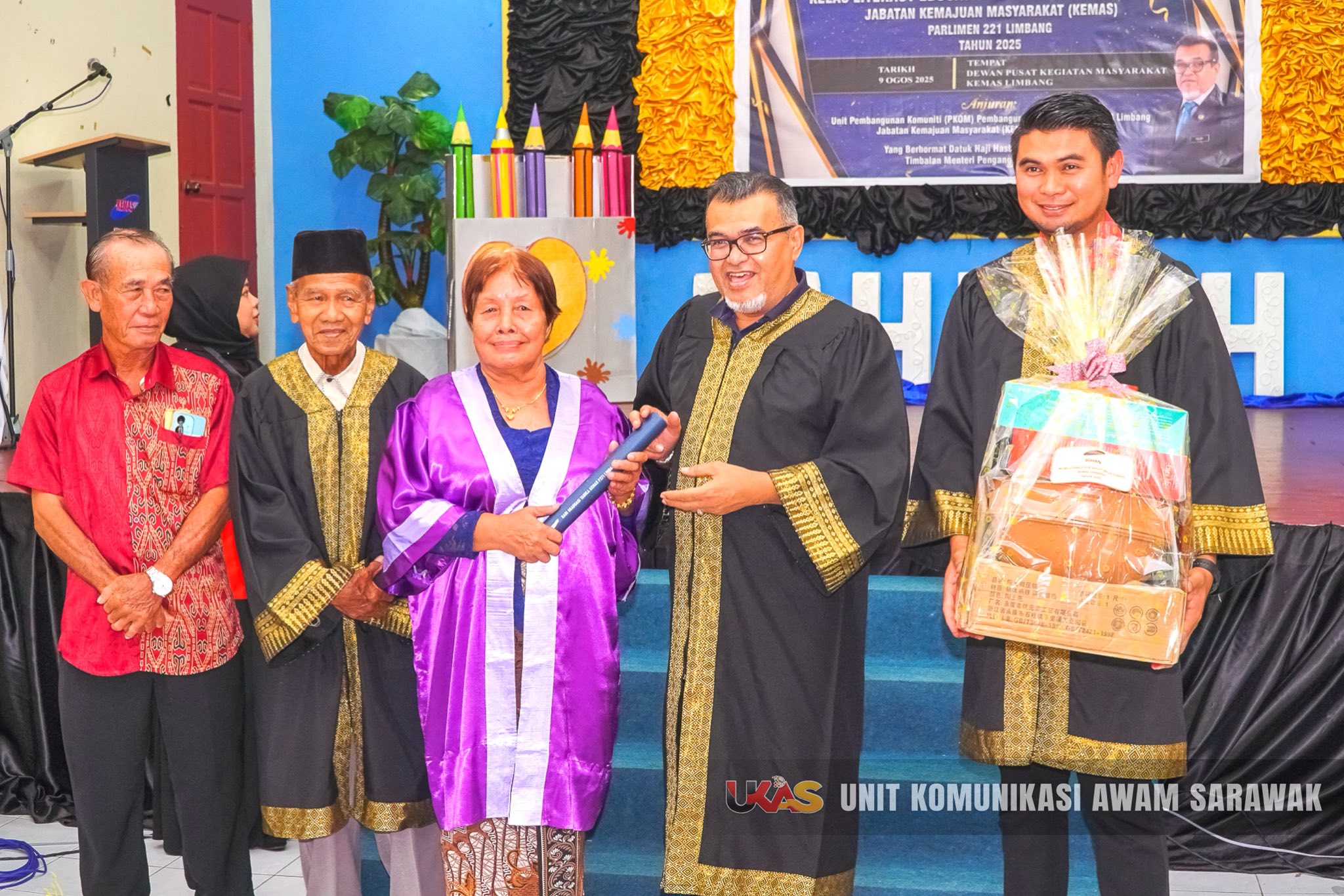
LIMBANG: A total of 20 adult participants from Rumah Imau and Rumah Senggat have successfully completed the Literacy Education for Adult Skills (LEADS) programme, organised by the Community Development Department (KEMAS) Limbang Parliamentary Office 2025, aimed at eradicating illiteracy in rural communities.
Deputy Minister of Transport, Datuk Hasbi Habibollah, said the implementation of non-formal education programmes such as LEADS aligns with the objectives of ‘Education for All’ under the United Nations Educational, Scientific and Cultural Organisation (UNESCO) and Sustainable Development Goal (SDG) 4, which seeks to improve adult literacy rates.
“This programme not only provides opportunities for communities to gain knowledge, but also boosts morale, develops human capital, and strengthens basic reading, writing and arithmetic skills,” he said when officiating at the LEADS Graduation Ceremony at KEMAS Limbang Office here recently.
Hasbi, who is also Limbang Member of Parliament, added that KEMAS also plays a role in developing local leaders through village-level community development activities, enabling them to plan, implement and manage religious programmes and human capital initiatives that have a positive impact on attitudes, socioeconomics and the well-being of rural communities.
Furthermore, he said, lifelong learning initiatives like LEADS give adults, young women and youth who have missed out on formal education the opportunity to enhance their knowledge and skills, empowering them to take an active role in the development of their families and communities.
He also extended his congratulations to KEMAS for its continued efforts in organising high-impact programmes that help narrow the literacy gap, especially in Sarawak and Limbang.
The four-month LEADS course, conducted by instructor, Nurul Syafikah Yusof, from April to July, was held at Rumah Imau, Mile 9, Jalan Kubong.
Through LEADS, participants were able to improve their basic literacy skills, enabling them to better understand official documents, fill out forms, read public instructions, and interact more confidently within their communities.