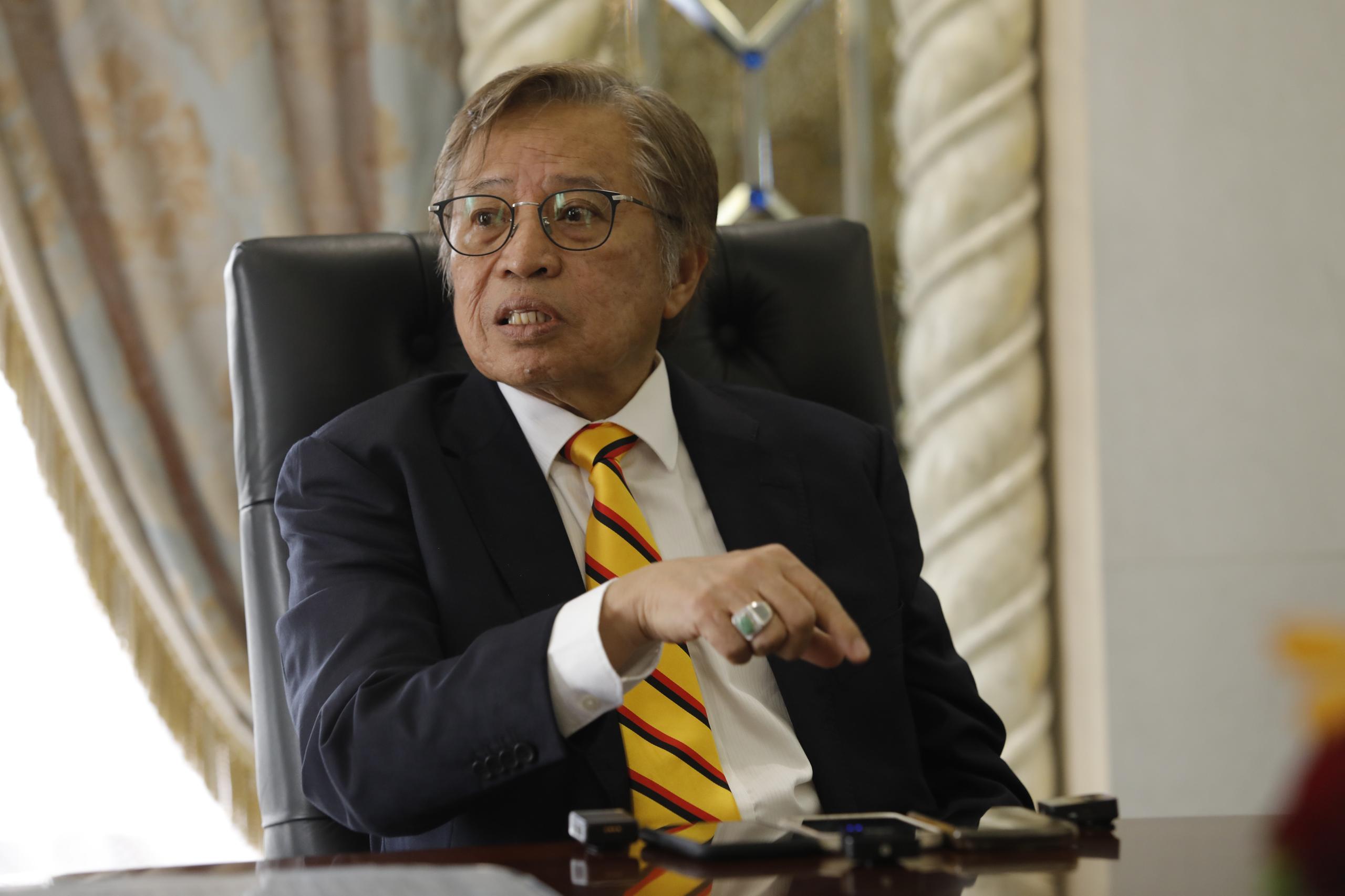
The 16th Parti Pesaka Bumiputera Bersatu (PBB) Triennial General Meeting (TGM) or PBB Convention marks an important moment in shaping the party’s future leadership and direction. Premier and PBB president Datuk Patinggi Tan Sri Abang Johari Tun Openg shares his thoughts on leadership transition and the party’s strategy in navigating evolving political and global challenges.
BY NATASHA JEE & NURIN PATRA
KUCHING: The 16th Parti Pesaka Bumiputera Bersatu (PBB) Triennial General Meeting (TGM) or PBB Convention marks an important moment in shaping the party’s future leadership and direction.
As Sarawak’s dominant political force within Gabungan Parti Sarawak (GPS), PBB safeguards Sarawak’s rights under the Malaysia Agreement 1963 (MA63) while steering its socio-economic development forward.
In an exclusive interview with Sarawak Tribune, Premier and PBB president Datuk Patinggi Tan Sri Abang Johari Tun Openg shares his thoughts on leadership transition and the party’s strategy in navigating evolving political and global challenges.
He also stressed the importance of strong leadership, grassroots unity, and strategies to ensure PBB’s continued stability and relevance.
Sarawak Tribune: Datuk Patinggi, you have once again been elected as the president of PBB, winning unopposed. Could you share your views on this matter?
Abang Johari: Firstly, I would like to express my gratitude to the leadership of PBB at the grassroots level throughout Sarawak for placing their trust in me to lead the party, as well as to my fellow deputy presidents and senior vice presidents.
Of course, this reflects the desire of the grassroots leadership to continue PBB’s efforts towards sustainable development and to form a leadership team that can earn the people’s trust.
More importantly, we aim to ensure that our struggles are grounded in the interests of Sarawak within the framework of the MA63.
This responsibility involves the PBB leadership working together with our GPS partners to continue assessing the benefits we have obtained so far.
Furthermore, as part of the MA63 agreement, we must look towards the future of Sarawak and Malaysia.
I am confident that with the unity and strong cohesion among PBB leaders and the cooperation we receive from the other components in GPS, we will be able to manage this responsibility effectively.
On the six-way contest for the PBB Bumiputera wing vice-president posts and contest for the PBB Supreme Council position in the convention. What are your hopes and how the party selects the potential leaders?
I leave this to the leadership at the grassroots level because I believe that grassroots leadership has the necessary level of thinking to identify potential leaders.
So, I view this contest as a family affair. There are no far-reaching effects because, based on my understanding over the decades, we have had contests, and the potential of leadership must be assessed through the confidence of the grassroots and their ability to see PBB’s direction for the future, especially in this evolving ecosystem.
However, looking at it intellectually, if they possess sufficient knowledge but lack connections with the grassroots, there may be gaps.
Leaders must comprehend the grassroots and be able to adapt themselves to their perceptions. Additionally, leaders should be capable of implementing a sound approach. In cases of gaps, a divide will emerge.
This is why our leaders must grasp interpersonal relationships and be able to effectively translate their values into actions that resonate with the grassroots. By following this approach, I am confident that our party can move forward and make progress.
In this contest, there will be a procedure for how we influence grassroots leadership regarding the structure within PBB.
We must acknowledge that in PBB, we have two wings, and there is a clear understanding of the roles between the two. Therefore, understanding the structure is essential.
Without this understanding, a situation may arise where some young leaders are unaware of the background and history behind the differentiation between the Pesaka and Bumiputera wings. However, this distinction is a cultural legacy established by our past leaders, which has been beneficial, and we must uphold the relationship between the two.
What is the main focus and your hope for the party’s convention this year?
The convention this time is a transitional one. If we consider our position as leaders of PBB, firstly, from the perspective of age, we are approaching our 70s. The reality is that we won’t be able to serve for much longer.
We expect this convention to provide an opportunity and space for grassroots leadership to observe the new generation of leaders who will carry on the party’s efforts over the past 60 years. Indeed, the era has changed.
Under the leadership of the late Tun Temenggong Jugah Barieng and later Tun Abdul Rahman Yakub, the era was different because it was a time when we had just gained independence. Many strategies were needed to develop Sarawak within the framework of the newly formed Malaysia, which had just been freed from colonial rule.
Then, under Tun Pehin Sri Abdul Taib Mahmud’s leadership, we focused on structured development through his political strategies. During that era, we saw Sarawakians we sent to study outside Sarawak return and take on leadership roles in several government agencies. They also became administrators to continue the development of Sarawak, whether in administration or politics.
For instance, Datuk Seri Fadillah Yusof is one of the products. There are many others in Sarawak’s leadership who have received higher education and are now playing important roles in the government.
During Tun Taib’s era, we saw that he had established a strong foundation in administration and politics, which helped facilitate political development.
After that, Tun Taib also had a vision for PBB, having trained several emerging leaders, including myself, the late Pehin Sri Adenan Satem (Tok Nan), Datuk Amar Douglas Uggah Embas, and Datuk Seri Alexander Nanta Linggi. Thus, we have a team that continues the late Tun Taib’s efforts.
Although Adenan only led for about three years, he ensured that the emerging leadership, which Tun Taib had trained, carried out the party’s responsibilities.
How about PBB’s leadership after you took over?
Under my leadership, following Tok Nan’s passing, I too encountered an era that had already shifted. This is a more sophisticated era, with technology as a key tool for developing Sarawak’s socio-economic aspects, and even Malaysia’s.
Therefore, with the collaboration of my colleagues, we are exploring new fields to meet the challenges of a borderless world. Whether we like it or not, we must consider the ecosystem we are immersed in, including climate change and the increasingly advanced economy, as we now compete with other nations.
This is why, upon assuming office, we encountered the challenge of COVID-19. After successfully navigating those obstacles using various approaches, we seek ways to restore the economic development impacted by the pandemic.
Consequently, I, alongside my party colleagues, the GPS coalition, non-governmental organisations (NGOs), and other stakeholders, collaborated to formulate a more competitive policy, resulting in the creation of the Post-COVID-19 Development Strategy (PCDS) 2030.
Within the PCDS 2030, three crucial pillars stand out: economic prosperity, social inclusivity, and environmental sustainability. I firmly believe this forms the foundation for the future.
Therefore, when discussing contemporary leadership, it is imperative that leaders not only engage in politics but also consider global challenges and their positioning within the highly competitive global landscape. Moreover, the current international situation is uncertain.
Contemporary leadership involves recognising the global socio-economic landscape because the world is now borderless, particularly with advanced media.
Leaders must be capable of offering thorough analysis and be courageous enough to introduce fresh ideas as a response to the rapidly changing global landscape.
This is why PBB must evaluate leaders who can bear the weight of the challenging responsibilities that lie ahead.
What lessons can we learn from the leadership, from Tun Jugah to Tok Nan, especially in the aspect that Datuk Patinggi emphasised earlier?
The first thing is that leadership has always progressed based on harmony and understanding between leaders. We know that there have been competitions.
In the late 1980s, there were contests at the vice president level, including myself; there were contests, but they didn’t split the party. Even though there were contests, the spirit was to protect PBB. That’s why they progressed well, with the understanding that, in the end, we fought for the people, not for personal gain.
Secondly, we aim to strengthen the position of the Bumiputera and Pesaka, and to ensure the Bumiputera community moves together with the ongoing development.
That is why I propose that by 2026, with our financial position, we aim to provide tertiary education for free. We need many scholars, technologists, and scientists who will develop our state in non-conventional ways. This is important.
Additionally, with our natural resources, I believe we have a strong foundation. We need to focus on utilising this foundation and strengthening our economy.
From gas, hydrogen, hydro, and solar, which we will combine as clean, renewable energy, we can share with our ASEAN partners.
What are the formulas in ensuring the stability of PBB and the strong understanding and harmony between the Pesaka and Bumiputera wings?
Yes, we foresee that in the future, PBB will have members who understand the culture of PBB, and possibly members who do not understand the culture of PBB.
Therefore, in my opinion, during this convention, we will also discuss this culture, to reach an agreement to preserve a culture that has been in place for 60 years.
Datuk Patinggi, could you elaborate on the convention’s theme ‘PBB Tonggak Kestabilan, Kemajuan dan Kelestarian Sarawak’?
Yes, we have reached a consensus that we will continue the direction of PBB as the dominant component within GPS to defend Sarawak’s rights within the framework of the MA63.
Furthermore, we will continue to boost the county’s stability because I don’t know what will happen to the government in the upcoming general election. Perhaps the coalition will continue, or maybe the components will change.
We don’t know the dynamism, but what is important is that Malaysia must have political stability. The country must contribute to a larger economy, as ASEAN is mentioned as the fourth-largest economy in the world.
We have many strengths in ASEAN with which we can reach the global development that is currently happening.
Secondly, nothing is certain. In the last 10 years, the world has desired free trade. That’s why through the World Trade Organisation (WTO), the economy would be balanced. But today, tariffs (a levy or duty that a government imposes on imported goods) have become a tool. Some people are using it as a weapon.
There is no longer free trade. Hence, the global situation now seems uncertain. So, in Malaysia, they must have a strong government. PBB and GPS will play this role, just as we did in the past four years.
PBB has endured for over 50 years, while many other parties have emerged and dissolved. What is PBB’s strategy to remain relevant?
If we look at history, many large parties have collapsed due to internal problems. For example, the Indian National Congress Party, which has a long history of fighting for India’s independence, split due to leadership issues and internal factions. Today, it no longer holds power. Similarly, major political parties in Japan had to merge with smaller parties to stay in power.
To avoid this, we must ensure that the leadership of PBB is of high integrity and not self-serving. If we maintain the people’s trust, the party will remain strong.
In the context of the national and global political landscape, what are the main challenges faced by PBB, and how does the party plan to overcome these challenges?
That’s why we must train our leadership. As I mentioned, most of our leaders are now in their 70s.
And we must accept the fact that our time is limited. Therefore, to fill the leadership gap, we must train a new generation that has a global approach, in addition to recognising the strengths within the party.
This certainly requires thorough training. For the upcoming generation, I’ve spoken about the need to establish a training institute for contemporary leaders. This means we need input from experts regarding the quality of leadership required.
Those exposed to these theories, which are more practical and suitable for current challenges, will be able to produce leaders who understand what is happening, especially in Sarawak.
This is important because politics cannot be limited to Sarawak alone. We must also understand what is happening around us. In this regard, it no longer depends on who you are, but on intelligence in assessing the current situation.
Take, for example, racial and religious issues become a problem if not managed well. These are complex matters where the decisions of leaders will have an impact.
Therefore, leaders must be trained and viewed from all perspectives to build the future. But in my opinion, PBB already has the leadership.
How can PBB, as the backbone of GPS, maintain good relations with its coalition partners?
It depends on our policies. We need to ensure that our policies are inclusive and consider the interests of all ethnic groups in Sarawak, including those not affiliated with PBB.
We cannot overlook the interests of the Chinese, Indian, and other communities. That is why we established the Unit for Other Religions (UNIFOR) to ensure interfaith harmony is maintained.
In Sarawak, we are unique, as seen in the coexistence of mosques and churches in Lutong and Sebauh … without any issues.
Therefore, PBB must maintain this harmony and ensure development benefits all communities, especially the rural population.
Lastly, looking ahead, what kind of legacy would the Premier like to leave behind?
That depends on the people to assess after I retire. What is important is that I have done my best for Sarawak.
“When discussing contemporary leadership, it is imperative that leaders not only engage in politics but also consider global challenges and their positioning within the highly competitive global landscape.”
”We expect this convention to provide an opportunity and space for grassroots leadership to observe the new generation of leaders who will carry on the party’s efforts over the past 60 years.”