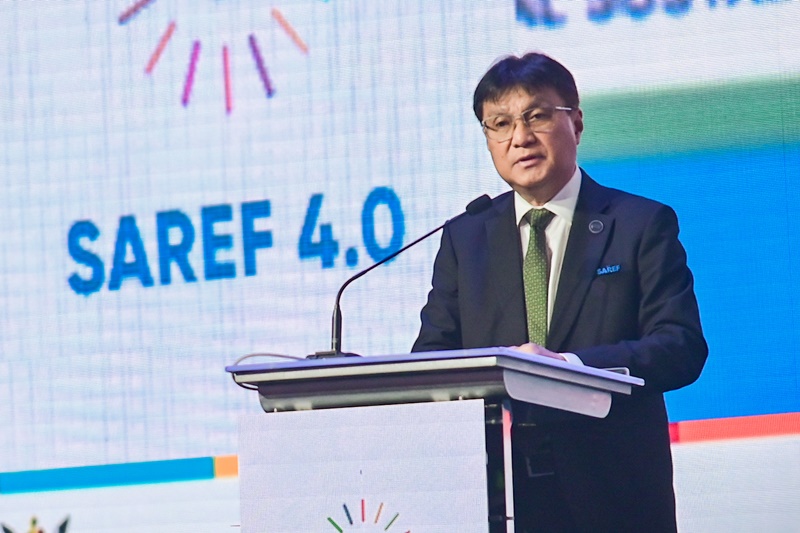
KUCHING: Sarawak Energy and regional partners will pursue three key actions to strengthen collaboration on the ASEAN Power Grid (APG) from the takeaways of the Southeast Asia High-Level Roundtable: Advancing the ASEAN Power Grid (APG).
Sarawak Energy Group Chief Executive Officer, Datuk Sharbini Suhaili, said the first step will be to generate early project preparation reports ahead of upcoming ministerial meetings, followed by close monitoring and regular progress updates with clearly identified responsible parties and timelines.
“The second step is to adopt a stepwise approach by breaking down project development scopes and leveraging end-to-end financing support across all stages – including feasibility studies, grants, and both capital and operational expenditure support.
“The third is to de-risk the supply chain through coordinated procurement and supply diversification strategies,” he said in his speech at the closing ceremony of the ‘Sustainability and Renewable Energy Forum’ (SAREF) 4.0 at Borneo Convention Centre Kuching (BCCK) here today.
Sharbini noted that key enablers identified during the roundtable include strong political commitment and proactive leadership as crucial drivers of the APG’s success, alongside financing support from financial institutions, multilateral development banks, and private sector capital.
“However, global shortages and long lead times for high-voltage equipment such as cables, transformers and DC converters pose significant risks,” he said.
“Coordinated procurement, diversified sourcing and proactive engagement with manufacturers are essential to overcome these challenges.”
He said that a report consolidating the outcomes of the Roundtable will also be shared with participants.
Sharbini also highlighted that this year’s SAREF also saw the exchange of significant Memorandums of Understanding (MoUs) with Brunei and the Asian Development Bank (ADB), as well as parallel agreements with International Union for Conservation of Nature (IUCN) and the AI Centre of Sarawak.
“In addition, the handover of the Carbon Study Permit further underscores our commitment to action, not just dialogue,” he added.
He said that the theme of SAREF 4.0, ‘Partnerships for Our Goals – Sustainable Growth & Prosperity for the Region’, reflects a shared responsibility to align with the United Nations Sustainable Development Goals (SDGs) while advancing inclusive and sustainable growth.
“SAREF is only a starting point. The real test is what happens after today, because the climate crisis leaves no time to waste,” he added.
“Whether through interconnections, circular solutions, green jobs or inclusive policies – the urgency is real, and action must begin now.”