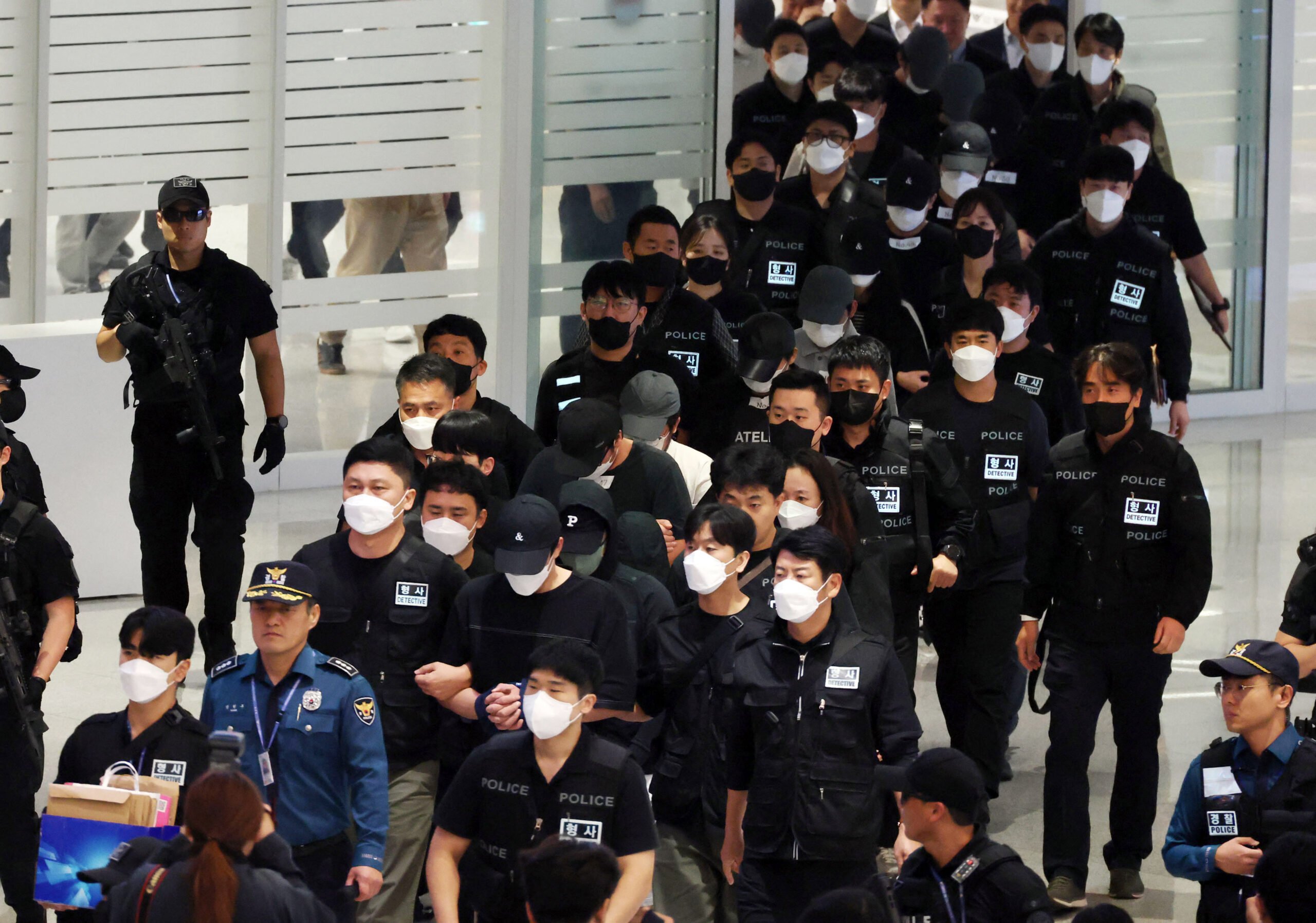
SEOUL: Sixty-four South Koreans accused of involvement in cyber scam operations in Cambodia were repatriated and arrested upon arrival at Incheon International Airport yesterday, police said.
The group was flown home on a chartered flight arranged after Seoul dispatched officials to Phnom Penh to negotiate their return and discuss the growing problem of scam networks targeting Korean nationals.
The detainees, many wearing masks and caps, were escorted through the airport in handcuffs and will be sent to police stations handling their respective cases.
They face charges related to online fraud, including voice phishing, romance scams, and “no-show” schemes, according to Park Sung-joo, head of the National Office of Investigation.
All will undergo drug testing amid suspicions of substance abuse during their time in Cambodia.
The repatriation follows outrage in South Korea over the torture and murder of a Korean college student in Cambodia in August, allegedly by a local crime ring. An autopsy confirmed the victim had suffered extensive injuries consistent with torture. In a separate case, South Korean and Vietnamese authorities are probing the recent death of a Korean woman near the VietnamCambodia border.
South Korean officials said the suspects include both “voluntary and involuntary participants” in cyber scam centres, where thousands are forced to commit fraud under threat of violence.
Vice Foreign Minister Kim Jina thanked Cambodian authorities for their cooperation, noting their “continued crackdown on criminal networks”. Seoul estimates that around 1,000 South Koreans are among roughly 200,000 people working in scam operations in Cambodia.
The scams, often dubbed “pig butchering” schemes, involve building fake online relationships before defrauding victims of cryptocurrency or savings.
Amnesty International has described Cambodia’s scam compounds as operating on a “mass scale”, involving human trafficking, torture, and forced labour. Cambodian authorities said they have arrested more than 3,400 suspects from 20 countries since June and deported over 2,800 foreigners linked to the illicit networks. – AFP