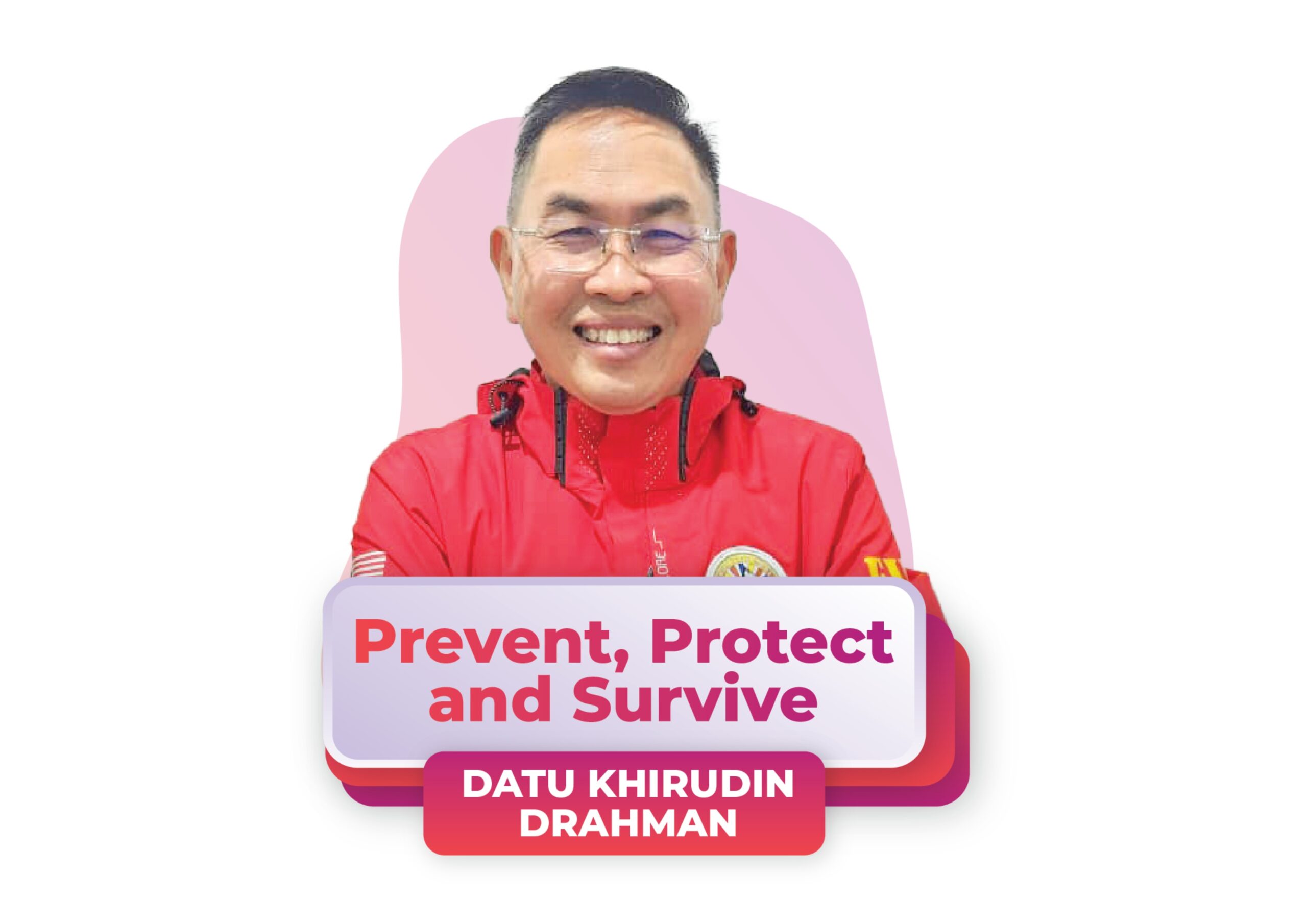
OCTOBER is recognised globally as Bulan Kesiapsiagaan – or Preparedness Month – a time to reflect on how ready we are to face disasters and emergencies.
Preparedness is more than a theme. It is a mindset and a culture that shape how we respond when the unexpected happens.
Too often, our readiness is tested only after a crisis strikes – and by then, the losses, whether in lives, property, or livelihoods, can already be severe.
As members of the community, we must ask ourselves: are we truly prepared to face threats to our lives, environment, and business continuity?
In my previous article, I discussed the importance of risk management – identifying, analysing, and mitigating threats through proper planning and execution.
Yet, a plan is only as effective as its implementation. The real measure of preparedness lies in how well we put awareness, planning, and action into practice.
A structured approach to disaster mitigation begins with awareness. This means understanding the risks around us, knowing the locations of evacuation centres, familiarising ourselves with warning systems, and following official instructions when necessary.
Preparedness also starts at home. Every household should secure their property, prepare an emergency ‘Go-Bag’, and ensure every family member knows what to do when disaster strikes.
In recent months, Malaysians have been reminded of the earthquake threats in our region. To prepare effectively, we must first understand what an earthquake is and how it occurs.
An earthquake happens when energy stored in the Earth’s crust is suddenly released, causing the ground to shake. This usually takes place along fault lines where rocks shift due to tectonic plate movement.
Occasionally, volcanic eruptions or collapsing underground caverns may also trigger quakes, though these are rarer events.
Knowing basic terms helps the public respond correctly. The epicentre is the point on the Earth’s surface directly above where the earthquake begins, while magnitude refers to the strength of the quake.
Aftershocks are smaller quakes that follow the main tremor, and seismic waves are the energy waves that cause the shaking.
Earthquakes can bring both primary and secondary hazards. Buildings may collapse, debris may fall, landslides can occur in hilly areas, and fires might start due to gas leaks or electrical sparks. Undersea quakes can even trigger tsunamis.
Secondary effects often include power outages, communication breakdowns, blocked roads, and water contamination.
Panic and trauma within the community can compound the physical damage with emotional distress.
Understanding the risks in our area and recognising community vulnerabilities are the first steps towards resilience.
Preparedness should involve public education, family drills, and the simple yet vital ‘Drop, Cover, and Hold On’ practice.
I often highlight the D.A.S.H. concept – Drop, Avoid, Secure, and Hold On – which can make a life-saving difference during an earthquake.
Recent parliamentary discussions have highlighted that Sarawak, including Kuching, is among six Malaysian states identified as being at risk of earthquakes due to active fault lines.
While Malaysia lies outside the Pacific ‘Ring of Fire’, East Malaysia – Sarawak and Sabah – is not entirely free from seismic activity.
Our risks stem mainly from ancient internal fault lines, such as the one near Niah, and from distant tectonic movements in Sumatra.
These are generally considered low to moderate risks, but even mild tremors can cause serious damage if we are unprepared.
Historical records remind us of notable events such as the 1976 Lahad Datu earthquake, which measured 6.2 to 6.3 on the Richter scale, and the 2015 Ranau and Mount Kinabalu quakes, which registered around 6.0.
Though rare, these incidents prove that nature’s forces can never be completely predicted.
From an infrastructure standpoint, it is time we strengthen our resilience through improved design and standards.
Adopting seismic building codes such as Eurocode 8 (MS EN 1998) will ensure new structures are built to withstand tremors.
Malaysia’s existing building regulations – including the Uniform Building By-Laws, Sabah Building Rules, and Sarawak Building Ordinance – can be reviewed to integrate seismic considerations.
Retrofitting older buildings and choosing safer construction sites should also form part of our long-term resilience strategy.
Preparedness, however, is not the sole duty of the authorities. Communities must not remain passive recipients of safety plans. They are the first responders and essential partners at every stage of disaster management.
We saw this spirit clearly during the COVID-19 pandemic, when Sarawakians displayed unity, discipline, and care for one another. That same spirit of togetherness is what builds true resilience.
By staying informed, trained, and proactive, communities can transform from potential victims into champions of safety and active partners in disaster governance.
Ultimately, our true strength lies not in avoiding disasters but in how we face and recover from them – with courage, awareness, and unity.
Preparedness saves lives, but resilience sustains them. Let us continue to nurture both.
The views expressed here are those of the writer and do not necessarily represent the views of Sarawak Tribune.