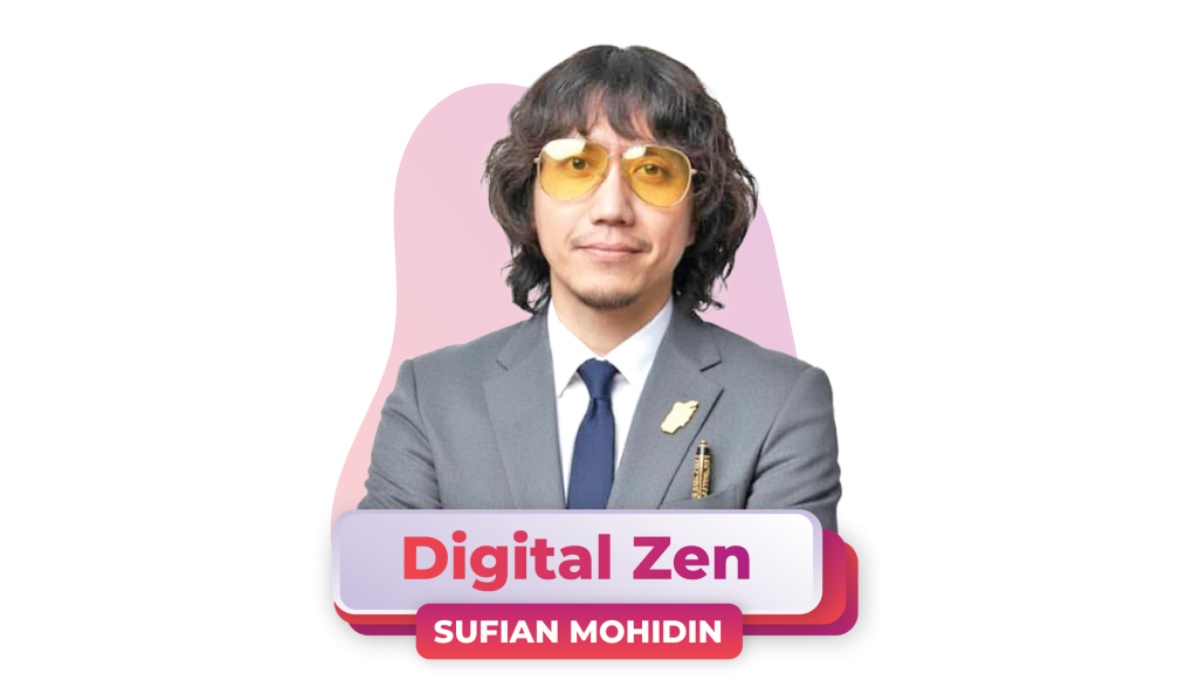
“We cannot afford to be left behind. We must embrace digital technology to leapfrog into the global digital economy.”
– Datuk Patinggi Tan Sri Abang Johari Tun Openg, Premier of Sarawak
HI readers, as we reflect on the relentless stream of the digital age, our attention is the most valuable currency, and it is under constant siege.
Notifications shatter our focus, the news cycle fuels anxiety, and the pressure to perform and project a perfect life is immense.
We seek solace in “digital detoxes”, but perhaps the answer is not in logging off, but in logging into a different mode of being.
The path to what we might call Digital Zen is not found in rejection, but in harmonious integration, guided by the unexpected confluence of Japanese principles, Islamic values, and the Daoist art of flowing.
The term ‘Zen’ itself points toward a mind undisturbed, a pond reflecting the moon without ripple.
Yet, achieving this state online seems a paradox. This is where the wisdom of ‘wu-wei’ – Daoist effortless action – becomes our first tool.
Digital Zen is not about fighting the digital stream with grim willpower, but about learning to navigate it with the skill of a kayaker.
It’s the practice of engaging with technology without letting it engage you. The compulsive scroll, the reflexive refresh, the frantic multitasking – these are the struggles against the current that exhaust us.
The digitally zen individual instead moves with purpose: they open an app with intent, consume information with discernment, and close it with the same mindful finality as a bow at the end of a tea ceremony.
Let’s get on the digital zen once again.
This is where discipline becomes the foundation of flow. The Japanese concept of makoto (sincerity) is a powerful antidote to the curated inauthenticity of social media.
Digital Zen asks: does your online presence flow from a place of inner truth, or is it a performance for an unseen audience?
Practising makoto online is about letting your digital actions mirror your real-world character, creating a unified self instead of dividing into ‘real’ and ‘virtual’ personas.
Similarly, the Islamic value of Ikhlas (sincerity of intention) invites us to purify our digital actions.
Are we posting to share genuine joy, or for validation? Are we commenting to contribute, or to provoke?
By constantly refining our intention, we filter out the noisy ego that pollutes our digital stream, allowing for a more authentic and peaceful flow.
The digital world is also a furnace of reactivity. Outrage is a commodity, and patience is in short supply.
Here, the virtues of Sabr from Islam and Gaman from Japan become essential pillars of Digital Zen.
Sabr is the patient perseverance that allows you to read a contentious comment without immediately firing back.
It is the “light” that helps you endure the fear of missing out (FOMO) without succumbing to it, trusting that your own path and timeline are sufficient.
Gaman is the dignified endurance to stay composed amidst the digital chaos – to see a trending topic designed to anger you, and to consciously choose not to let it disrupt your inner peace.
This isn’t passive acceptance; it is the active, resilient choice to not be jerked around by every algorithmic pull.
It is flowing with the digital current without being drowned by its waves.
Finally, the principle of balance – so central to Daoism, Japanese wa (harmony), and the Islamic “middle nation” – is the ultimate compass for Digital Zen.
The digitally zen individual avoids the extremes of digital asceticism and digital gluttony.
They do not demonise technology, nor do they become enslaved by it.
They find the middle path: using a tool for connection without letting it become the source of isolation; consuming information without being consumed by it.
Their online engagement is characterised by the harmony of yin and yang – active posting balanced with silent reflection, consumption balanced with creation.
In practice, Digital Zen looks like this: It is closing your eyes for a moment after sending an email, practising a micro-meditation to reset.
It is turning off all non-essential notifications, not as an act of rejection, but as a conscious curation of your attention’s flow.
It is applying Jin (benevolence) by leaving a kind comment or offering support in a digital space.
It is embodying tawakkul (trust) by working diligently on a project, then releasing anxiety about its online reception.
Building Digital Zen is not about finding a secret app or hack. It is about applying ancient, cross-cultural wisdom to the most modern of landscapes.
It is the disciplined practice of making your digital life an extension of your highest values, not a distraction from them.
By weaving together the flow of Dao, the sincerity of Japan, and the resilient heart of Islam, we can learn to move through the digital world not as frazzled victims, but with the poised, present, and peaceful mind of a master – truly achieving a state of Zen in the heart of the stream.
Hopefully this week’s lesson has brought upon some wisdom and strength as we embark in this digital. Until then, I wish you all the best.
The views expressed here are those of the writer and do not necessarily represent the views of Sarawak Tribune.