KOTA SAMARAHAN: Sarawak is committed to building resilience among its next generation, ensuring its workforce remains relevant in high-technology sectors.
Education, Innovation and Talent Development Minister, Datuk Seri Roland Sagah Wee Inn, said the state is focused on developing real skills and real careers, not training for its own sake but capabilities that could sustain long-term growth and resilience.
He said education must be industry-linked, outcome-driven and future-ready to meet the demands of rapidly evolving sectors.
“The ‘Sarawak Semiconductor Roadmap 2030 – Beyond Moore’s Law’ places people firmly at the centre of our strategy.
“From early science, technology, engineering and mathematics (STEM) exposure and vocational pathways to advanced chip design and industry-embedded training, our approach is clear.
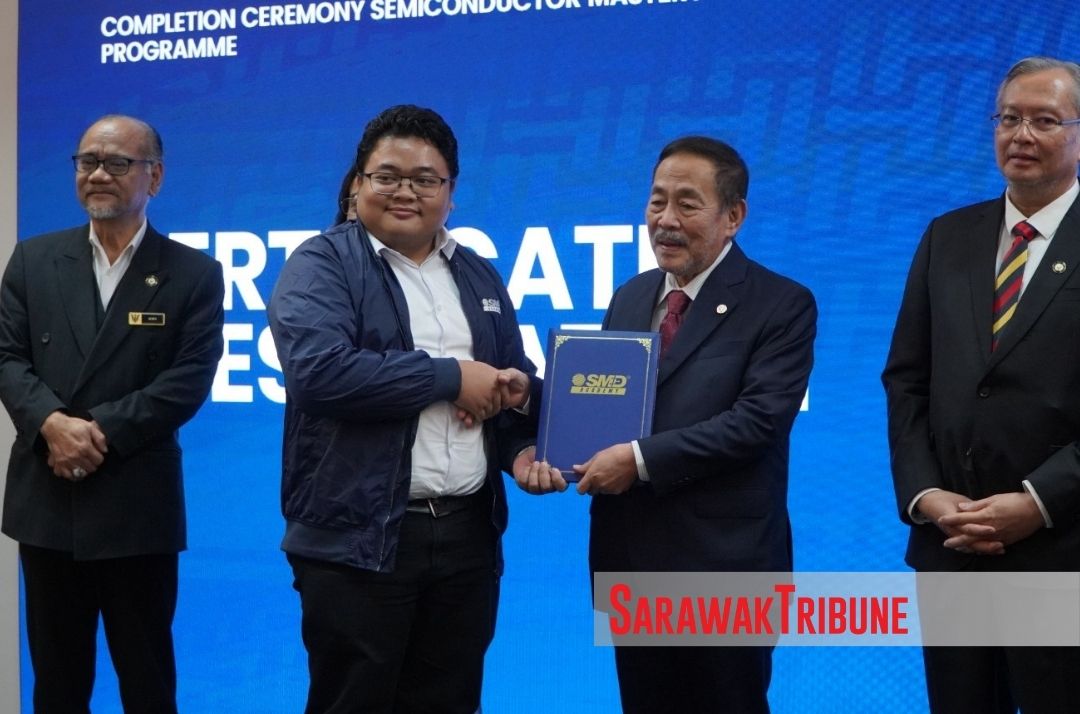
“Technology succeeds only where talent thrives,” he said when officiating the SMD-CENTEXS Digital IC Design Semiconductor Mastery Programme at SMD Academy here today (Jan 23).
The event marked the graduation of 10 participants from the first cohort of the SMD Semiconductor-CENTEXS Digital IC Design Semiconductor Mastery Programme.
Sagah commended the collaboration between Sarawak Microelectronics Design (SMD) Semiconductor and the Centre for Technology Excellence Sarawak (CENTEXS), saying their joint efforts are helping to shape Sarawak’s technology landscape.
He said the programme was industry-led, guided by real semiconductor requirements, and designed to prepare participants not only for employment but for continuous learning in a fast-evolving sector.
“The collaboration between SMD Semiconductor and CENTEXS shows how public institutions and industry can translate policy into real, measurable capability development.
“This is how we move beyond plans and frameworks – through partnerships that execute, programmes that deliver, and institutions that remain focused on outcomes,” he added.
Looking ahead to 2030, Sagah said Sarawak would require designers, engineers, researchers, trainers and future leaders who understood both technology and responsibility.
He encouraged graduates to carry forward not only the technical skills gained, but also the discipline, ethics and curiosity that defined world-class engineers.
“Semiconductors are not a short-term technology trend. They are a foundational industry underpinning artificial intelligence, electrification, renewable energy and digital infrastructure. Sarawak is not chasing trends. Sarawak is building foundations.
“Through programmes such as this, we are ensuring that when opportunities arise in the global semiconductor industry, our people are ready – not as spectators, but as contributors and future leaders,” he said.