KUCHING: Sarawak’s approach to space is practical and mission driven with a focus on satellite technology, data utilisation and downstream applications.
Premier Datuk Patinggi Tan Sri Abang Johari Tun Openg said this focus supports forest and assets management, agriculture, disaster preparedness and maritime monitoring while delivering tangible benefits to the people.
To execute this effectively, he said Sarawak is strategically evaluating the full spectrum of space technologies including the practical deployment of the small satellites system, namely the CubeSats platform that is becoming a trending category of spacecraft.
“CubeSats have the advantage of being less expensive. Scientists say the cost of a traditional satellite ranges from 100 to 300 million euros compared to a CubeSats which cost less than 500,00 euros.
“Moreover, a conventional satellite requires between five and 15 years to develop and deploy while CubeSats might need less than a year to build and go out in low orbit,” he said.
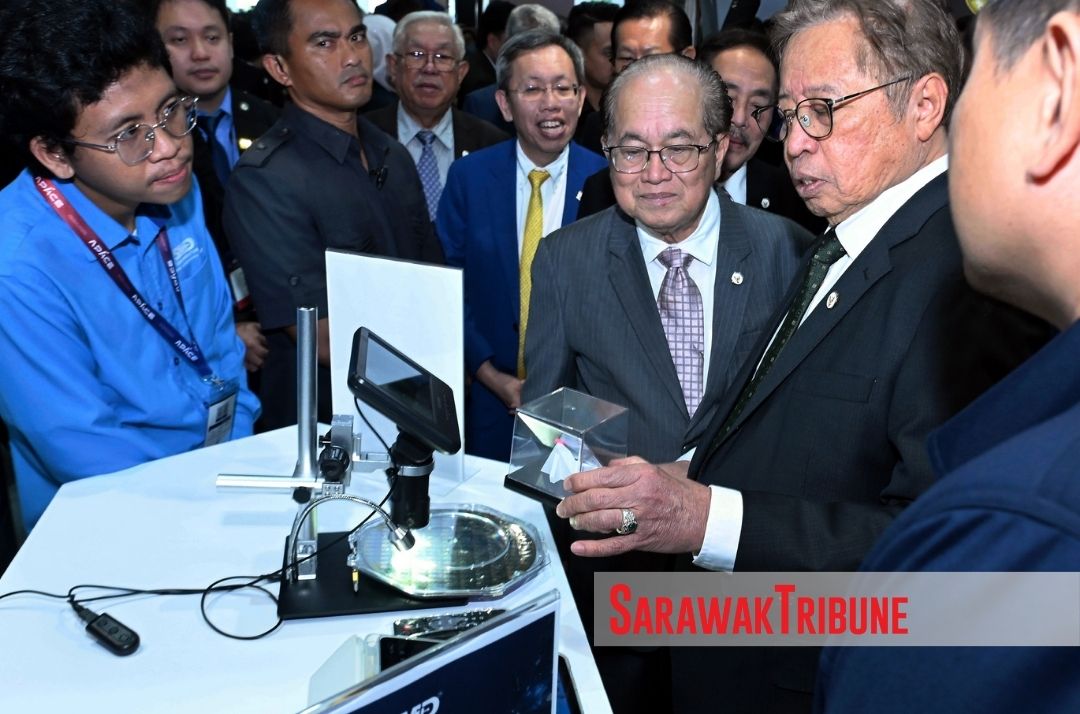
He made these remarks during his keynote address at the launching of the Asia Pacific Aerospace Conference and Exhibition (APACE) 2026 at Borneo Convention Centre Kuching on Tuesday (Jan 27).
Noting how in the past only rich nations and corporations could afford satellites with projects taking 10 years or more to materialise, Abang Johari said CubeSats provides the disruptive change where bigger systems demand massive investment compared to nanosats that can be built in months and launched at a much lower cost thus reducing financial risk.
He explained that the low Earth orbit satellite operates 160 to 2000km(100-1200 miles) above Earth, offering low-latency, high-bandwidth communication, Earth observation and navigation.
These satellites orbit rapidly (about 7.8km per second) completing a circle in 90 to 120 minutes, often deployed in large, interconnected constellation to ensure continuous global coverage.
“We have already put this capability to work as Sarawak has already begun using satellite data to support forest and natural resources management, agriculture and land-use planning, disaster preparedness, maritime and coastal monitoring.
“The way forward for Sarawak is for us to expand research in satellite systems, ground operations, data analytics and AI-driven interpretation that can provide automatic and continuous insights from space.
“It means building the ground stations and fostering the start-ups to turn this stream of data into actionable intelligence for our farmers, our foresters, and our first responders,” he said.
For Sarawak, Abang Johari said this is a strategic imperative as the state’s unique geography is not just a challenge to monitor but is the greatest living laboratory.
“It is where we will test, validate, and perfect the next generation of space-enabled solutions. It is a deliberate and disciplined path, aligned with the encouraging government regulations and global industrial trends that are fueling this sector.
“The largest demand for CubeSats services is anticipated to come from the telecommunications sector, which has mostly migrated from ground to space-based operations. This has become a crucial part of the global infrastructure for communications, commercial and government data transfer, and applications.
“In addition, environmental and scientific research and meteorology are becoming more dependent on data from satellite services,” he said.