SERIAN: Knowledge must transcend religious and cultural boundaries and be shared for the benefit of all humanity.
Premier Datuk Patinggi Tan Sri Abang Johari Tun Openg said intellectual advancement is the cornerstone of civilisation-building and sustainable development.
He also said knowledge should unite society rather than divide it, noting that throughout history, civilisations have progressed when education, ideas and innovation were openly shared across cultures and faiths.
“Knowledge has no boundaries. It is not only for Muslims, but can be shared with non-Muslims because it can be used by everyone. It is a tool for human development, and the benefits of learning and innovation should extend to all, regardless of background or faith,” he said.
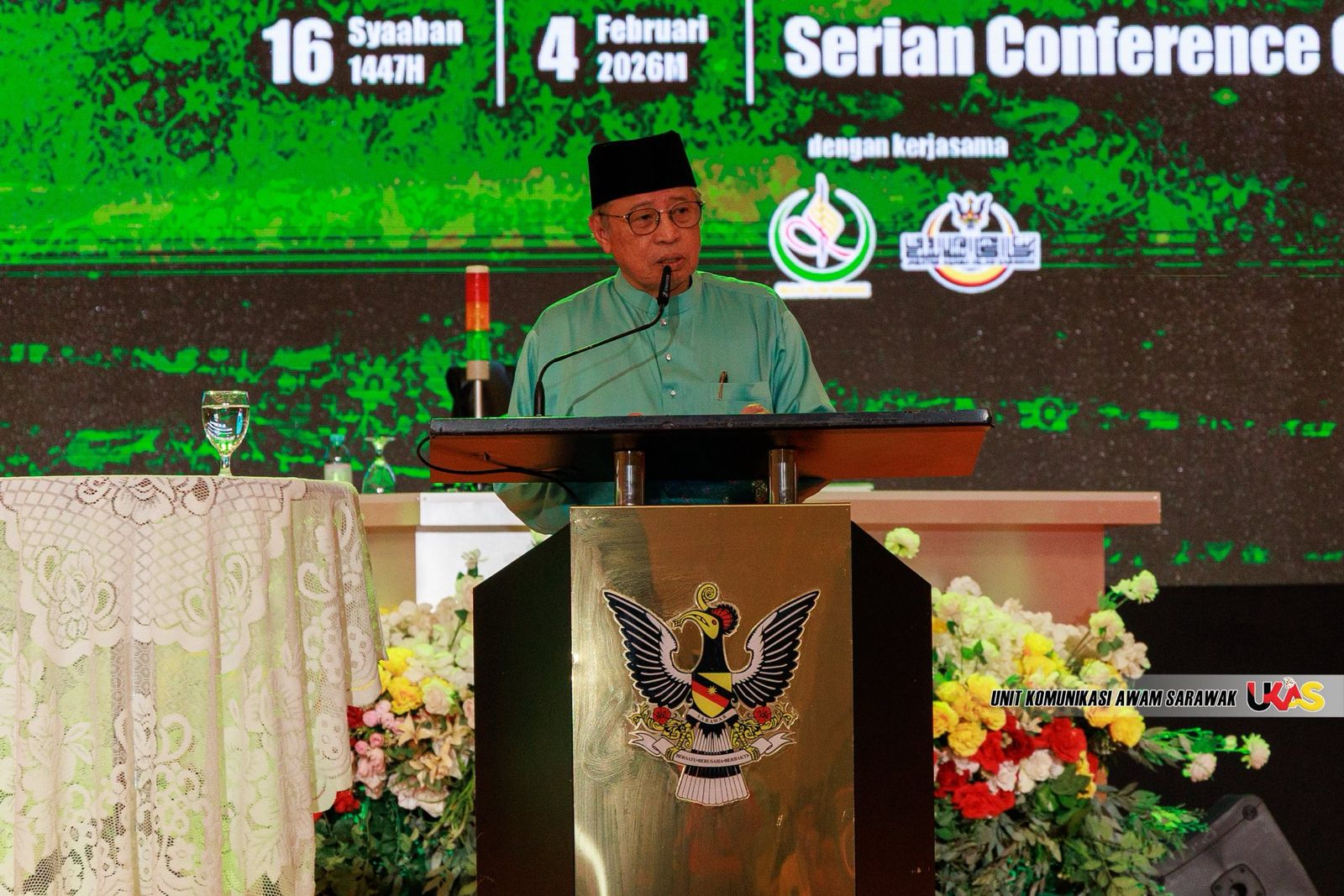
He made these remarks when officiating at the ‘Majlis Tilawah dan Hafazan Al-Quran Peringkat Sarawak Kali Ke-65’ on Wednesday (Feb 4) night.
Abang Johari said the Al-Quran itself encourages the pursuit of knowledge and its application for the betterment of humanity.
He said its teachings should not merely be read or memorised, but translated into action and development grounded in knowledge.
“For instance, works of 13th-century Islamic philosopher Ibn Khaldun, whose ideas on civilisation, society and governance were later studied by Western scholars and went on to influence economic thinkers such as Adam Smith.
“This clearly shows that knowledge transcends geography, religion and time. When knowledge is shared, it shapes and elevates civilisations,” he said.
Abang Johari said Sarawak’s development strategy is anchored in the same principle of knowledge-based growth, with strong emphasis on education, science, technology and innovation to prepare future generations for an increasingly complex global landscape.
Quoting the Quranic principle that Allah will not change the condition of a people unless they change what is within themselves, he said meaningful change begins with knowledge.
“To change, we must have knowledge. Knowledge allows us to explore what is on earth and even beyond, into the skies. That is why education is central to our efforts to develop Sarawak,” he said.
Abang Johari said Sarawak is actively expanding into frontier fields such as artificial intelligence, aerospace, astronomy and semiconductor technology, which now form the backbone of the global economy.
“If we master these new areas of knowledge, we will not only develop Sarawak, but also become players on the world stage. We do not want to remain mere users of technology; we want to be contributors to its creation,” he said.
As such, Abang Johari stressed that Sarawak will continue to prioritise Science, Technology, Engineering and Mathematics (STEM) education, while strengthening research capacity through international collaborations with leading universities and institutions.
In the semiconductor sector alone, he said Sarawak has begun working with overseas universities with specialised expertise, with three Sarawakians set to pursue doctoral studies in the field.
“This is part of efforts to build local talent and strengthen the state’s position in the global high-technology value chain,” he said.
The Premier pointed out that Sarawak’s investment in knowledge also extends to inclusive human capital development, including free education initiatives and equal access to learning opportunities regardless of religion.
“Our children today are learning in a very different world. With the rise of artificial intelligence, data-driven technologies and advanced digital systems, the pursuit of knowledge must be continuous,” he said.
While economic progress is important, Abang Johari said development must be balanced with environmental stewardship, particularly in addressing global climate change.
“Sarawak remains committed to green energy and sustainable approaches to ensure long-term ecological balance,” he said.
At the same time, Abang Johari also announced that a permanent building for the Darul Hana Al-Quran Development Centre under the Sarawak Islamic Council will be constructed in Petra Jaya, serving as a hub for the dissemination of Al-Quran-based knowledge that can benefit the wider community.
He said investing in knowledge is ultimately an investment in Sarawak’s future, ensuring that all Sarawakians, Muslims and non-Muslims alike, are equipped to lead, innovate and contribute meaningfully at both national and global levels.
“Knowledge is not only an economic tool, but a social one. When we learn and share knowledge, we build an intellectually resilient, harmonious and inclusive society,” he said.