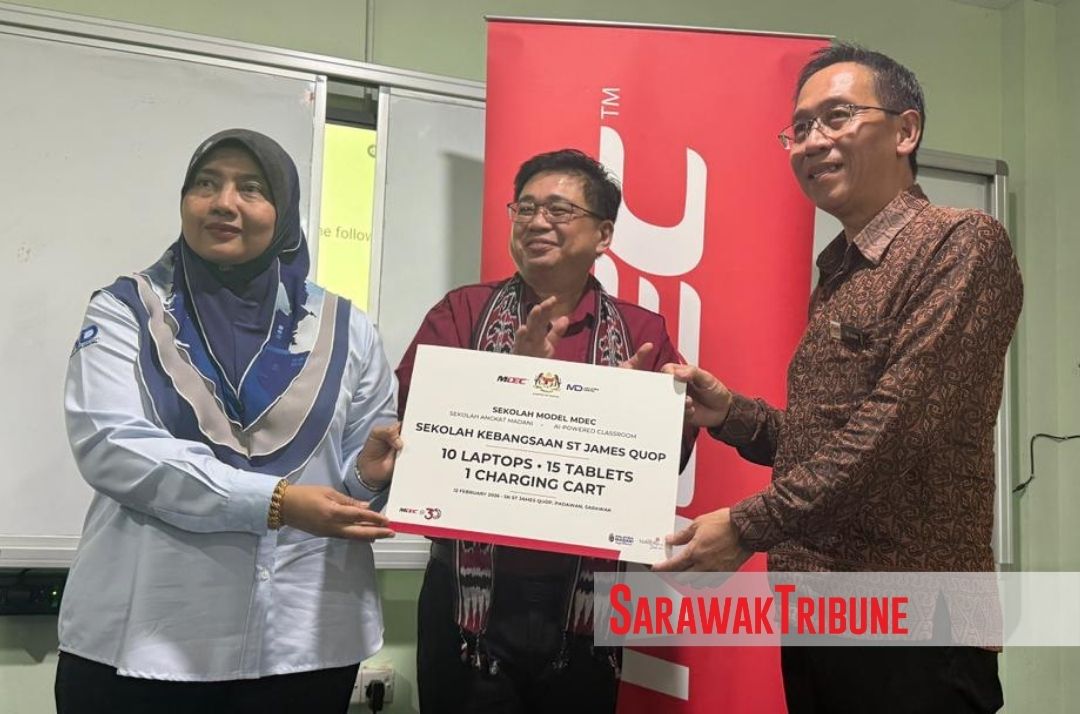
KUCHING: The pilot Proof-of-Concept (PoC) ‘AI-Powered Classroom’ project at Sekolah Kebangsaan (SK) St James Quop has borne fruit, transforming the rural school with modern artificial intelligence (AI)-enabled learning facilities and upgraded infrastructure.
Digital Ministry Secretary-General, Datuk Fabian Bigar, said the initiative is a collaboration between the Ministry of Education (MOE) and the Malaysia Digital Economy Corporation (MDEC), an agency under the Ministry of Digital.
He explained that the project forms part of the ‘Sekolah Angkat MADANI’ initiative, making it a “two-in-one” programme that combines digital learning transformation with physical infrastructure improvements.
“The AI-Powered Classroom programme is a collaboration between the Ministry of Education and MDEC. When we selected this school under the ‘Kampung Angkat MADANI’ initiative, it became a two-in-one effort.
“We are not only introducing AI into the classroom to prepare students for the AI era, but also upgrading equipment, improving facilities and addressing basic needs such as water supply,” he said when met during an official visit to the school today.
Fabian noted that prior to the intervention, the school was still using laptops from the early 2000s.
These have since been replaced or refurbished, with new devices contributed by corporate partners. Smart screens have also been installed to replace traditional blackboards.
“In terms of physical facilities, the school previously depended on a nearby church for its water supply. It now has its own storage tanks and pumps, reducing that dependency,” he added.
Earlier in his speech, Fabian emphasised that AI should be introduced to students in a structured and responsible way, ensuring it functions as a supportive learning tool rather than a shortcut to completing tasks.
“In a traditional classroom, one teacher may handle 30 to 40 students. With generative AI, students can have an additional personal tutor at home, creating a one-to-one learning ratio.
“However, proper guardrails must be in place. AI should not complete homework for students, but guide them in understanding and solving problems,” he said.
He also underscored the importance of developing local AI-driven learning solutions to ensure content is suited to Malaysia’s context and environment.
Fabian said that the selection of SK St James Quop was also linked to the ‘Santuni MADANI’ and ‘Kampung Angkat MADANI’ initiatives.
“Today, we can clearly see the progress. While we cannot take full credit, as many parties are involved, this success reflects strong synergy and shared commitment,” he said.
With the 13th Malaysia Plan (RMK-13) setting the direction towards becoming an AI-driven nation by 2030, Fabian emphasised that preparations must begin now.
“We no longer want to produce just digital natives, but AI natives. We cannot afford to be left behind.
“Through this PoC project, we have proven that geographical location is not a barrier to accessing world-class education,” he said.
He expressed hope that SK St James Quop would serve as a new benchmark for the ‘Sekolah Angkat MADANI’ programme nationwide, paving the way for a future-ready generation capable of driving Malaysia’s digital economy.