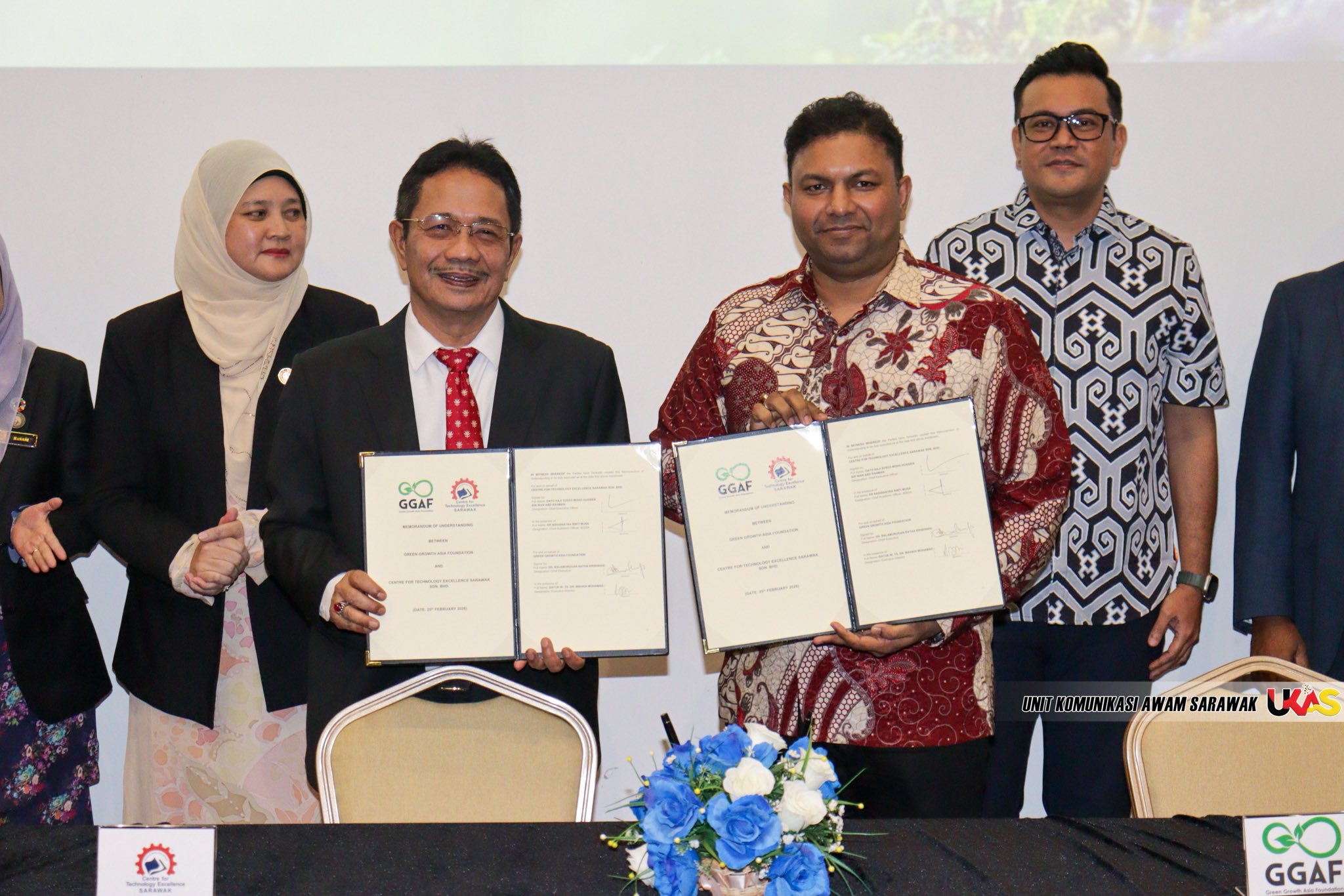
KUCHING: The Centre of Technical Excellence Sarawak (CENTEXS) and the Green Growth Asia Foundation (GGAF) have signed a strategic Memorandum of Understanding (MoU) to strengthen green talent development and accelerate the implementation of the low-carbon city agenda in Sarawak.
According to UKAS, the MoU signing ceremony held on Wednesday witnessed the document being signed by CENTEXS chief executive officer Datuk Syeed Mohd Hussien Wan Abd Rahman and GGAF chief executive officer Dr Balamurugan Ratha Krishnan.
The collaboration focuses on strengthening Education for Sustainable Development (ESD) within the Technical and Vocational Education and Training (TVET) ecosystem, enhancing the capacity of city implementers, and expanding career opportunities in the green economy.
The MoU signing was held in conjunction with the two-day “GreenGov 360: Building Future-Ready Cities through GCAP – ESG Strategies to City Action (GCAP Implementation Champions Training)” programme, which began on Feb 24 at CENTEXS.
The programme brought together city implementers and key stakeholders to enhance their capacity to translate Environmental, Social and Governance (ESG) strategies into practical, implementable and high-impact city actions.
Meanwhile, Syeed Mohd Hussien said the collaboration marks a significant shift from the planning phase to concrete implementation in building green capacity at the grassroots level.
He noted that previous collaborations with GGAF through the Green City Action Plan and the Eco-Campus programme had laid a strong foundation of trust and strategic alignment, culminating in the formalisation of the MoU.
Balamurugan emphasised that the strength of the green economy depends on a competent, highly skilled and ESG-aligned human capital that is prepared to meet global standards.
Under the partnership, both parties will develop integrated TVET programmes grounded in ESD from certificate to diploma levels, including train-the-trainer pathways and stackable micro-credentials.
In addition, capacity-building training related to the Green City Action Plan (GCAP) will be implemented in phases through technical clinics to assist local authorities in systematically operationalising green development priorities.
The collaboration will also strengthen digital capabilities for green cities through the use of Geographic Information Systems (GIS), the Internet of Things (IoT), data analytics, and pilot projects under a ‘sandbox’ concept.
Both parties will also develop a Sustainability Certificate that emphasises practical skills and labour market needs, aligned with ESG requirements and GCAP implementation.
City councils, government agencies, industry partners, higher education institutions and community organisations are invited to participate in the training cohorts and outreach programmes to be carried out in the first phase of the collaboration in Sarawak.
The strategic initiative is expected to strengthen the state’s green workforce ecosystem while supporting the sustainable development agenda and enhancing the competitiveness of Sarawak’s cities at the national and regional levels.