MIRI: Sarawak’s long-standing social harmony is being reinforced through inclusive policies, free tertiary education and equitable development initiatives introduced by the Gabungan Parti Sarawak (GPS) government, according to Women, Childhood and Community Wellbeing Development Minister Datuk Seri Fatimah Abdullah.
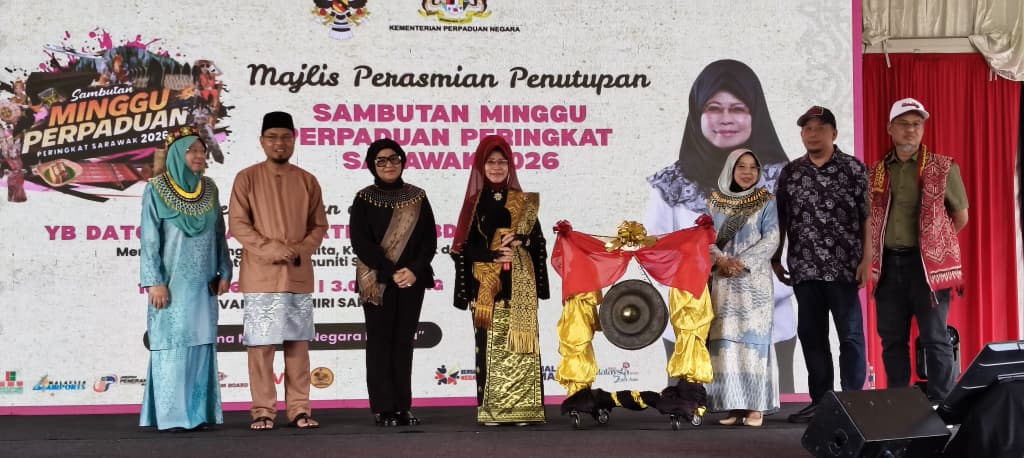
Speaking at the closing ceremony of the Sarawak Zone Unity Week 2026 at Boulevard Mall here today, Fatimah said Sarawak had demonstrated that diversity was not an obstacle to unity but a strength that continued to bind communities together.
She said the state government’s commitment to inclusivity was reflected through policies and programmes that benefitted all Sarawakians regardless of race, religion or background.
“One of the clearest examples is the Unit for Other Religions (UNIFOR), which I believe is difficult to match elsewhere. Through UNIFOR, houses of worship of non-Muslim faiths receive assistance for construction, maintenance and religious activities.
“This proves that every religion in Sarawak is respected and given fair attention by the government,” she said.
Fatimah said another major initiative was the implementation of free tertiary education at state-owned higher learning institutions for eligible Sarawakian students, particularly in Science, Technology, Engineering and Mathematics (STEM) fields.
She said the initiative covered four state institutions, namely University of Technology Sarawak, Curtin University Malaysia, Swinburne University of Technology Sarawak Campus and i-CATS University College.
“In the past, parents had to think many times before sending their children to universities because of the high fees. Today, as long as our children are willing to study, perform well and pursue fields identified by the government, they can obtain free education.
“This is a high-impact initiative which opens opportunities to all Sarawakian children without imposing a heavy financial burden on families,” she said.
Fatimah noted that equal access to education would help reduce social inequality while further strengthening unity in the state.
She also stressed that development in Sarawak was being implemented inclusively, covering both urban and rural constituencies through allocations such as the Rural Transformation Programme (RTP) and Minor Rural Project (MRP) grants.
According to her, the state government was also continuing to strengthen social welfare assistance through various schemes under her ministry.
She cited initiatives such as the Endowment Fund Sarawak, which provides RM1,000 for every newborn Sarawakian child, financial assistance for mothers giving birth, and the Kenyalang Gold Card programme, which includes funeral assistance.
“From cradle to grave, assistance is available for Sarawakians. Digital transformation and economic opportunities are also being expanded from urban centres to rural areas so that no one is left behind,” she said.
Fatimah said such policies had strengthened the people’s sense of belonging and confidence that every Sarawakian had a place under the “blessed land of Bumi Kenyalang”.
On national unity, she said programmes such as Unity Week played an important role in fostering interaction among communities and strengthening understanding between different ethnic groups.
She warned that challenges posed by social media, misinformation and differing views required Malaysians to remain mature and responsible in preserving harmony.
“The values of understanding, mutual respect, acceptance and celebration of diversity must continue to be strengthened in society,” she said.
Fatimah added that younger generations must continue to be exposed to the values of unity, patriotism and the principles of the Rukun Negara to ensure harmony could be sustained in the future.
She also highlighted the important role of family institutions in nurturing respect and tolerance among children from an early age.
“Strong unity begins at home, within the family institution. It is within the family that children first learn the values of mutual respect and understanding,” she said.
Earlier, Fatimah commended the Ministry of National Unity, the National Unity and Integration Department of Sarawak, strategic partners, volunteers and all agencies involved in making the Sarawak Zone Unity Week 2026 a success.
She said the programme reflected the true spirit of unity and cooperation in safeguarding harmony and stability in the country.
Among those present were Deputy Foreign Minister and Sibuti MP Datuk Lukanisman Awang Sauni, Sarawak Deputy Minister for Women, Childhood and Community Wellbeing Development Datuk Rosey Yunus, and National Unity Ministry secretary-general Haslina Abdul Hamid.