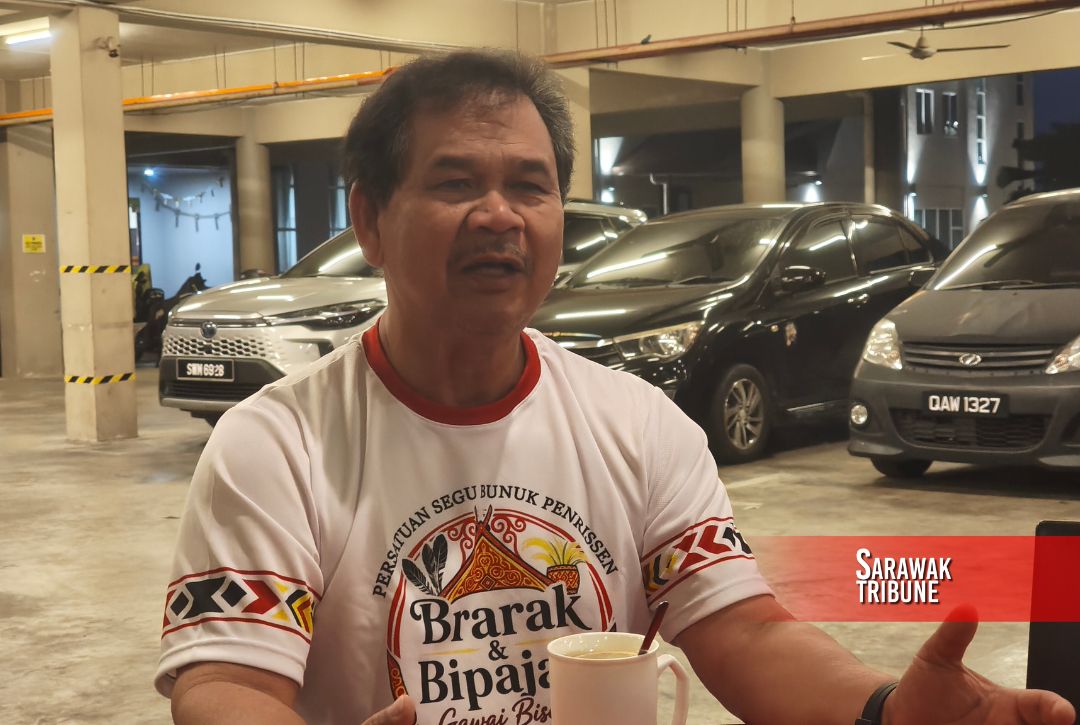
KUCHING: The Dayak Bidayuh National Association (DBNA) will continue pushing three major agendas it considers vital to the future of the Bidayuh community — Native Customary Rights (NCR) land documentation, Bidayuh language development and the establishment of a Bidayuh Heritage Gallery.
Its president Datuk Ik Pahon Joyik said the initiatives, though advancing steadily, are far from complete.
According to him, the first responsibility entrusted to DBNA by former Bidayuh leaders and politicians, including Datuk Amar Michael Manyin, was to help document Bidayuh NCR land and facilitate the issuance of land titles.
“Our leaders thought DBNA would be the best forum or platform for us to do the documentation,” he said in an interview.
The effort began in 2007, but Ik admitted it has been a long and challenging journey.
“I must admit, it is not an easy advocacy to convince our people,” he said.
He recalled how some villagers were initially sceptical during DBNA’s roadshows, even questioning the association’s authority to undertake land documentation.
Despite the resistance, DBNA has made substantial progress.
From only 338 recorded Bidayuh villages in 2010, the number of registered villages in Kuching, Serian and Samarahan divisions has now risen to 404.
Of these, about 60 per cent have participated in DBNA’s NCR land documentation programme.
“At least now, they know where their land is. Even though it’s not surveyed yet, the document is already with the village,” he said.
DBNA is continuing its outreach efforts, targeting communities that have yet to participate.
Ik said the association hopes to achieve about 90 per cent participation by 2030, acknowledging that full participation may be difficult to attain.
“We are still aggressively doing roadshows to villagers who are so-called late starters,” he said.
He added that DBNA has already submitted documentation for more than 60 villages to the Land and Survey Department, with over 40 villages having received titles, including perimeter and individual titles.
Beyond land matters, DBNA is also intensifying efforts to strengthen the Bidayuh language.
Ik described language as a cornerstone of identity and warned against its gradual erosion among younger generations.
“That is our language, because without our language, and if you don’t talk your own language, then where is your identity?” he asked.
To promote language use among children, DBNA has produced a series of picture dictionaries featuring vocabulary from four major Bidayuh dialects — Selako, Bau, Biatah and Serian.
The dictionaries are intended to serve as learning references for families and encourage children to use their mother tongue.
Ik said DBNA is also planning to establish linguistic classes for those interested in learning or teaching the language.
At the same time, a special task force has been formed to develop a Bahasa Bidayuh curriculum.
The curriculum, he said, is designed as an elective subject and has already received approval from the Education Department for development.
“This is something we want to pursue seriously because language preservation cannot wait,” he said.
The third agenda focuses on preserving and showcasing Bidayuh cultural heritage through the proposed Bidayuh Heritage Gallery.
DBNA is currently converting the Baruk building at its headquarters into a gallery that will house and present Bidayuh cultural treasures.
Ik said the association has formed a dedicated task force and committee to oversee the project.
The initiative is being undertaken in collaboration with the Sarawak Museum to ensure the gallery is engaging, educational and interactive.
“We want to digitalise all those heritage documents that we can display, because the Baruk is quite a small building,” he explained.
The digital approach, he said, will help maximise limited space while allowing a richer presentation of Bidayuh history, traditions and artefacts.
Although the three agendas remain works in progress, Ik expressed gratitude for the strong backing DBNA has received from community leaders, the state government and the wider Bidayuh community.
“They are aware of what we are doing. With the support of every sector of our community, I feel confident that we will be able to push for this agenda for the Bidayuh community,” he said.