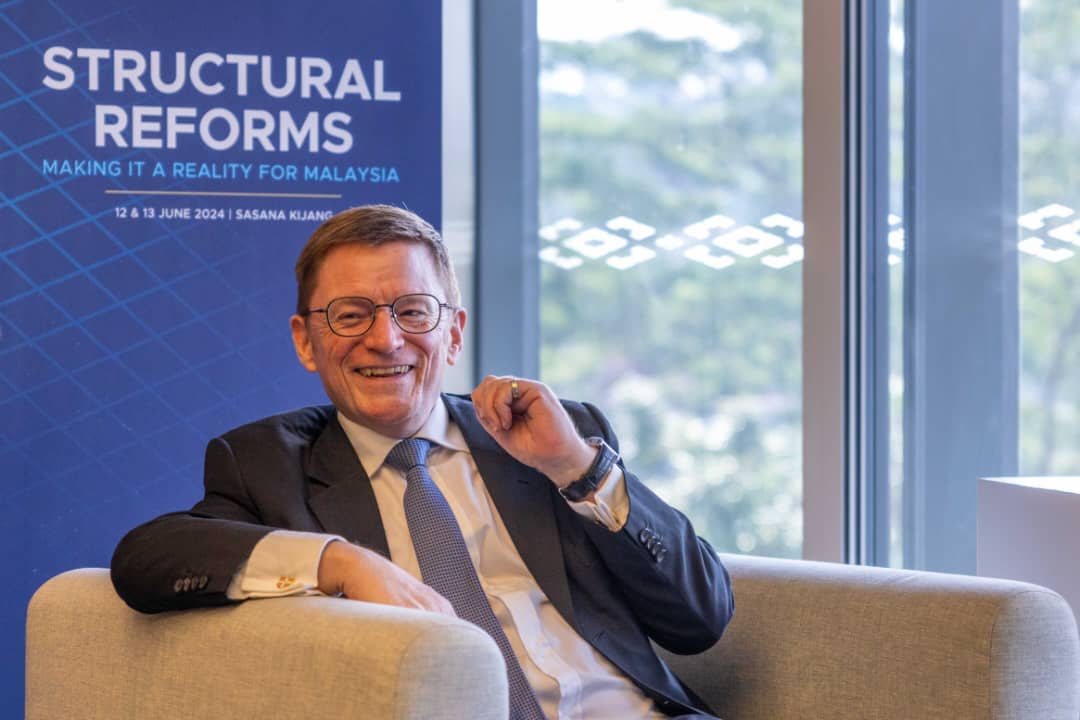
KUCHING: Malaysia’s pursuit of high-income status risks obscuring deeper economic weaknesses, with stagnant wages, inequality and weak purchasing power remaining unresolved, says Williams Business Consultancy Sdn Bhd founder and director Geoffrey Williams.
He said crossing the World Bank’s high-income threshold would not solve the structural problems facing the domestic economy.
According to the latest World Bank data for 2025, Malaysia’s per capita income reached US$12,380, or 86.1 per cent of the US$14,375 high-income threshold under the Atlas Method.
“This was the highest proportion since 2019 and 2014, when the ratios stood at 85.8 per cent and 85.1 per cent respectively.
“However, Malaysia’s income relative to the threshold had effectively flat-lined despite the country gradually moving closer to high-income status.”
Williams said policymakers should prioritise stagnant wages, income and wealth inequality, and the overall quality of economic growth instead of chasing a headline income target.
He said focusing on nominal gross domestic product (GDP) or gross national income (GNI) figures could encourage policies that improved statistics without delivering meaningful gains for ordinary Malaysians.
He described Malaysia’s decades-long pursuit of highincome status as a psychological and political fixation that had become increasingly irrelevant.
“The high-income label is also widely misunderstood because it is not a comprehensive measure of economic development or social well-being,” he said.
“The World Bank’s GNI per capita thresholds are originally administrative tools used to determine whether countries qualified for financial assistance and concessionary loans.
“Graduating to high-income status would mean Malaysia losing access to certain multilateral benefits, including the closure of the World Bank office in Sasana Kijang.”
Williams said a change in classification would not alter the underlying structure of Malaysia’s economy.
“The threshold also did not indicate how income was distributed across the population.
“A country could record a high average GNI per capita while continuing to experience substantial domestic income inequality.”
He cited the United States as an example of a country that remained firmly in the high-income category despite significant income inequality, widespread poverty and a fragile social safety net.
“If a rising national average is driven entirely by the top tier of earners while the majority see their purchasing power stagnant or eroded, high-income status is nothing more than a statistical illusion,” he said.
Williams added that the classification also revealed little about an economy’s sophistication, diversity or resilience.
He pointed to Saudi Arabia, which has retained high-income status for decades despite remaining heavily dependent on oil revenues and specialised sectors such as Islamic finance.
“Its economy also lacked a diversified, innovative and competitive industrial base.
“High income generated through resource extraction or low-complexity sectors did not necessarily indicate a developed economy or society.”
Malaysia adopted highincome status as a national policy goal under the Economic Transformation Programme in 2010, targeting achievement by 2020.
Williams said the deadline was missed because of structural stagnation and political disruptions before the target was repeatedly pushed back.
“Now, even with organic growth, Malaysia would be 10 years late and will remain in the upper-middle income group beyond 2030,” he said.
He noted that global inflation and nominal income growth had also lifted more developing economies into the upper-middle income category since 2010.
“Vietnam, the Philippines and Sri Lanka were among the latest countries to enter the group.”
Williams said the World Bank’s classification and the policy advice associated with it had failed to adequately address stagnant wages, inequality and the quality of Malaysia’s economic growth.
“True development is measured by the dignity of a universal pension, the purchasing power of an ordinary person and a fair share of economic value-add, not by a certificate of graduation from the World Bank,” he said.