Steam rises from a plate of butter prawns as another mud crab is placed in the middle of the table. Around it, conversations pause only long enough for shells to crack, fingers to get messy and someone to jokingly claim the biggest claw.
Yet almost no one at the table stops to wonder where that meal truly began.
Not at the market. Not on a fishing boat. And certainly not in the kitchen.
Long before a mud crab reached a fisherman’s basket or a prawn landed in a sizzling wok, many spent the earliest days of their lives hidden among tangled mangrove roots, sheltered from predators by one of nature’s most remarkable ecosystems.
Their story began in a mangrove forest.
In many ways, so did ours.
Every year on July 26, the world marks the International Day for the Conservation of the Mangrove Ecosystem, proclaimed by UNESCO to raise awareness of the importance of mangroves and the many benefits they provide to people and nature.
While rainforests often steal the spotlight with towering trees and iconic wildlife, mangroves are frequently overlooked as little more than muddy swamps. Yet beneath that muddy surface lies one of the most productive ecosystems on Earth.
Scientists call mangroves the “nurseries of the sea” because countless marine species begin life there.
Protected by a maze of roots, juvenile fish, prawns and crabs find shelter before moving into rivers and the open sea. The Food and Agriculture Organization (FAO) recognises mangroves as vital breeding and nursery habitats for many commercially important marine species.
That means the connection between mangroves and our dinner table is far closer than many realise. Many commercially valuable fish, prawns and crabs depend on healthy mangroves during part of their life cycle.
Lose these nurseries, and the effects are gradual rather than immediate — fewer young marine animals survive, fisheries take longer to recover and seafood eventually becomes less abundant.
We often thank the fisherman or compliment the chef, but rarely think about the forest that made much of the meal possible.
Sarawak’s forgotten coastal kingdom
Sarawak is home to approximately 126,000 hectares of mangrove forests, making up about a quarter of Malaysia’s mangrove coverage.
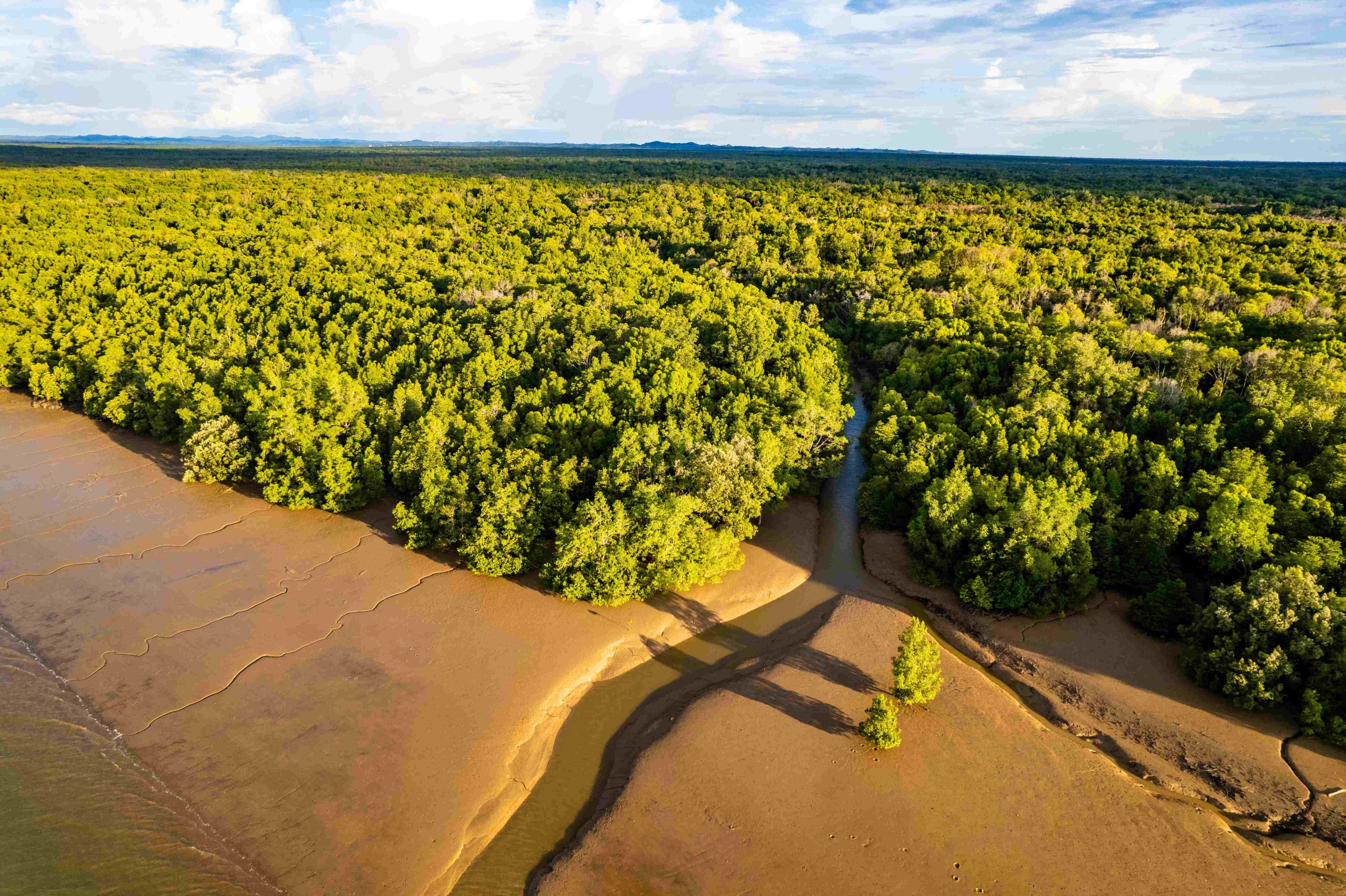
Stretching from Kuching to Limbang, these forests line river mouths, estuaries and coastlines where land meets the South China Sea.
Among the state’s most important mangrove ecosystems are Kuching Wetlands National Park, Rajang Mangrove National Park, and the mangrove belts of the Rajang Delta, Belawai and Santubong Peninsula.
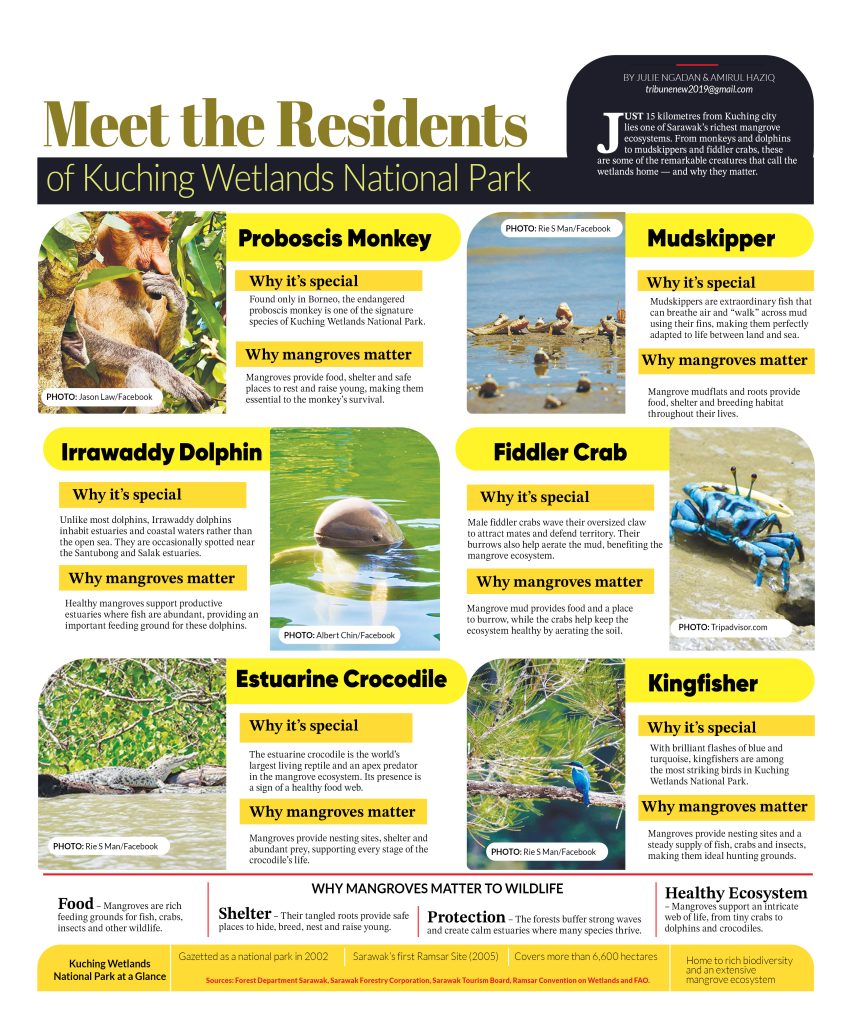
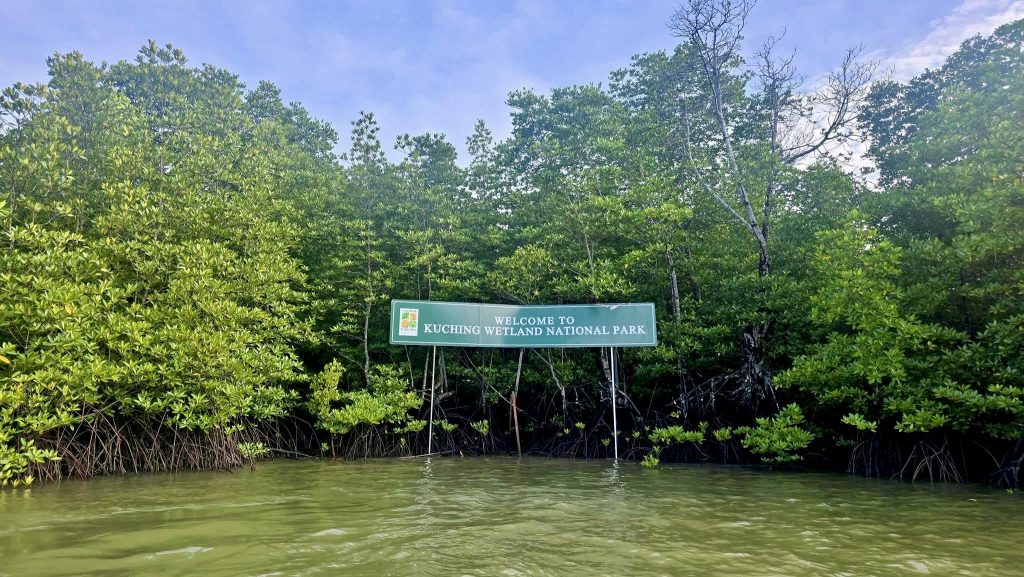
Kuching Wetlands National Park, covering more than 6,600 hectares, is Sarawak’s first site recognised under the Ramsar Convention on Wetlands, an international treaty that identifies wetlands of global importance.
Perhaps the beauty of a mangrove forest lies in its subtlety.
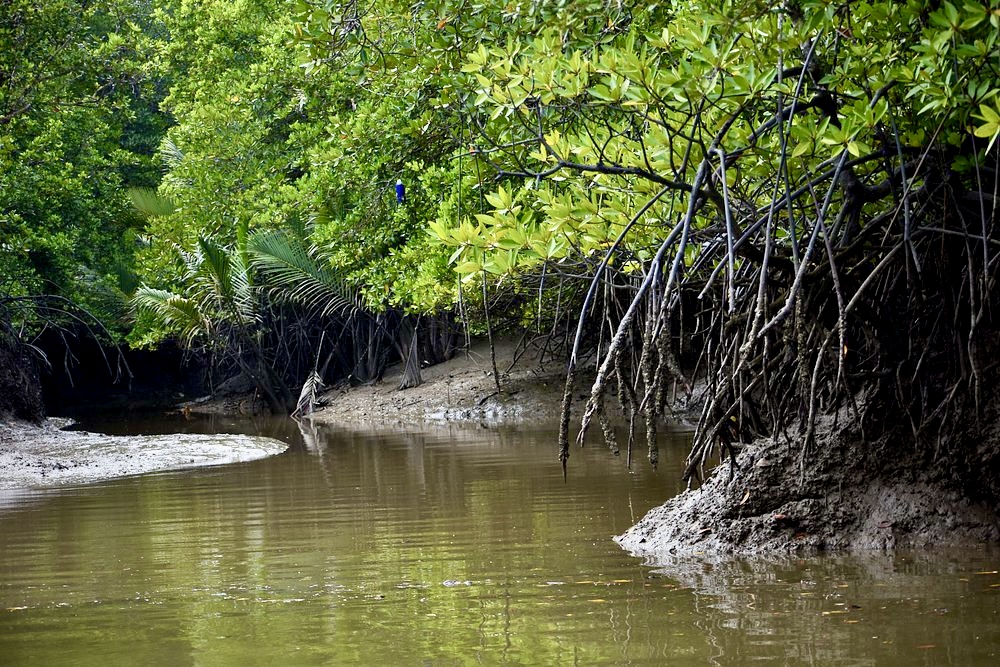
Unlike a rainforest that impresses with towering trees, a mangrove reveals itself slowly. The rhythmic splash of water replaces the sound of traffic as roots arch above the mud like natural sculptures.
Then, almost without warning, the forest comes alive.
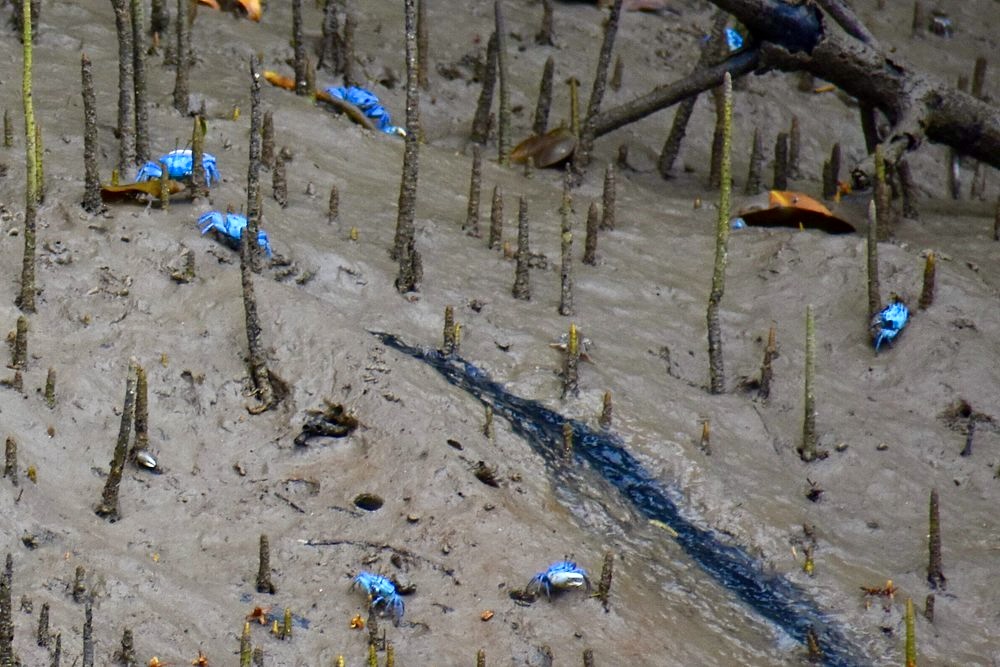
A kingfisher flashes electric blue across the river. Proboscis monkeys leap through the canopy while mudskippers hop across exposed mudflats. Fiddler crabs wave oversized claws from the muddy banks and, if you’re fortunate, an Irrawaddy dolphin briefly surfaces before disappearing beneath the water once more.
Far from being an empty swamp, the mangrove is a thriving ecosystem where every species depends on the same tangled network of roots.
Mangrove trees themselves are extraordinary. Adapted to survive in saltwater, some species even produce seedlings that begin growing while still attached to the parent tree — a rare phenomenon known as vivipary. When mature, the young propagules fall into the water and drift with the tide until they find a suitable place to take root.
The forest that stands between us and the sea
If mangroves are the nurseries of the sea, they are also the guardians of the shore.
Unlike concrete sea walls, mangroves work with the tides. Their dense roots trap sediment, reduce coastal erosion and weaken incoming waves, making them one of nature’s most effective coastal defences as sea levels rise and extreme weather becomes more frequent.
Their work is almost invisible. No headlines celebrate a coastline that remains intact after heavy rain. The forest simply continues doing what it has done for centuries.
Mangroves do more than protect coastlines. They are also among nature’s most effective carbon stores.
As they grow, they absorb carbon dioxide from the atmosphere and lock much of it away in their trees and waterlogged soils, where it can remain trapped for centuries.
But when mangrove forests are cleared or degraded, that stored carbon is released back into the atmosphere, contributing to climate change.
Their importance extends far beyond climate. Mangroves also provide habitat for countless species and support ecotourism in places such as Kuching Wetlands National Park. Remove the forest, and the intricate web of life that depends on it begins to unravel.
The day the forest went silent
No one wakes up one morning to discover that every mangrove has vanished.
Instead, the loss arrives quietly.
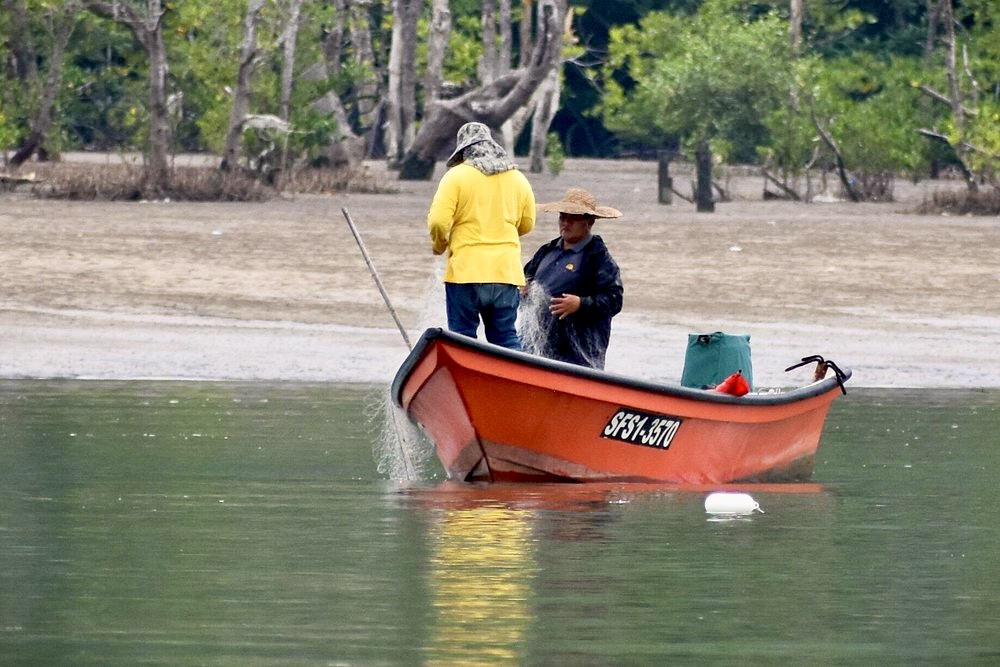
A fisherman returns with a smaller catch.
A crab collector comes home with a lighter basket.
The familiar flash of a kingfisher becomes increasingly rare.
The shoreline edges a little further inland after every monsoon.
A child who once spotted proboscis monkeys during a river cruise begins asking why they no longer appear.
Each change seems small on its own. Years later, people realise they were never isolated — they were connected all along.
When mangroves disappear, the consequences are measured not only in hectares of forest lost, but also in declining fisheries, eroding coastlines, disappearing wildlife and livelihoods that become harder to sustain.
A future still within reach
The encouraging news is that mangroves are not beyond saving.
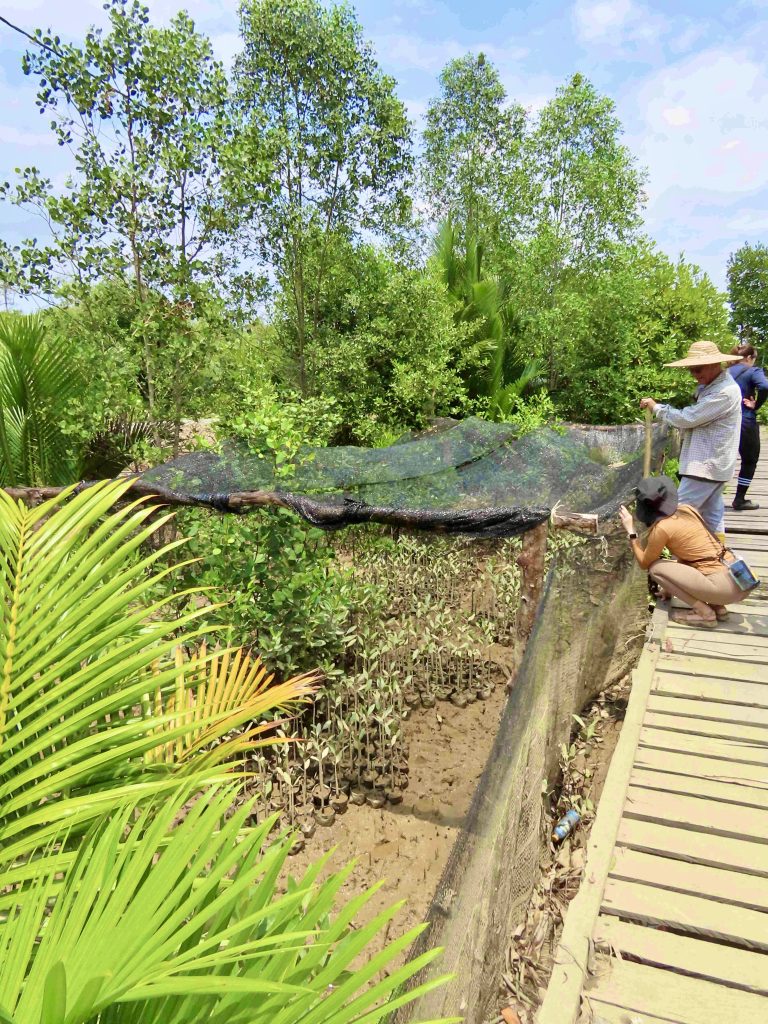
Across Sarawak, government agencies, conservation organisations, local communities and volunteers have restored degraded coastal areas by planting thousands of mangrove seedlings.
While restoration is important, experts agree that protecting existing mangrove forests remains the most effective form of conservation.
Perhaps that begins with something surprisingly simple — seeing mangroves for what they really are.
Not muddy wastelands. Not forgotten corners of the coastline. But living forests that quietly connect land and sea.
The next time a plate of butter prawns, steamed siakap or freshly cooked mud crab arrives at your table, pause for just a moment.
Remember that its journey began long before it reached the fish market or a fisherman’s net.
For many marine species, it began among tangled mangrove roots, where the tide rises and falls each day and a quiet forest continues its work without expecting anyone to notice.
Perhaps the greatest tragedy of losing a mangrove forest is not the loss of the trees themselves.
It is the quiet disappearance of everything they had been giving us all along.