BATU KAWAN: McDonald’s Malaysia is expanding its renewable energy partnership with the Tenaga Nasional Berhad (TNB) through rooftop solar installations, renewable electricity sourcing and electric vehicle (EV) charging facilities as part of efforts to strengthen sustainability across its restaurant network.
McDonald’s Malaysia Managing Director and Local Operating Partner Datuk Azmir Jaafar said the latest phase will see rooftop solar systems installed at 51 additional restaurants, with an estimated combined capacity of 1.685 megawatt-peak (MWp).
“This is on top of the 100 restaurants that we already have fully set up with photovoltaic solar panel systems.
“So, the vision with TNB and GSPARX (TNB subsidiary GSPARX Sdn Bhd) is that by the end of 2027, we would have 200 to 250 restaurants equipped with photovoltaic solar panels,” he told Bernama after the McDonald’s Malaysia and TNB Renewable Energy Partnership announcement at McDonald’s Batu Kawan Drive-Thru here recently.
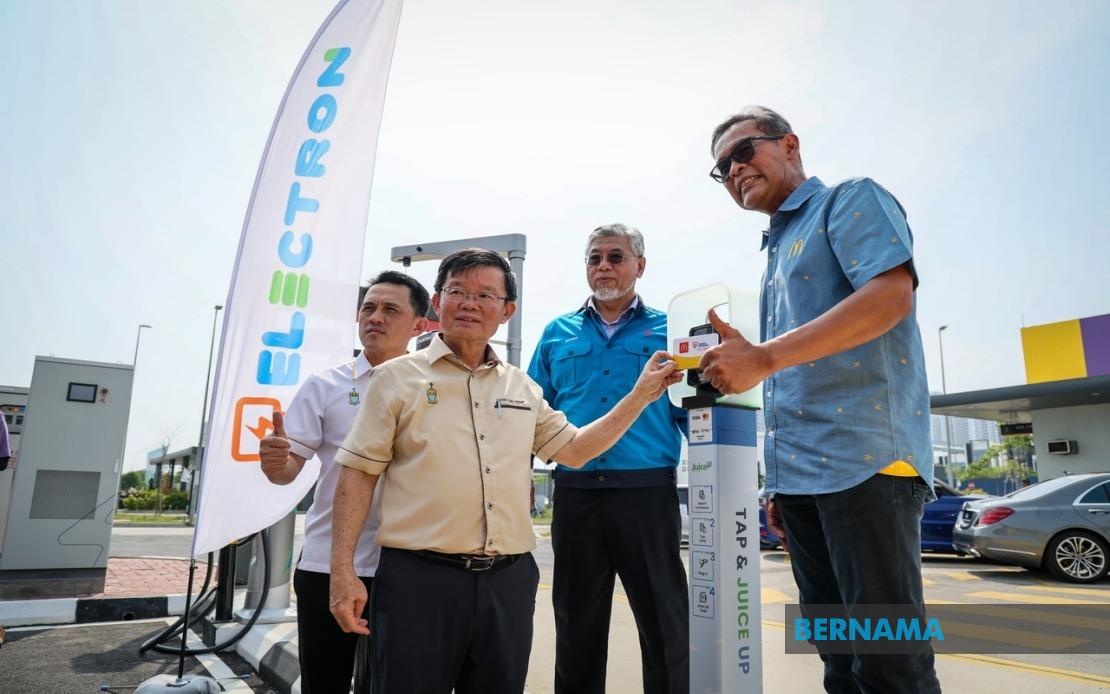
The collaboration which witnessed by Penang Chief Minister Chow Kon Yeow, involved the signing of a Supply Agreement for Renewable Energy (SARE) for the next phase of McDonald’s rooftop solar programme, the presentation of a Green Electricity Tariff (GET) certificate and the official launch of a TNB Electron EV charging facility.
The SARE agreement was signed by Azmir on behalf of McDonald’s Malaysia and TNB President and Chief Executive Officer Datuk Shamsul Ahmad on behalf of the utility company.
Under the latest solar project, GSPARX will develop, operate and maintain the rooftop solar systems, with implementation expected to begin in 2026 and be completed by 2027.
The expansion builds on the first phase of the partnership established in 2023, covering 100 selected McDonald’s Drive-Thru restaurants nationwide.
Azmir said the adoption of solar energy is part of McDonald’s broader move towards sustainably sourced energy, while also helping to reduce reliance on electricity from the grid.
“We believe in sustainable sourcing. In terms of sustainable energy, we started this back in 2016. We installed our own solar panel on a rooftop in Putrajaya,” he said.
McDonald’s Malaysia also plans to subscribe to TNB’s GET for up to 285 restaurants or electricity accounts, which currently record a combined average monthly electricity consumption of approximately 15.5 gigawatt-hours (GWh).
The initiative will position McDonald’s Malaysia as the first and largest quick-service restaurant operator in the country to subscribe to GET, which allows businesses to match part or all of their electricity consumption with renewable electricity supplied through the national grid.
On green mobility, Azmir said McDonald’s currently has EV charging facilities at 12 restaurants nationwide and plans to increase the number to about 30 in the near term.
“Today we have 12. Two are with Electron under GSPARX, so there are still many more to open. We plan to provide EV chargers at about 30 restaurants nationwide, at least one or two restaurants per state,” he said while adding that two operational TNB Electron facilities are located at McDonald’s Batu Kawan and McDonald’s Seri Austin in Johor.
The Batu Kawan facility, the first TNB Electron location in the food and beverage sector, features a 200-kilowatt (kW) DC fast charger with two charging points, expandable to four, and operates 24 hours a day.
Beyond renewable energy, Azmir said McDonald’s Malaysia has also pursued other sustainability initiatives, including phasing out several single-use plastic items, adopting paper straws, sourcing core products and packaging more sustainably, and recycling used cooking oil into biodiesel.
He noted that 78 per cent of the company’s packaging currently comes from renewable, recycled or certified sources, while 97 per cent of supplies across its six core categories, namely beef, chicken, coffee, fibre-based packaging, fish and palm oil, are sourced sustainably.
Meanwhile, Chow said private-sector participation is essential to advancing renewable energy and energy efficiency, adding that the partnership demonstrated how businesses could translate Penang’s and Malaysia’s energy ambitions into practical action while bringing cleaner energy and green mobility closer to communities.
Shamsul said the collaboration would enable businesses and consumers to participate more directly in Malaysia’s energy transition by integrating renewable energy, green electricity and EV charging into everyday locations, in support of the National Energy Transition Roadmap (NETR).
The partnership also supports the National Energy Efficiency Action Plan 2.0 and the Penang Energy Framework, which targets 10 per cent renewable energy adoption and a 25 per cent reduction in electricity energy intensity by 2030. – BERNAMA