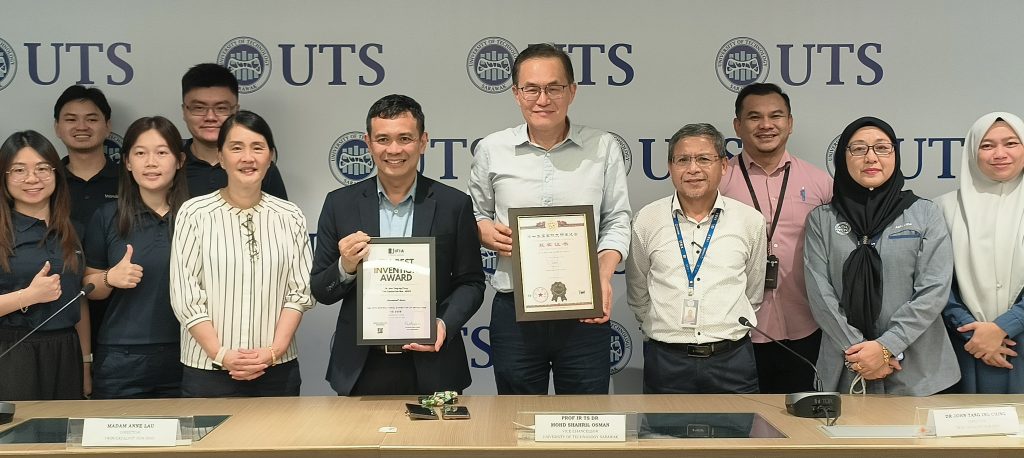
SIBU: A made-in-Sibu product, the Wondaleaf® Afresh cooling headband, has won the IFIA (International Federation of Inventors’ Associations) Award 2026.
The product, invented by University of Technology Sarawak (UTS) adjunct professor Dr John Tang Ing Ching, beat more than 3,700 entries from over 30 countries to claim the award at the 12th International Exhibition of Inventions (IEI 2026), co-hosted by the China Association of Inventions (CAI) and the International Federation of Inventors’ Associations (IFIA), in Guangzhou, China, recently.
An elated Dr Tang shared at a press conference on Wednesday that it took him and his team 18 months to develop the product.
He and his team from Twin Catalyst Sdn Bhd worked on the idea, producing more than 100 prototypes using different materials and designs and testing them in various environments and under different body conditions before finally developing a functional and robust prototype.
They also received technical support from UTS.
“The idea came from living in Malaysia. The only thing I dislike about Malaysia is that it is too hot. So, I have always been trying different methods to cool myself down, especially when I exercise.
“I bought a very expensive top-blowing fan for my exercise room and even installed an air conditioner. But even with air conditioning, when you exercise, you still sweat a lot because your body generates so much heat.
“Then I discovered this idea. When I put it on, the sweat no longer gets into my eyes. That is why I specifically mention this as part of our invention – no more stinging sweat in the eyes,” he said.
He said the product allowed users to be drenched in sweat without the sweat getting into their eyes.
“Sweat can help cool us down, but it is not very effective at evaporating because it contains salt. Clean water evaporates much faster and can cool you down more quickly.
“That is why, if you get caught in the rain and your shirt becomes wet, you feel very cold. It is because the water evaporates and takes heat away from your body.
“Sweat, on the other hand, evaporates more slowly. That is why it does not cool you down as effectively. So, using this product is a better way of managing the heat,” he added.
Explaining, Dr Tang said water was probably the most effective cooling medium in nature.
Through the latent heat of vaporisation, heat is absorbed and drawn away from the body when water evaporates. That is why a wet towel can cool the body down.
However, a wet towel drips and dries out quickly. Therefore, the team created a refillable water reservoir made of a semi-permeable membrane that keeps the water in while allowing water vapour to pass through it.
They then realised that stagnant water acts as an insulator, while moving water is a heat-dissipating medium.
“That explains why a thick wet towel does not cool us down. The water in the reservoir has to move constantly to distribute coolness around. Realising this was the Eureka moment,” he said.
He said there were only five parts of the human body that could move constantly and easily – the head and four limbs.
“The head accounts for two per cent of our body weight but uses up 20 per cent of our energy. It makes perfect sense that keeping it cool should take precedence over other parts of our body. So, it had to be a headband,” he said.
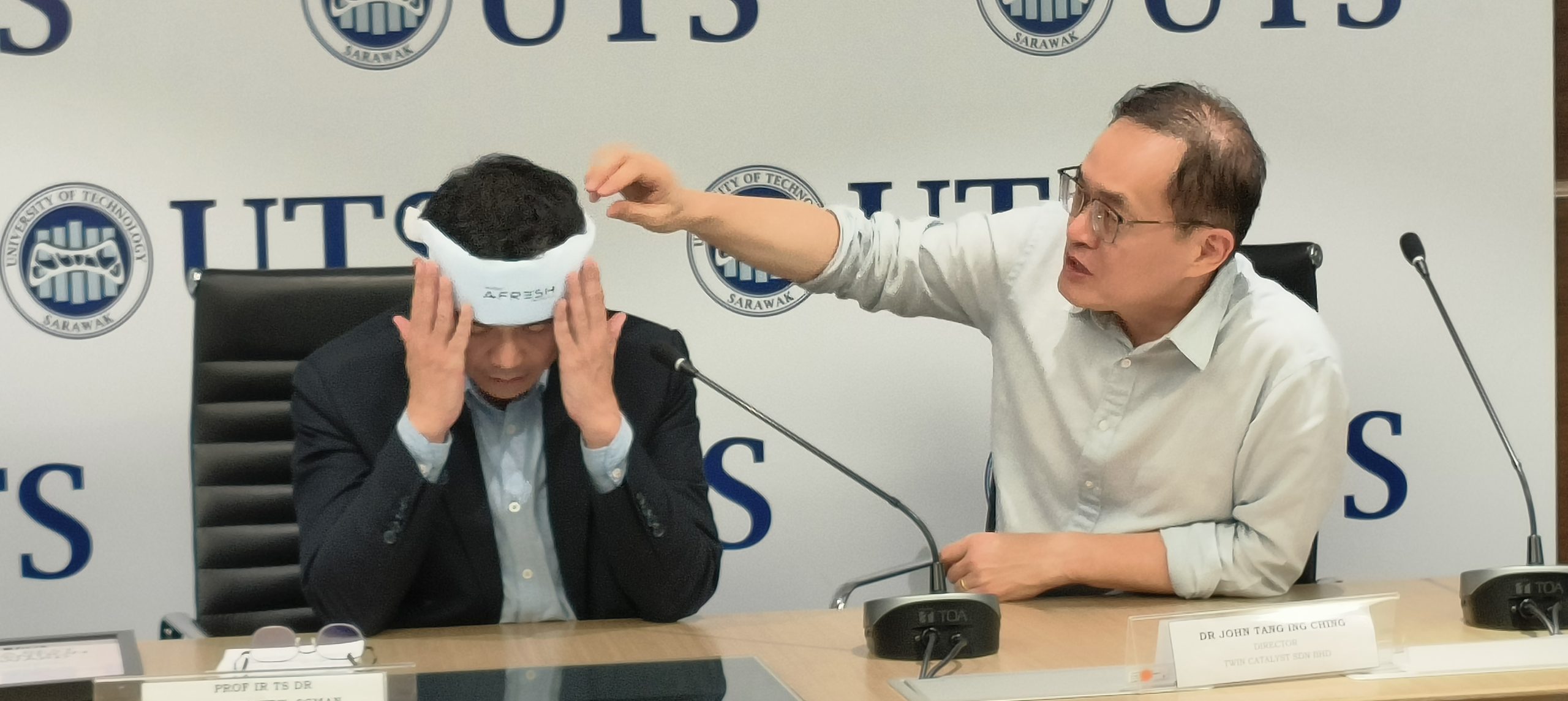
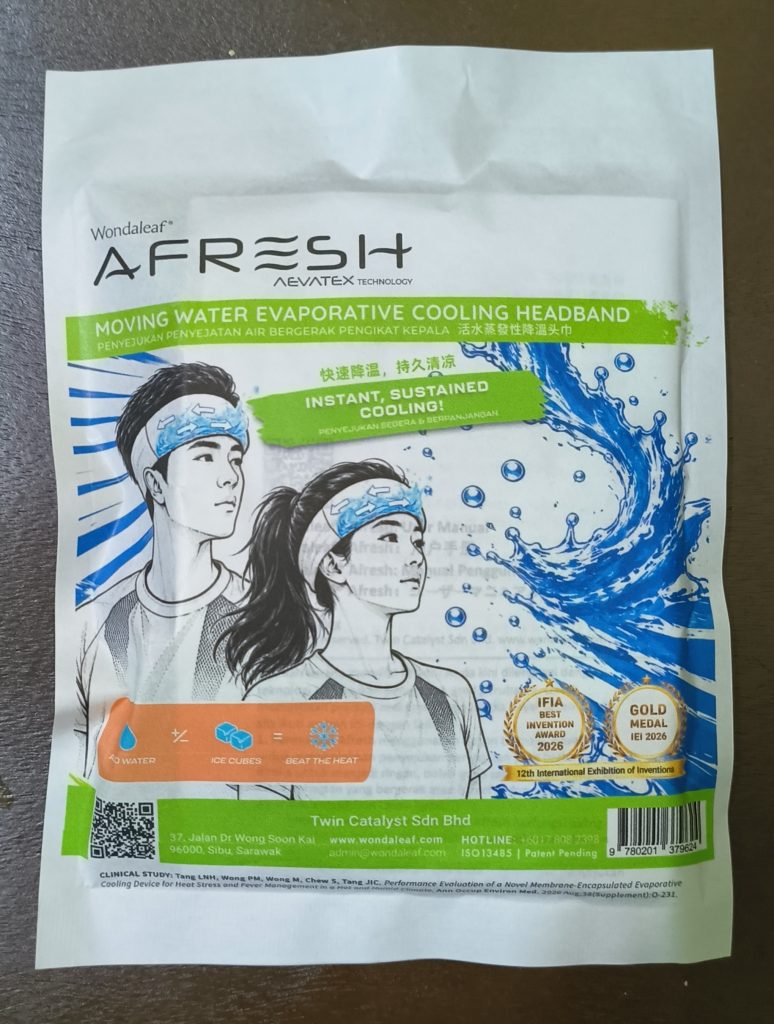
Dr Tang described Wondaleaf® Afresh as a moving-water evaporative cooling headband that provides instant and sustained cooling.
“It is easy to use, cheap, lightweight, dry to the touch, hands-free, portable, refillable, washable and reusable.
“It does not create any noise, dry eyes or a dry nose like handheld fans; it does not need refrigeration or batteries; we can wear it and forget it or even wear it to sleep; and perhaps, above all, it is fashionable,” he said.
He said the product was designed for use in hot environments, during physical activities and for topical fever management.
It can be carried easily in an insulated tumbler, while ordinary household ice cubes can be added to Afresh to help mitigate extreme heat.
Recalling how they decided to enter the competition, Dr Tang said they showcased Afresh as a Sarawak innovation when the Sarawak Science Centre was launched on July 29.
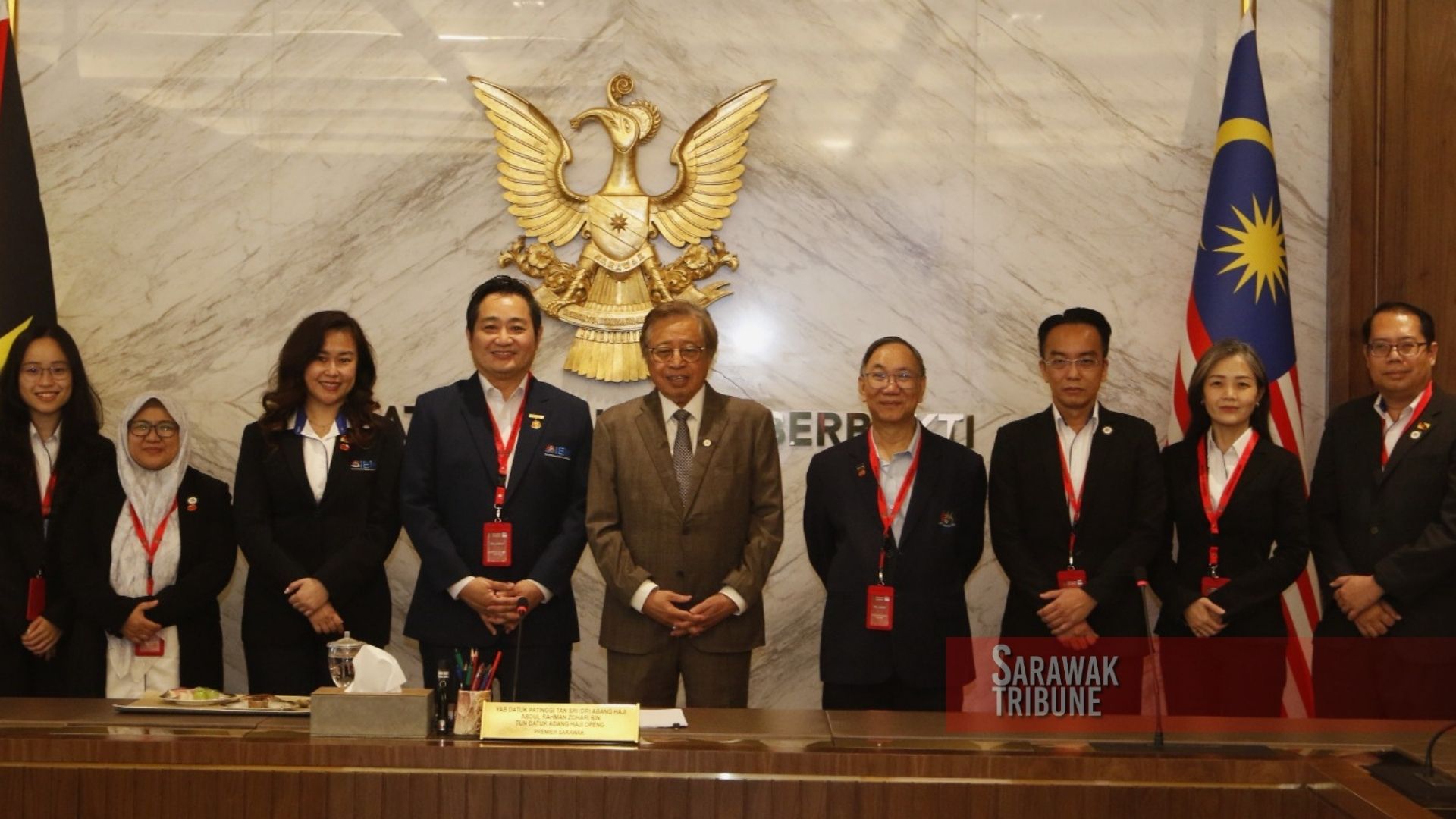
“The response was overwhelming. We even asked our Premier to have a go with it. That gave us the confidence to enter the 12th International Exhibition of Inventions (IEI 2026).
“We had no idea what we were getting into. The event was world-class, with more than 3,700 entries from over 30 countries. This is China – the second-largest economy and the factory for the entire world.
“Just the thought of going there to show and tell Afresh was frightening. So, we approached the Malaysian Invention and Design Society to check if anyone else was going, so that we could at least join forces and keep each other company.
“It turned out that no one else from the society was going. The society nevertheless gave us their blessings, which we cherished dearly,” he said.
He said the crowd at the invention exhibition was an entirely different genre, comprising professionals ranging from engineers from DJI, executives from ByteDance and researchers from Peking University to a military procurement entrepreneur from India.
“It was a nonstop, constant stream of visitors trying out and placing orders for Afresh. Their approving comments kept us going despite our physical tiredness,” he said.
The jury then came to assess their invention.
The following day, an entourage of officers from the CAI (China Association of Invesntions) and IFIA visited their booth to learn about Afresh.
“We showed them the device as usual and did not think much of it when they left,” he said.
On the morning of the final day of the event, a CAI staff member briefed them on the strict protocols for the closing ceremony, including where to sit, how to line up and which documents to bring.
“It was only then that we were told, to our surprise, that we had not only been given a gold medal but had also won the Best Invention Award.
“Frankly, I do not think we deserve it. Ours is too simple. Period. I went around the halls in awe, witnessing inventions in AI, robotics, deep-sea tunnelling, cancer drugs and even nuclear reactors.
“But what do I know?
“I only know that the journey to Guangzhou was made of endless dreams, countless hours invested by the Wondaleaf team, relentless support from the Sarawak Research and Development Council, and an aspiration to excel for the University of Technology Sarawak,” he said.
UTS Vice-Chancellor Dr Mohd Shahril Osman said the university was as proud as Twin Catalyst of the achievement, adding that the award reflected the creativity, dedication and innovation of the team behind the product.
Dr Tang said the product would be officially launched at the Borneo Cultural Festival from Sept 3 to 12.
It is priced at RM80 but will be sold at a special promotional price of RM40 during the festival.