WHY football’s most prestigious individual prize has spent decades changing the definition of greatness.
Interviewing three-time Ballon d’Or winner Michel Platini remains one of the defining moments of my career.
I had just started out as a television host, so sitting across from a man my father spoke about constantly while I was growing up felt surreal. Truth be told, I never watched much of Platini’s football beyond highlight reels and archive shows. But you did not need to live through his era to understand the aura around him.
You could feel it in the way other footballers spoke his name – almost reverently, as though he belonged to a different tier of the sport.
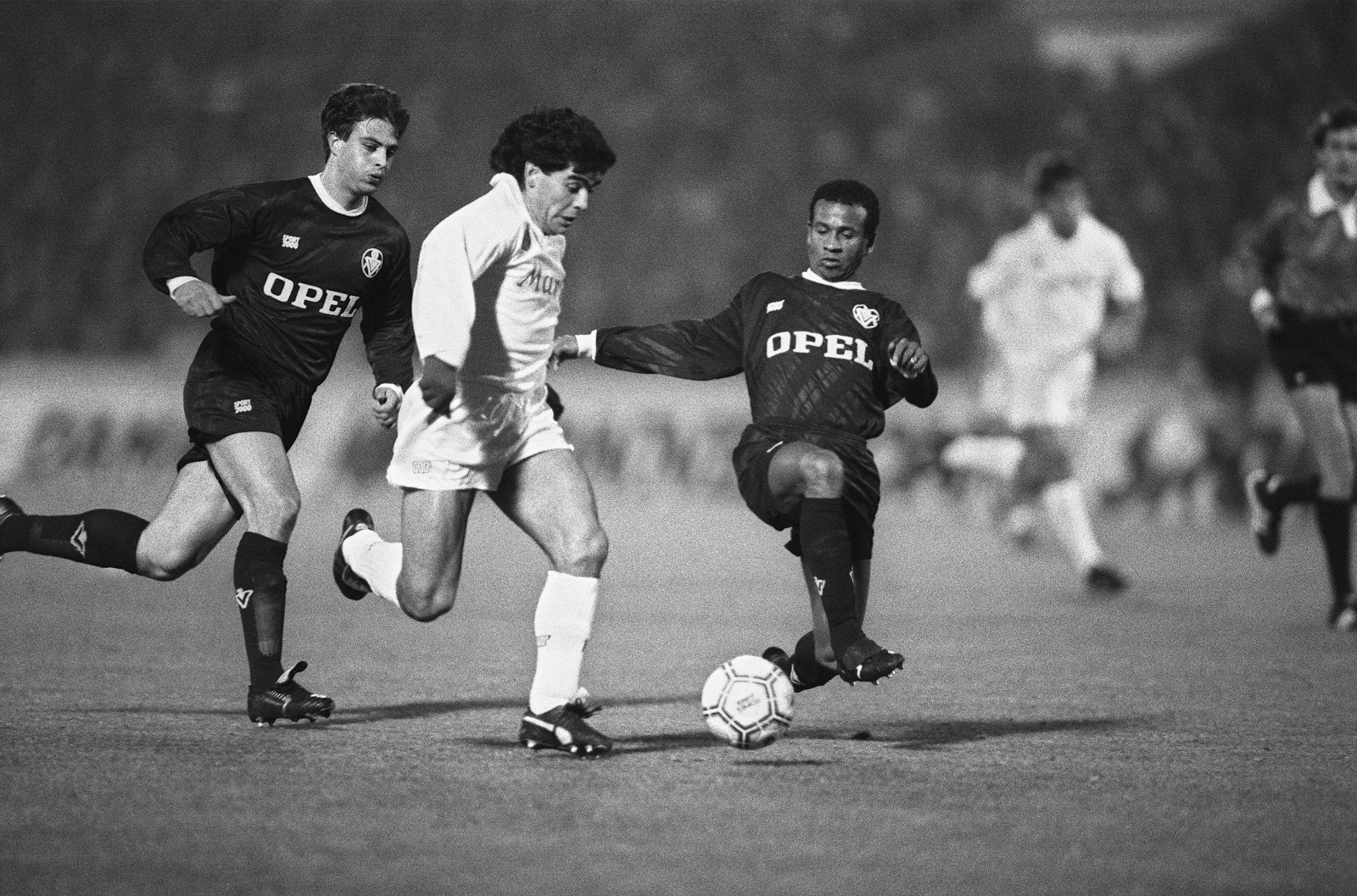
During that interview, Platini said something I have never forgotten. He brought up Diego Maradona unprompted, calling him an anomaly – a player who seemed to defy the laws of physics on a football pitch.
He also went on a tangent about VAR long before it became the lightning rod it is today.
Looking back, the man was right on both counts.
VAR has become, in my view, Very Accurate Rubbish – a system that slows the game down and still somehow leaves everyone arguing about the biggest decisions.
And Maradona?
I will say it plainly. He is the greatest footballer who ever lived.
The trophy Maradona never could win
Here is where the argument usually begins.
Mention Maradona to any fierce defender of the Ballon d’Or and the response often comes quickly: he never won one.
Technically, they are right.
But that was not because he was not good enough. It was because, until 1995, the Ballon d’Or was restricted to European players. That meant some of the most gifted footballers on the planet were never even eligible because of where they were born.
Pelé is the even more glaring example. A three-time World Cup winner, one of the most decorated international footballers in history, and yet he has no competitive Ballon d’Or to his name.
For decades, the supposed gold standard of individual football greatness excluded an entire world of genius.
That is not a small footnote. That is the foundation of the problem.
Once you start pulling that thread, the confusion never really goes away. It simply changes shape.
The Messi-Ronaldo era
For my generation, the obsession truly began with Cristiano Ronaldo against Lionel Messi.
Ronaldo’s first Ballon d’Or in 2008 was fully deserved. He had just delivered a brilliant season with Manchester United, winning the Premier League and Champions League.
The following year, Messi rightly claimed the award after helping Barcelona complete a historic treble, capped by his goal in the Champions League final against, of all teams, Manchester United.
So far, so clear.
Then Ronaldo moved to Real Madrid, and the award entered its most famous era.
Messi dominated from 2009 to 2012, winning four in a row. The 2012 award remains the most discussed of that run because of the numbers. Messi broke Gerd Muller’s 40-year record for goals in a calendar year, scoring 91 in total.
On pure individual brilliance, it was extraordinary. No argument there.
But here is the strange part. Barcelona’s major domestic success that year was limited to the Copa del Rey. No league title. No Champions League.
So the message seemed clear: individual brilliance could outweigh team trophies.
Fine. At least that is a standard.
Except the very next year, the criteria seemed to shift again.
Ronaldo ended Messi’s streak in 2013, largely on the back of breathtaking personal scoring numbers. Real Madrid, however, did not win a major trophy that calendar year.
Meanwhile, Franck Ribery had been central to Bayern Munich’s treble-winning season – Bundesliga, German Cup and Champions League – and still finished third.
A genuine treble winner, beaten by two players from clubs that did not win the major prizes that year.
Then in 2014, Ronaldo won again, this time with both individual numbers and Real Madrid’s historic La Decima Champions League triumph behind him.
So in three consecutive years, the award rewarded three different ideas.
Individual brilliance without major team success.
Individual brilliance over a rival’s treble.
Then individual brilliance supported by team success.
At that point, what exactly was the trophy measuring?
The names left behind
This is not only a Messi-Ronaldo issue.
Go back to 1999. Manchester United completed the Treble, becoming the first English club to do so. David Beckham, one of their standout players that season, finished runner-up to Rivaldo.
Rivaldo had a brilliant year with Barcelona. That is not in dispute.
But again, the question is consistency.
In 2010, Andres Iniesta scored the goal that won Spain the World Cup. He was one of the most important footballers in the world that year, for club and country, yet still finished behind his Barcelona teammate Messi.
Team glory, individual genius, calendar-year numbers, international success – the award seems to pick whichever narrative suits the season.
Choose the wrong year, and you become Beckham, Iniesta or Ribery, watching someone else lift the trophy you could easily argue belonged to you.
The Lewandowski problem
Then came Robert Lewandowski.
In 2020, he helped Bayern Munich win the treble, finished as Europe’s top scorer and produced the finest individual season of his career.
Then France Football cancelled the award because of the pandemic.
No winner. No runner-up. No moment.
Lewandowski never got his Ballon d’Or.
A year later, Messi won the 2021 award after Argentina’s Copa America triumph. Messi is one of the greatest players to ever play the game, but watching Lewandowski applaud that moment never sat right with me.
It felt like the award had denied him when his case was strongest, then simply moved on.
Messi, 2026 and the question of standards
Now, in a twist I genuinely did not expect, Messi is back in the conversation for the 2026 Ballon d’Or after being named on the 30-man shortlist.
My reaction is simple: why, where, what and how?
That is not hatred towards Messi. Far from it.
Messi’s case is not empty. He led Inter Miami to the 2025 MLS Cup, won the MLS Cup MVP, claimed the MLS Golden Boot and was named MLS MVP. He also helped take Argentina to the 2026 World Cup final.
For a 39-year-old, that is remarkable.
But is that now the bar for a Ballon d’Or nomination?
Major League Soccer has its strengths, but it is not generally regarded as being on the same competitive level as Europe’s top leagues or the Champions League. If MLS dominance, combined with international prestige, is enough, then the award has redefined itself again.
And once again, nobody seems to have explained the criteria.
For the record, I do not hate Messi. I do not hate Argentina either.
Argentina will always hold a special place in my heart because of the memories of watching football with my father, especially stories of Maradona, the greatest of all time, putting Napoli on the map of world football.
The problem with eight
Which brings me back to the number eight.
Eight Ballons d’Or for Messi.
On the surface, it sounds like undeniable proof of transcendence. Maybe it is.
But when so few major individual awards in global sport produce anything close to an eight-time winner, it should also make us question the measuring stick itself.
Michael Jordan won five NBA MVP awards.
Tom Brady won three NFL MVP awards.
In football, Messi has eight Ballons d’Or.
That does not make him less great. It does, however, make the award worth examining.
Because when one prize produces an outlier this extreme, while also carrying a history of exclusion, shifting standards and unexplained criteria, the conversation should not only be about the player who won it.
It should be about the system that keeps producing these outcomes.
Football’s most confused prize
That is why I still think about that afternoon with Platini.
I still think about his line on Maradona being an anomaly. And the more I look at the Ballon d’Or, the more I wonder whether he was right in a way he may not have intended.
Maybe the greatest anomaly in football was not just Maradona.
Maybe it is the award itself.
Until the Ballon d’Or honestly reckons with its history of exclusion, its changing criteria and the moments it simply failed to honour the obvious candidate, it will remain football’s most prestigious individual prize – and perhaps its most inconsistent.
A beautifully marketed measuring stick that has never quite decided what it is measuring.
The views expressed in this article are those of the author and do not necessarily reflect the views of Sarawak Tribune.
The views expressed in this article are those of the author and do not necessarily reflect the views of Sarawak Tribune.