WAR leaves behind more than just ruins and trauma. It steals the future of generations, uprooting families, orphaning children, and scarring societies long after the last bullet is fired.
Even after the guns fall silent, the effects of war linger. Entire communities are displaced. Children grow up without parents.
Nations spend decades rebuilding not just infrastructure, but trust and identity. For those who survive, the memories never fully fade. Even for outsiders who step in to help, such as peacekeepers, the experience can be life-changing.
They were sent into environments still heavy with fear and loss, where their presence offers a sense of order, but where healing is slow. They see firsthand how fragile peace can be, and how much effort it takes to maintain it.
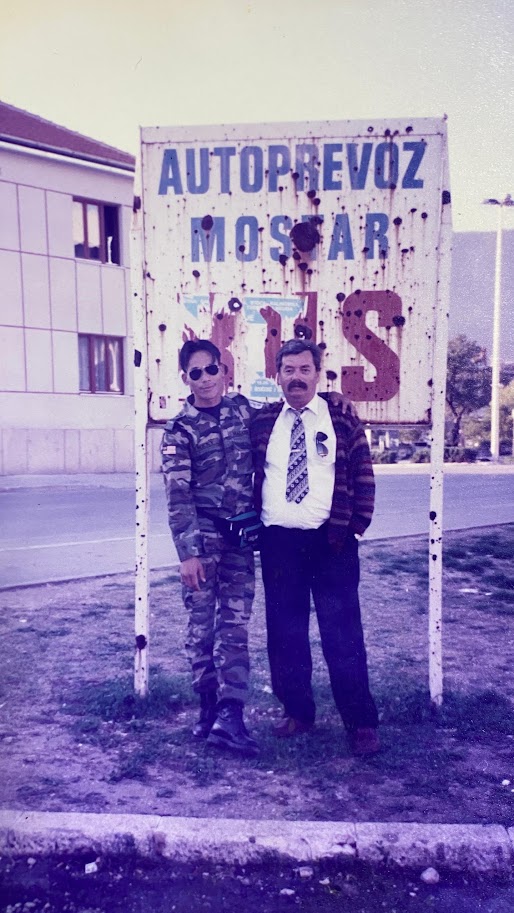
In conjunction with Warriors’ Day, commemorated nationwide on July 31, Sarawak Tribune spoke with retired Corporal Micky Laah, who served in post-war Bosnia in 1996.
He was part of the Malaysian peacekeeping contingent under the North Atlantic Treaty Organisation (NATO)’s Implementation Force (IFOR), deployed to enforce the Dayton Peace Agreement following the end of the Bosnian War.
Hailing from Serian, Micky joined the Malaysian Armed Forces (ATM) in 1991 and was assigned to the Royal Armoured Corps (KAD), also known as Kor Armor DiRaja.
He was 24 when he was deployed to Bosnia for six months, where he witnessed firsthand the deep scars left by war — not just on the land, but on the people.
“The situation was chaotic, even though the war had already ended. We were there for six months, and what we saw were the remnants of destruction, abandoned towns, broken buildings, and empty homes.
“Only the elderly were left behind. The younger population had mostly fled to neighbouring countries like Germany,” he said.
Malaysia’s deployment was part of a larger international mission.
While some personnel were based in Split in Croatia or Glamoč, Micky and his unit were stationed in Livno, near Bosnia’s western border.
Each location came with its own set of challenges, terrain, and stories. The Bosnian War began in 1992 after Bosnia and Herzegovina declared independence from Yugoslavia.
However, Bosnian Serbs – supported by the Yugoslav People’s Army and Serbia – rejected the move and launched a campaign to seize territory and establish their state.
The conflict quickly escalated into a brutal war involving the country’s three main ethnic groups: the Bosniaks (Bosnian Muslims), the Serbs (Orthodox Christians), and the Croats (Catholics).
Although they once lived side by side, rising nationalism and territorial ambitions turned neighbours into enemies.
Bosnian Serb forces killed more than 8,000 Bosniak men and boys in the 1995 Srebrenica massacre, which was among the most horrific incidents.
The war ended later that year with the signing of the Dayton Peace Agreement, which divided Bosnia into two autonomous entities: the Federation of Bosnia and Herzegovina (Bosniak-Croat) and the Republika Srpska (Bosnian Serb).
When Micky and his fellow peacekeepers arrived in early 1996, Bosnia was in a state of profound turmoil. Its towns lay in ruins, its populace displaced, and its future hung in uncertainty.
He said his unit’s responsibilities included regular patrols and manning observation posts as part of NATO’s stabilisation efforts.
“Our main task was peacekeeping. We patrolled, monitored movement, and supported stabilisation efforts.
“Unlike some other units stationed in areas like Glamoč or Split, we were not heavily involved in humanitarian missions such as rebuilding churches,” he said.
Despite the end of the war, the silence felt heavy.
Micky likened the atmosphere in Bosnia to that of Bukit Pelanduk during the Japanese Encephalitis (JE) outbreak – quiet, tense, and stripped of life.
“Most of the shops and buildings were either destroyed or abandoned. It was like walking through a ghost town. I remember attending Sunday Mass at a church with no roof. That’s how bad it was,” he added.
Even simple things like the weather became a challenge. The extreme cold was unlike anything he had experienced back home.
Micky recalled that while he had initially felt excited about the deployment, the moment he set foot on Bosnian soil, a chilling thought crossed his mind.
“I thought to myself, ‘I might die here’. The walls of their buildings were thick, built for snow and cold. Even so, many were damaged during the war. If their walls had been like ours in Malaysia, they would have been flattened,” he added.
For Micky, adapting to the unfamiliar environment meant adjusting even the most basic routines.
“The mineral water there didn’t taste like what we’re used to. It usually depends on the climate. For nearly a week, we couldn’t drink it. The taste was brackish.
“But after about a week, we got used to it and could even enjoy coffee made with it. As for bathing, I avoided using tap water because it was too cold. So I used mineral water instead,” he recalled.
Although the mission was serious, there were also moments of humanity that stuck with him.
He shared how they built bonds with foreign troops stationed at the same base.
Micky said the interactions with other NATO soldiers were generally cordial. Each unit operated within its own designated area, but occasionally, they would meet during joint patrols or at the camp.
To ease communication with the local population, he said the government even provided Bosnian-Malay translation dictionaries, helping troops to manage basic exchanges with residents at least.
“The locals, especially the elders, were kind. They offered us food and drinks during our patrols. They were kind people, but the root of the war, we weren’t entirely sure,” he said.
Micky said some of the locals he met in Bosnia had opened up about the horrors they experienced before peacekeepers arrived. Many spoke of the chaos and violence that unfolded in their villages, even before the war reached its peak.
“They told us bridges were blown up, and everything was destroyed. It was extremely bad,” he said.
He recalled hearing disturbing details – accounts of civilians being tied up, pregnant women dragged behind vehicles, and young girls being gunned down. The stories, though unofficial, left a lasting impression on him.
“These were things they said happened before the height of the war. It was already terrible even then,” he added.
According to a 2008 statement by the first Prime Minister of the Federation of Bosnia and Herzegovina, Haris Silajdžić, at the United Nations General Assembly (UNGA), an estimated 200,000 people were killed during the Bosnian War, including 12,000 children.
Up to 50,000 women were reportedly raped, and more than 2.2 million people were forced to flee their homes, figures that reflect the scale of what he described as genocide and the destruction of a society.
The three-year war saw widespread atrocities, particularly against Bosniak and Croat civilians.
Historical records show that women and girls were subjected to systematic sexual violence in so-called “rape camps” in places like Foča and Višegrad, and mass killings occurred across the country.
In the years following the war, numerous key figures were held accountable for their roles in the atrocities.
Several prominent leaders, particularly from the Bosnian Serb side, were charged and convicted by the International Criminal Tribunal for the former Yugoslavia (ICTY) and later by national and international courts.
Radovan Karadžić, the political leader of Republika Srpska during the war, was arrested in 2008 and found guilty in 2016 of genocide, crimes against humanity, and ethnic cleansing, particularly for his role in the Srebrenica massacre and the Siege of Sarajevo.
His military counterpart, Ratko Mladić, infamously known as ‘The Butcher of Bosnia’, was arrested in 2011 and convicted in 2017 for genocide, war crimes, and leading systematic ethnic cleansing campaigns across the region.
Other individuals, such as Croatian Serb leader Milan Martić, were convicted in the mid-2000s.
As for Serbian state security officials Jovica Stanišić and Franko Simatović, they were found guilty by the United Nations’ (UN’s) International Residual Mechanism for Criminal Tribunals (IRMCT) in 2021 for aiding and abetting war crimes and crimes against humanity in Bosnia.
Prosecutions were not limited to one side. While many of the most serious convictions involved Bosnian Serb leaders, some former Bosniak officials were also charged by local courts in Sarajevo for alleged wartime abuses.
For Micky, the mission, though brief, left a lifelong impression.
Nearly 30 years have passed since his time in Bosnia, but he has followed the country’s journey ever since.
He expressed relief seeing the region return to stability and peace.
“Each group has their own country now. No more fighting. It makes me grateful to see them live in peace again,” he said.
Today, Micky hopes Malaysians, especially the younger generation, will never have to experience what he saw.
He stressed that differences in ideology should never lead to violence but instead be accepted as part of a shared life in a peaceful nation.
“Why fight each other? Whether poor or rich, whatever race or religion, peace must be protected.
“Once war begins, no one wins. Political ideologies can differ. Faith is personal. But as fellow human beings, we must live in harmony.
“Be thankful for what we have. Here, we can work, eat, and live together. Think of your children growing up in a war-torn country. Would you want that?” he said.