KUCHING: Sarawak has mapped out four priority sectors beyond 2030.
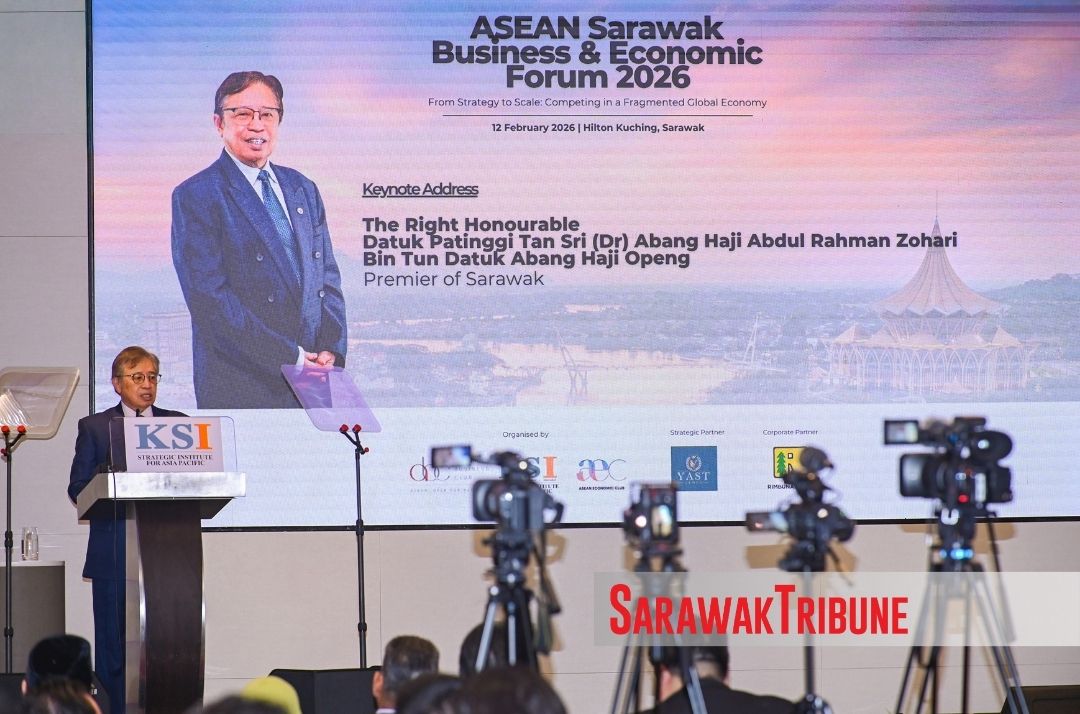
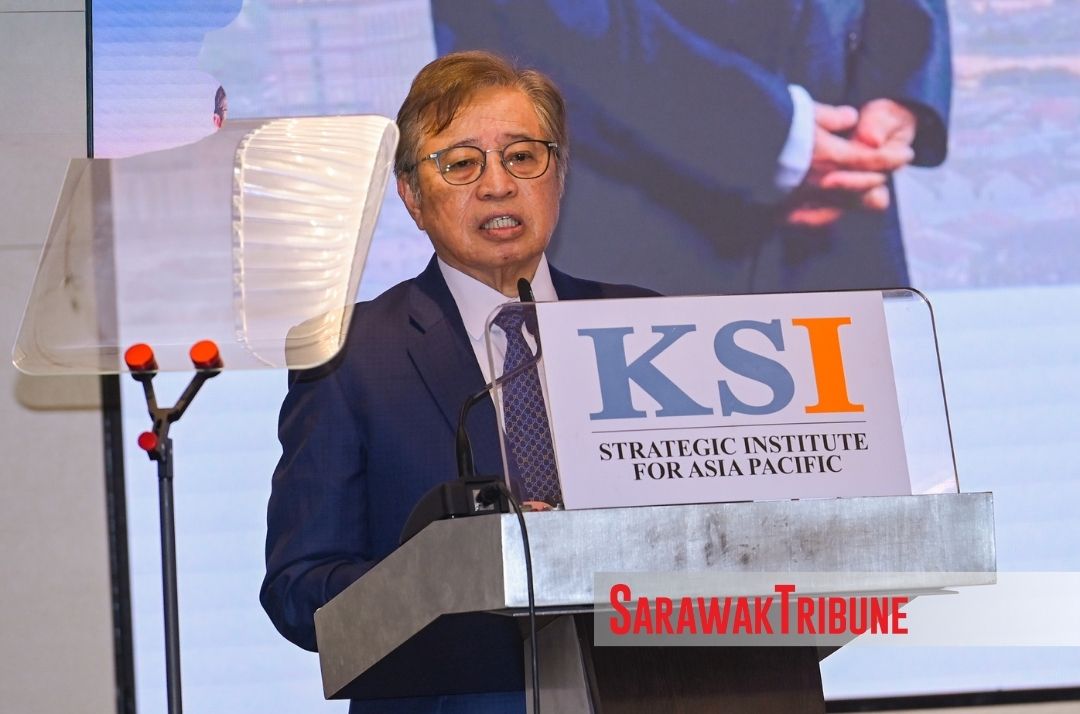
Premier Datuk Patinggi Tan Sri Abang Johari Tun Openg said Sarawak is already planning beyond its PCDS 2030 horizon and has identified four sectors for priority.
He said the first is the continuation of Sarawak’s renewable energy agenda, including hydro, cascading dams, biomass, solar and hydrogen, supported by methane gas supply.
“At the moment, we are building the capacity of two 500-megawatt gas turbines in Bintulu. That means an additional one gigawatt, and one more in Miri, also producing 500 megawatts. So by 2030, we will have a capacity of 10 gigawatts,” he added.
Abang Johari was speaking at the ASEAN Sarawak Business and Economic Forum 2026 held at Hilton Hotel here today.
“We are now supplying Kalimantan Barat already for the past four years. Two months ago, we started supplying power to Sabah, 100 megawatts, and at the end of the year we will be in Brunei,” he shared.
The second priority is semiconductors, anchored on chip design research, including a lab in Cardiff and work with United Kingdom’s Catapult Research Institute, with a focus on an AI-powered gallium nitride chip and intellectual property.
“We are concentrating on chip design, not on foundries, but on chip design,” Abang Johari stressed.
He said Sarawak wants to move from producing analogue to becoming a creator of chips.
“We want to be a creator rather than a user of chips.”
The fourth priority is aerospace, driven by the need for data storage beyond 2030, and argued that CubeSat offers a far cheaper alternative to conventional satellites.
One conventional satellite costs about €300 million to €500 million euros. But the new generation of satellites, CubeSat, cost roughly between €500,000 and €700,000.
Abang Johari said CubeSat would allow Sarawak to store and retrieve data through its own satellite, positioning it to compete beyond 2030.
“If we have our own satellite called CubeSat in low-Earth orbit, in other words, you are in the game,” he opined.