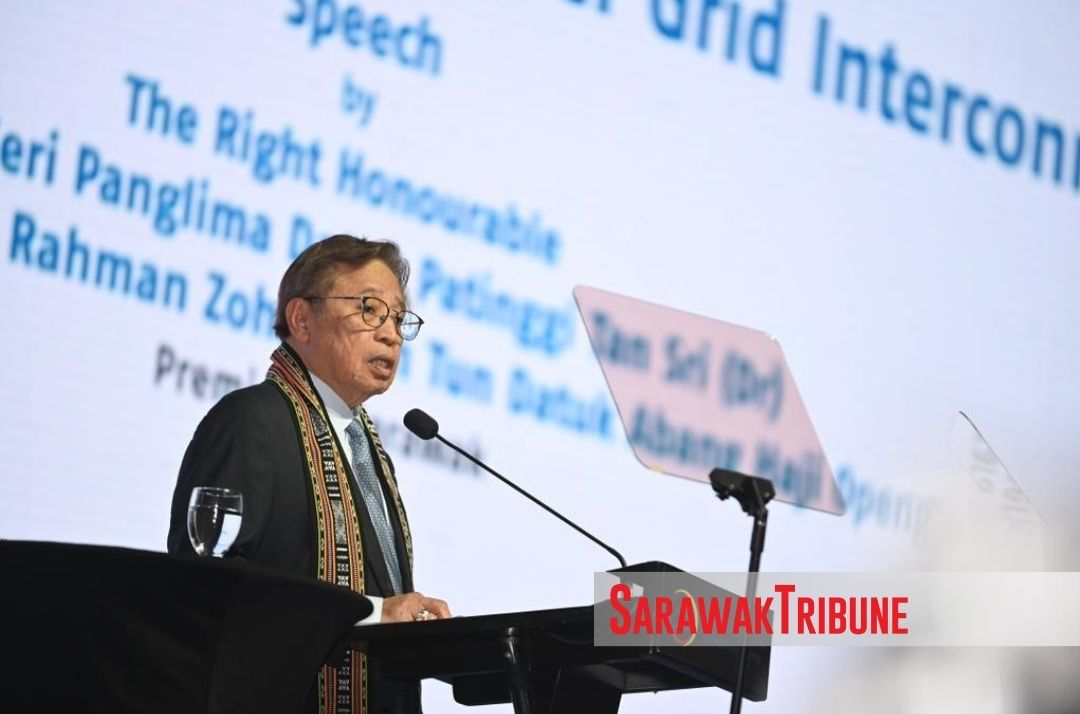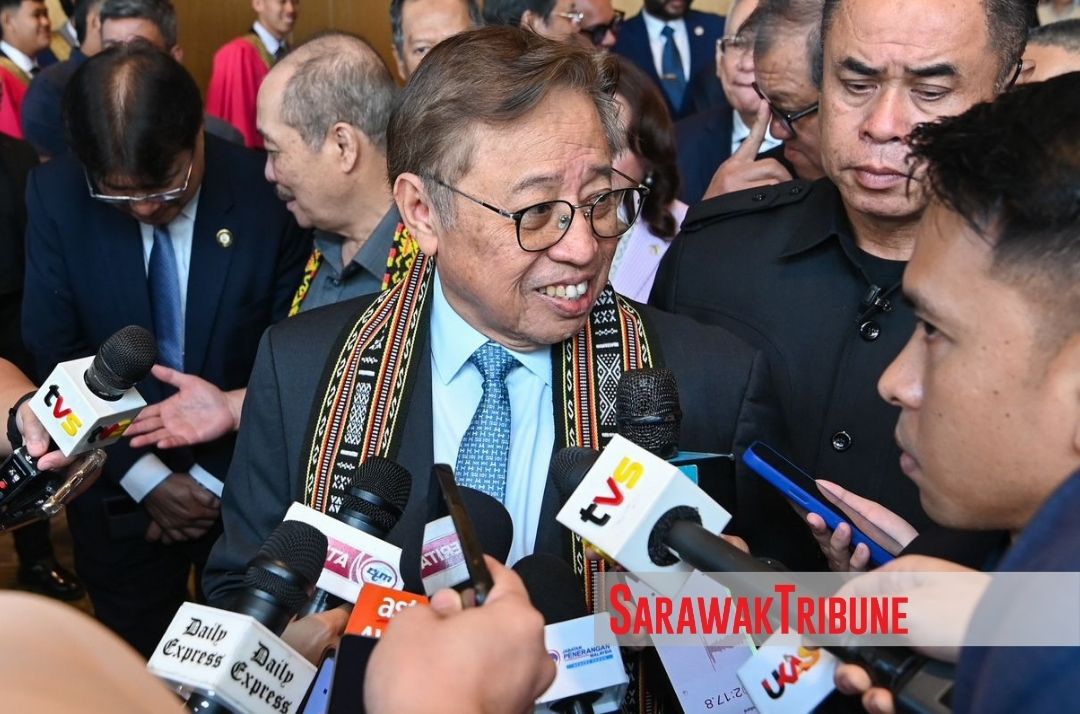
KOTA KINABALU: ASEAN should study the European Union’s power interconnection framework as a model to develop a regional electricity grid, said Premier Datuk Patinggi Tan Sri Abang Johari Tun Openg.
Abang Johari noted that the bloc currently lacks a formal multilateral framework for power collaboration.
He said the EU’s experience, including cross-border electricity supply among Nordic countries via undersea cables, offers valuable lessons that ASEAN can adapt rather than starting from scratch.
“I did suggest that they look at the European Union interconnection of power. We don’t have to reinvent; we can look at that collaboration in Europe as a model for ASEAN,” he told reporters after officiating the ‘Energisation of the Sarawak-Sabah Power Grid Interconnection Project’ held at the Sabah International Convention Centre here on Saturday (Jan 24).
He added that the approach would help address legislative and national considerations across member states.
Abang Johari said he shared Sarawak’s views where he highlighted the absence of a structured collaboration framework among ASEAN’s 11 member countries.
“At the moment, there isn’t any framework of collaboration among the 11 member countries. That is why ASEAN must have such a model,” he said.
He said Sarawak and Sabah’s electricity interconnection serves as an initial trigger towards building the Borneo Power Grid, which could later expand into a wider ASEAN Power Grid.
“Now Sarawak and Sabah already have this interconnection, which is something to start, to trigger off. We also already have an interconnection with Kalimantan,” he said.
Abang Johari said Sarawak has also agreed to supply electricity to Brunei, forming the core of the Borneo grid, while plans are in place to extend power connectivity from Sabah and Sarawak to the southern Philippines.
“In addition, we have agreed to supply power to Singapore. When you look at this together with power from Laos going through Terengganu towards Singapore, you can see the ASEAN Power Grid taking shape,” he said.
However, he stressed that most current arrangements are still bilateral, underscoring the need for a multilateral framework involving all ASEAN member countries.
“This is bilateral, not multilateral. You have to have a multilateral framework among the 11 member countries. At least we start with the Borneo grid,” he said.
On Sarawak’s energy capacity, Abang Johari said the state is fortunate to have abundant power resources, including renewable energy and low-carbon sources such as gas-based combined-cycle gas turbines.
He said Sarawak is developing a 500-megawatt power plant in Miri and a 1,000-megawatt facility in Bintulu.
“By 2030, our installed capacity will reach 10,000 megawatts, or 10 gigawatts, which can be the basis of power supply for us to share within Borneo,” he said.
KOTA KINABALU: Sarawak’s hydropower foundation will be further strengthened with an additional 1,285MW of hydropower capacity in Baleh Hydroelectric Plant (HEP) scheduled to come on stream by 2030.
Premier Datuk Patinggi Tan Sri Abang Johari Tun Openg said Sarawak today has 3,558MW of large-scale hydropower capacity in operation, forming the backbone of a stable, low-carbon electricity system.
“Sarawak is blessed with abundant, predominantly renewable energy resources, particularly hydropower.
“This foundation will be further strengthened with an additional 1,285 MW of hydropower capacity in Baleh, scheduled to come on stream by 2030, giving a total of 4,843 MW of hydropower when we include the present 3,558 MW by 2030,” he said in his speech during the official ceremony for the ‘Energisation of the Sarawak-Sabah Power Grid Interconnection Project’ held at the Sabah International Convention Centre here on Saturday (Jan 24).
Abang Johari said Sarawak is also exploring the development of cascading hydropower and floating solar installations on existing reservoirs to increase its total generating capacity to 10 gigawatts (GW) by 2030 and 15GW by 2035.
He noted that these initiatives are aimed at positioning Sarawak as a regional renewable energy powerhouse and the “battery of ASEAN”.
In this context, he said the Sarawak-Sabah Interconnection serves as a practical demonstration of how renewable energy resources can support the energy transition in real and tangible ways.
According to him, the interconnection enables greater operational flexibility between the two power systems, enhances overall system reliability and strengthens energy security.
“With this interconnection, electrons can now flow more efficiently across state boundaries, optimising the use of generation resources and ensuring supply is available where and when it is needed most,” he said.
Abang Johari said this level of energy resilience provides businesses with the confidence to invest, industries with the assurance to expand, and communities with the certainty of a reliable and secure electricity supply.
Importantly, he added, the strengthened energy resilience will enable shared growth, delivering long-term benefits for both Sarawak and Sabah while creating lasting value for the people of Borneo.