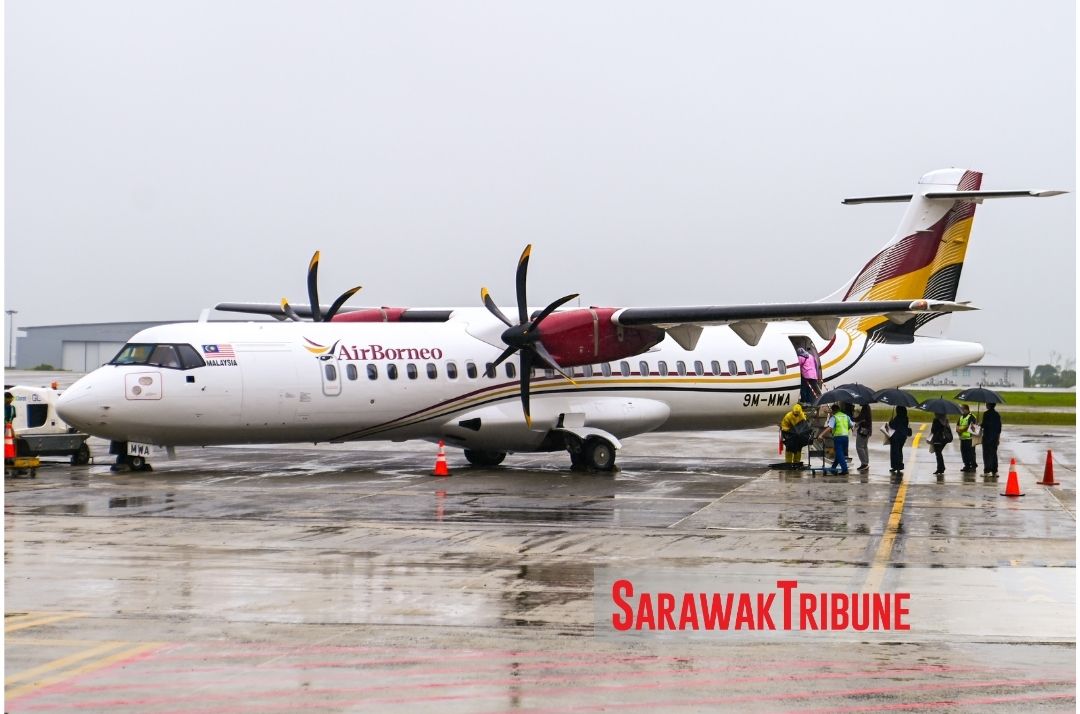
KUCHING: AirBorneo’s long-term case rests on how it handles a domestic oligopoly, and builds an overseas play in monopolistic competition, says a Universiti Malaysia Sarawak (UNIMAS) academician.
Senior lecturer Dzul Hadzwan Husaini said the proposal should be evaluated as an economic decision for Sarawak, rather than framed around ownership or fares.
“The proposal to establish AirBorneo should not be approached as a narrow discussion about airline ownership or ticket pricing, but as a broader economic decision that will shape Sarawak’s long-term development trajectory.
“In earlier public commentaries, I have consistently argued that air connectivity is a critical enabler of growth for Sarawak, particularly given its geographical separation from Peninsular Malaysia and its reliance on air transport for mobility, tourism and business linkages,” he told Sarawak Tribune.
He said the domestic market structure changes the risk profile for any new entrant.
“The domestic aviation market is best described as an oligopoly, dominated by a small number of powerful players, particularly AirAsia and Malaysia Airlines,” he stressed.
“This interdependence is the essence of oligopolistic competition and is central to game theory.”
He said the core danger lies in how incumbents respond when challenged.
“In an oligopoly, aggressive entry or expansion often triggers retaliatory behaviour that erodes profitability for all firms involved,” he added.
“The history of aviation is replete with examples of new entrants that failed not because demand was absent, but because strategic retaliation by incumbents made survival financially impossible.”
He said the domestic approach should be restraint, including a complementary role that limits exposure.
“Economic theory and industry experience both suggest that oligopolistic markets tend to stabilise through cooperation rather than confrontation,” he explained.
“Rather than positioning itself as a direct challenger to existing airlines, AirBorneo should seek a complementary role that supports connectivity objectives while minimising financial exposure.”
Dzul stressed that cooperation should be read within legal boundaries and commercial realities.
“This does not imply illegal collusion, but rather a recognition of mutual dependence and the avoidance of strategies that destroy value,” he added.
“Cooperation with established carriers, particularly in domestic operations, is not a sign of weakness but a rational response to oligopolistic realities.”
He said domestic operations should not be treated as the airline’s main income base.
“This is why I have consistently maintained that AirBorneo should not view the domestic market as its primary source of income,” he shared.
“Domestic connectivity should therefore be treated as a strategic and social function of the airline, while its commercial sustainability must be anchored elsewhere.”
Dzul warned that affordability and connectivity can backfire without proper design.
“However, I have also stressed that connectivity and affordability, while important, cannot be treated as ends in themselves,” he opined.
“Without careful economic design, an airline can easily become a recurring fiscal burden rather than a strategic asset for the state.”
He said Sarawak should treat aviation with the same discipline applied to large public investments.
“Megaprojects often promise transformative benefits but can impose long-term financial obligations if their economic logic is not rigorously assessed,” he warned.
“The industry is capital-intensive, highly sensitive to fuel prices, exchange rate movements, and external shocks and characterised by thin profit margins even for established global carriers.”
Dzul also emphasised that affordability should be used carefully to avoid long-term fiscal drag.
“Yet, if affordability becomes the dominant objective, the airline risks functioning primarily as a price-suppression mechanism. This approach may be politically attractive, but it is economically fragile,” he said further.
“Persistent losses would eventually require public subsidies, diverting scarce fiscal resources away from education, healthcare, or infrastructure investments that may offer higher social returns.”
He said overseas markets offer a different basis for competition.
“When AirBorneo operates abroad, it enters a setting closer to monopolistic competition, where many airlines coexist, but each differentiates itself through branding, service quality, route specialisation, and reputation,” Dzul explained.
“In such markets, success is not determined solely by cost leadership or scale, but by the ability to offer a distinct value proposition.”
He said Sarawak’s profile can be part of that positioning.
“International travellers are not choosing airlines purely on ticket prices; they respond to brand narratives, perceived reliability, and the broader travel experience,” he elaborated.
“By positioning itself as a gateway to Sarawak’s natural heritage, cultural diversity, and eco-tourism potential, AirBorneo can develop intangible assets that competitors cannot easily replicate.”
This, he added, requires long-term commitment to building demand.
“This is often where public enterprises falter, treating marketing as an expendable cost rather than a strategic investment,” he said.
“In reality, consistent and targeted international marketing is essential for establishing route viability and capturing higher-value demand.”
He said governance will decide whether the strategy holds under pressure.
“Strong governance, professional management, and insulation from short-term political pressures are crucial,” Dzul stressed.
“Decisions on routes, partnerships, and pricing must be guided by economic reasoning rather than populist considerations.”
He said the airline must be managed as a commercial entity with a strategic mandate.
“If AirBorneo is treated as a commercial entity with a strategic mandate, rather than as a political instrument, its chances of success improve substantially,” he opined.
“Ultimately, AirBorneo should be assessed not by the number of routes it operates or the short-term affordability of its tickets, but by whether it strengthens Sarawak’s economic resilience and generates sustainable returns over time.”