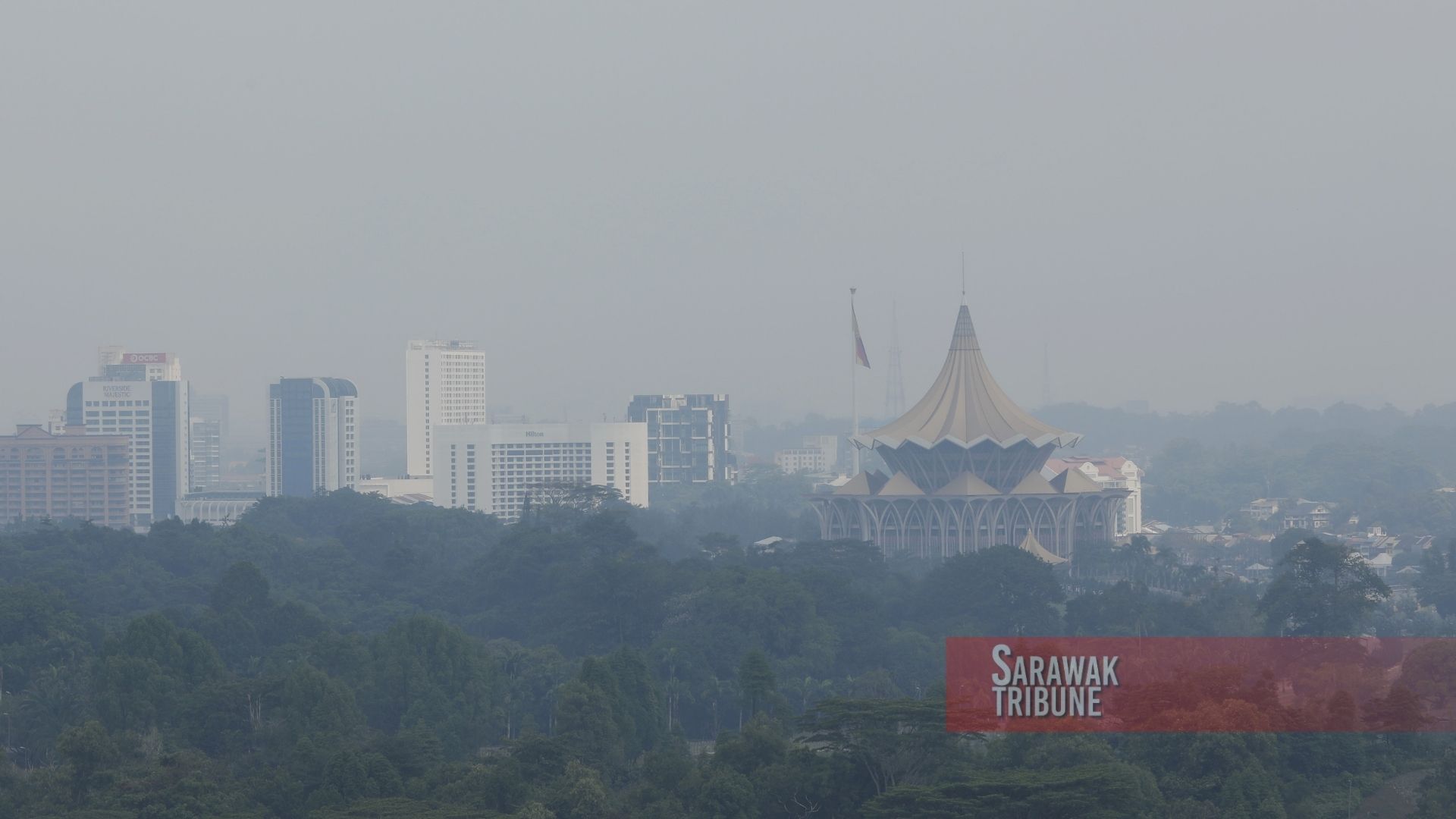
KUCHING: All nine areas nationwide that recorded unhealthy Air Pollutant Index (API) readings as of 11:00 am today (Aug 15) were located in Sarawak.
According to the Department of Environment (DOE), Kuching recorded the highest reading at 164, followed by Samarahan (161), the Serian district police headquarters (160), Bintulu and Sarikei (157 each), Sri Aman (153), Sibu (152), Mukah (151) and Samalaju (118).
Nationwide, 11 areas recorded good air quality, while another 48 registered moderate readings.
DOE Deputy Director-General (Development), Azuri Azizah Saedon, said the country’s air quality had deteriorated, with more areas in Sarawak recording unhealthy readings due to the movement of haze from various directions
.
Citing an August 14 report by the Singapore-based ASEAN Specialised Meteorological Centre (ASMC), she said satellite images detected 226 hotspots in Kalimantan and five in Sumatra.
Seven hotspots were also detected in Malaysia, comprising five in Sarawak and two in Sabah.
“Moderate to dense transboundary smoke plumes were observed coming from clusters of hotspots in West Kalimantan and moving northwards into western Sarawak,” she said in a statement today.
Azuri said moderate-to-dense localised smoke plumes were also detected from hotspots across much of Kalimantan, central Sarawak and central Sumatra.
She also said several air quality monitoring stations in West Kalimantan, as well as western and central Sarawak, recorded unhealthy readings.
“However, the full extent of the hotspot and haze situation could not be determined due to cloud cover,” she said.
Azuri said DOE had stepped up enforcement and daily patrols in areas at risk of open burning, while continuing to monitor API readings from time to time.
She also said the National Open Burning Action Plan and National Haze Action Plan have also been activated to coordinate the response of government agencies in tackling open burning and the haze.
Under the National Haze Action Plan, the National Disaster Management Agency (NADMA) will activate disaster management committees at the district, state and federal levels if the API exceeds 150 for more than 24 hours.
At the same time, Azuri said all activities outside classrooms must be stopped when the API exceeds 100.
“Schools, kindergartens and childcare centres must be closed immediately when the API exceeds 200. School administrators are also required to closely monitor API readings and prepare for possible closure if the readings continue to rise towards 200,” she said.
Cloud-seeding operations may be carried out when the API remains above 150 for more than 24 hours, subject to suitable cloud and weather conditions.
DOE also advised landowners to closely monitor fire-prone areas, including landfills, forests, peatlands, plantations, agricultural land and industrial sites.
Members of the public were reminded not to carry out open burning or allow irresponsible parties to enter their land or premises and start fires.
Under the Environmental Quality (Amendment) Act 2024, those convicted of open burning face a minimum fine of RM25,000 and a maximum fine of RM1 million, imprisonment of up to five years, or both.
A compound of up to 50 per cent of the maximum fine may also be imposed for each offence.
The public can report open burning or fire incidents to the Fire and Rescue Department through 999 or DOE’s toll-free hotline at 1-800-88-2727.