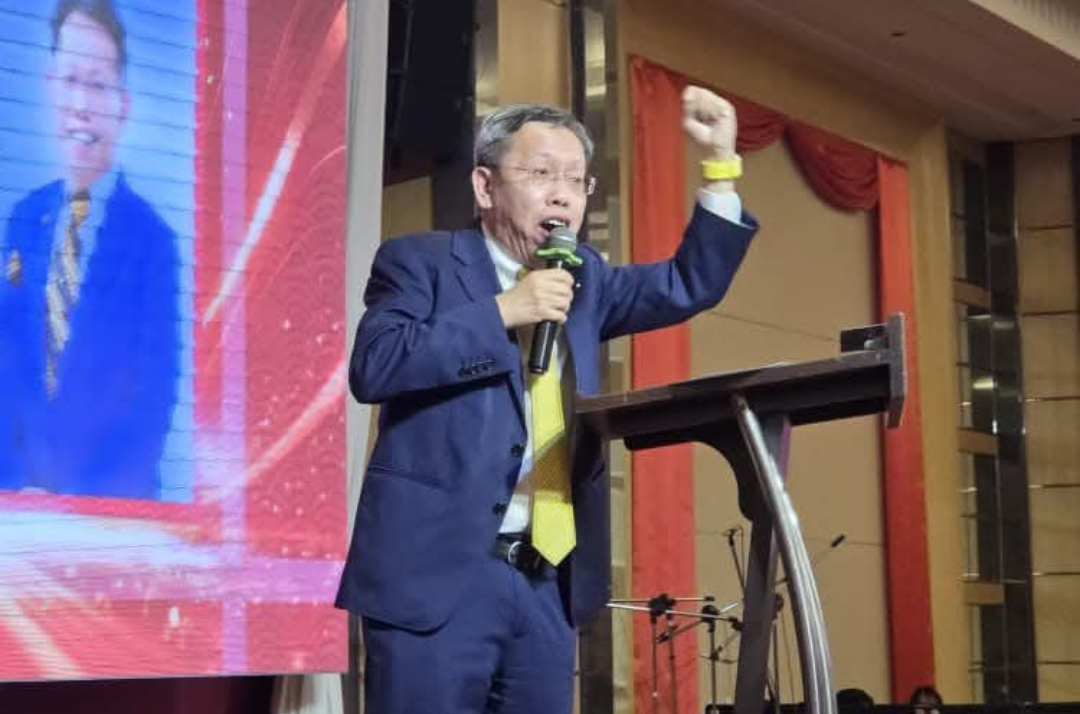
MIRI: The Sarawak government has once again called for greater Chinese participation in the state’s public service, framing it as a strategic imperative for Sarawak’s long term governance and development.
Delivering the Premier’s message at the Federation of Chinese Associations of Miri Division Chinese New Year dinner, Deputy Premier Datuk Amar Prof Dr Sim Kui Hian said the civil service must reflect the full diversity of Sarawak’s society if it is to remain effective, credible and future ready.
Speaking on behalf of Datuk Patinggi Tan Sri Abang Johari Tun Openg on Thursday night (Feb 26), he described Chinese community participation, particularly among graduates and young professionals, as essential to strengthening policy delivery and institutional leadership across the state.
“Your government should reflect the diversity of our people, and we need your talents to make that a reality,” the Premier said in his speech, inviting students and professionals from all disciplines to consider careers in the Sarawak civil service.
The message was unambiguous. Public service, he said, was not merely about filling vacancies but about shaping Sarawak’s next chapter.
Contributions in administration, engineering, healthcare, education and other sectors would form part of a broader state building effort that extended beyond individual ambition.
The Premier’s remarks carried added weight given Dr Sim’s own professional trajectory. Returning to Malaysia after 17 years in Australia, the latter chose public service over a potentially lucrative private sector career.
That decision, Dr Sim said, enabled him to mentor young professionals, build institutions and contribute directly to Sarawak’s healthcare transformation.
As a result, he became the first Malaysian to serve as president of the Asian Pacific Society of Cardiology in its 70 year history and the inaugural governor for the American College of Cardiology in the Asia Pacific region.
Under his leadership, the Sarawak Heart Centre rose into the top tier of heart centres in the Asia Pacific, while Sarawak General Hospital emerged as one of Malaysia’s leading clinical research centres, with ambitions to extend its reach regionally following the completion of the Sarawak Cancer Centre.
“If I had stayed in Australia, becoming a millionaire would not have been an issue. But I would not have been able to serve in these roles or contribute meaningfully to Sarawak’s development,” he said.
Beyond public service recruitment, the Premier also used the occasion to reaffirm Sarawak’s multicultural identity, pointing to the dinner itself as a reflection of the state’s social fabric.
“What makes tonight special is not just the food or the performances,” he said. “It is who is sitting at the table.”
He described Sarawak as a society where ethnicities, faiths and backgrounds continue to coexist in mutual respect, standing in contrast to a world increasingly marked by division. That cohesion, he said, is both Sarawak’s defining strength and its competitive advantage.
The Chinese community, he added, has been integral to Sarawak’s development journey from early commerce and pioneering days to contemporary leadership in business, education, technology and the professions.
“Your hard work, resilience and entrepreneurial spirit have helped shape our economy and enrich our society,” the Premier said.
Among those present were Datuk Sri Lee Kim Shin, Sarawak Minister for Transport; Datuk Sebastian Ting, Deputy Minister for Tourism, Creative Industry and Performing Arts; Datuk Gerawat Gala, Deputy Minister in the Premier’s Department with responsibility for Labour, Immigration and Project Monitoring; Chiew Choon Man, Deputy Minister for Tourism, Arts and Culture Malaysia; Adam Yii, Mayor of Miri City Council; Hajiawati Tambi, director of the Sarawak branch of the Registrar of Societies Malaysia and James Hii Sing Lung, president of Federation of Chinese Associations Miri Division Sarawak.