KUCHING: A proposed Coffee Campus in Bayur, near hear, is set to become a game-changer for Sarawak’s growing coffee industry, aiming to transform Mambong in particular into a centre of excellence for coffee research, training, and agro-tourism.

The ambitious project, proposed by Deputy Transport Minister, Datuk Dr Jerip Susil, through the Greater Kuching Coordinated Development Agency (GKCDA) will serve as a central hub for coffee cultivation, processing, training, and marketing.
The Mambong state assemblyman said the proposed campus will house a coffee research and innovation centre, nursery, processing and roasting facilities, training classrooms, and coffee estate.
“We also hope to have the coffee café where people come to drink the coffee, taste or try the coffee, and buy the coffee products. The campus will also have the viewing point for people to see the coffee estate.
“The estate will be run by international people at the standard which is equivalent to that of the ones in Venezuela and other countries that plant coffee on large scale, like in Brazil,” he said.
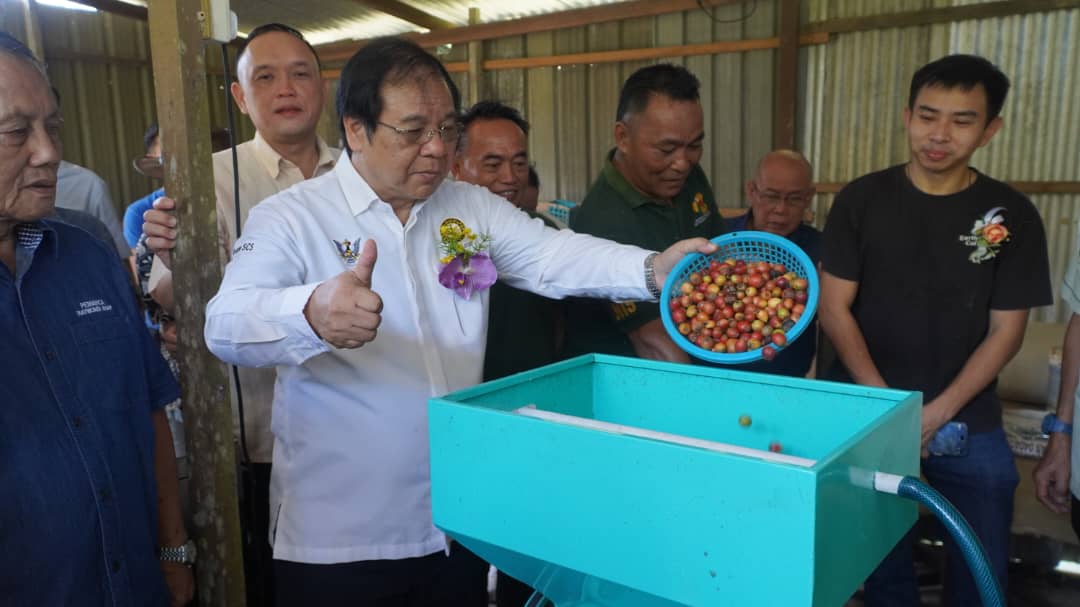
Dr Jerip said this to reporters after launching Persatuan Penanam Kopi Padawan Kuching (Perkop) and Perkop mini collection centre at Kampung Git, Jalan Puncak Borneo, here today.
He said quality standard would be set up while a fair trade would be assured at the campus.
“Fair trade, meaning the people who are involved in the planting will also be taken care of. No one will be exploited so that in this fair trade, the coffee price is premium in the world market.
“So, it is very important that whoever is running the campus and the estate, or planting them on cluster farms in the villages or wherever, all these things are done at the criteria set by the world’s fair trade.
“With all that being set and put in price, the coffee will be at the premium price,” he said.
Dr Jerip said a foreign company, which is one of the biggest coffee roasters in Belgium, is expected to manage the campus as well as the estate in Bayur.
He said the company will buy the coffee beans, look into the quality, and then pack it and sell it overseas.
He assured that the company that managed the campus and the estate will also buy the coffee beans from other local farmers from within and outside Mambong.
He said Sarawak now is concentrating on Liberica first because although Liberaca is found in other parts of the world, Sarawak is the one that promotes Liberica.
He believed Liberica is a special coffee, saying if blended with Robusta and Arabica, the mixture will produce a different aroma.
“At the moment, the world market is on Robusta and Arabica. So Liberica is an additional coffee which will help to create the aroma of the coffee.
“We are going to promote Liberica because it is found most extensively in Sarawak. With that, we will look into how we can promote Liberica coffee,” he said.
Dr Jerip said the proposed campus project, which has been approved by GKCDA, is going to be located on a 20-acre land in Bayur.
He said the state Public Work Department (JKR) is putting up a tender now, and he hoped it will be tendered out at end of this year so that by the next year, the coffee campus project can be started.
“The whole coffee campus is going to cost about RM20 million, mainly to build the necessary infrastructure and facilities,” he said.
Dr Jerip said for the moment the total estate in Mambong is about 600 hectares, including the planting areas in Kampung Bayur and Kampung Jambu.
He said the estate in the two villages was formerly used to plant cocoa before it was replaced with coffee, as the cocoa project was not fruitful.
Earlier in his speech, Dr Jerip said the proposed Coffee Campus in Bayur is not just about planting coffee, its about creating an ecosystem that supports farmers, promotes quality, and builds Sarawaks brand in the global coffee market.
He believed local farmers are expected to benefit from hands-on training in modern coffee cultivation techniques, post-harvest processing, and marketing.