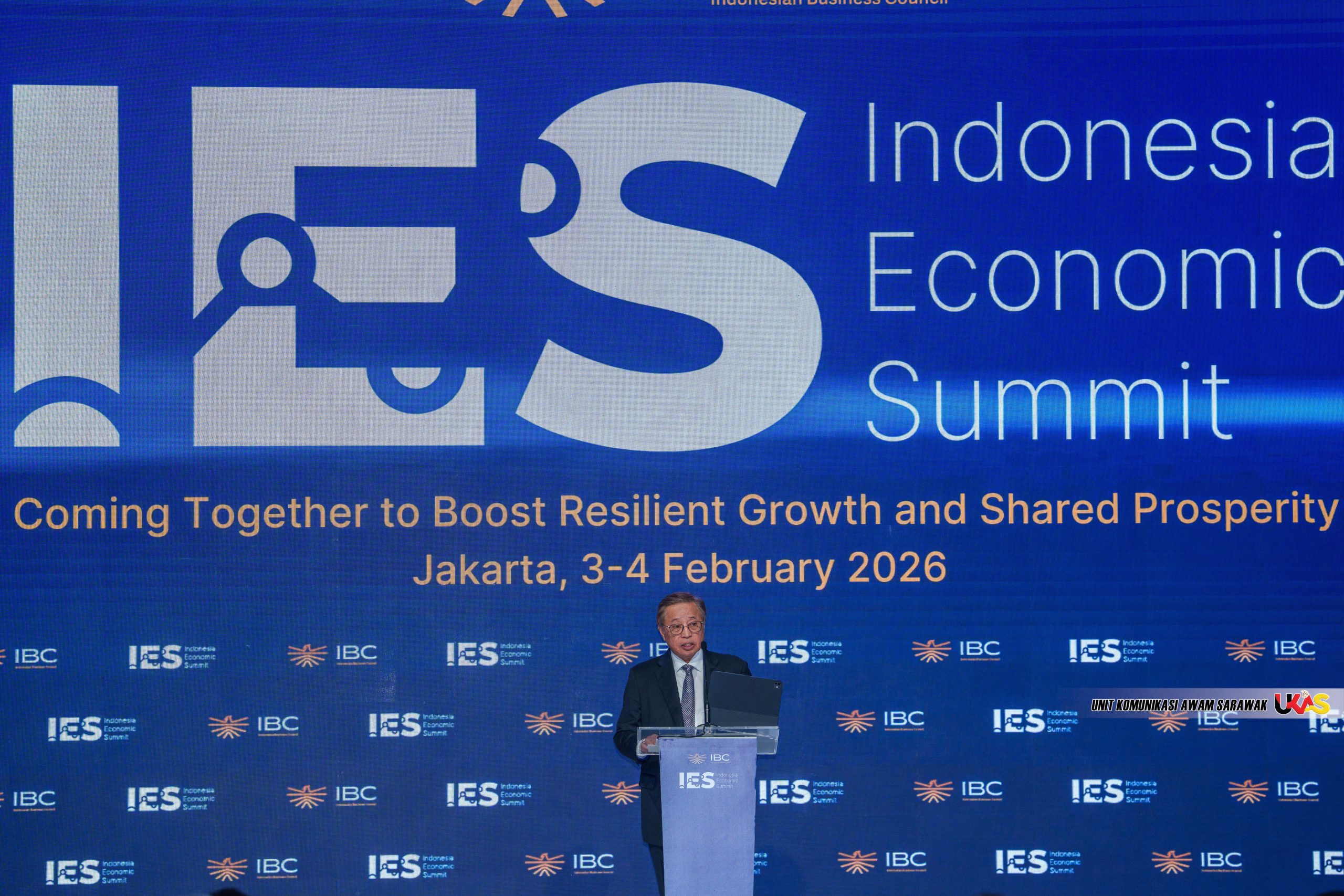
JAKARTA: The revival of the Borneo Economic Community (BEC) has taken on renewed relevance amid today’s challenging global economic environment, said Premier Datuk Patinggi Tan Sri Abang Johari Tun Openg.
Commending the Indonesian Business Council’s (IBC) initiative to revive the BEC, he said its presence brings the Borneo family together and reaffirms a collective destiny and deep sense of regional kinship.
“In today’s global economic climate, more is being asked of us as nations and as regions. Rising protectionism and shifting supply chains remind us that resilience depends on adaptability,” he said in his keynote address in conjunction with the Indonesia Economic Summit (IES) 2026 themed “Ideas from Borneo: Investing in the Next Engine of Growth” here Tuesday (Feb 3).
Abang Johari said IES 2026 presents a rare opportunity to discuss solutions and a way forward, as well as to present opportunities for partnerships, collaboration and investments, all of which are necessary for the development of the region and the improvement of standards of living.
He said regional business bodies and associations, including the IBC and others, must not stand still, but must have the courage to forge new partnerships and the foresight to deepen existing ones.
“That is why regional business communities must deepen economic linkages, widen trade and enhance competitiveness,” he said.
At a time of growing global competition and economic uncertainty, Abang Johari said this spirit of regional cooperation matters more than ever, as global crosswinds test not only domestic economies but also the collective resolve to remain open and connected as trading partners, particularly within ASEAN.
“We must move forward with confidence, seize opportunities amid uncertainty, and translate intent into tangible outcomes,” he said.
He noted that ASEAN is home to over 670 million people and generates a combined gross domestic product (GDP) of USD3.8 trillion, making it the world’s fifth-largest economy in 2023, and is now at the transition point of a major industrial transformation.
“To sustain its growth trajectory and global competitiveness, ASEAN must evolve towards a more diversified, high-value and low-carbon industrial model,” he said.
On Borneo, Abang Johari said the island is home to over 20 million people across the world’s third-largest island, comprising Sarawak and Sabah, parts of Indonesia and Brunei Darussalam, and is rich in cultures and natural resources.
He added that situated close to 60 per cent of the world’s population, including China and India, Sarawak accounts for about 17 per cent of Borneo’s land mass and sits at the crossroads of the Indian and Pacific Oceans.