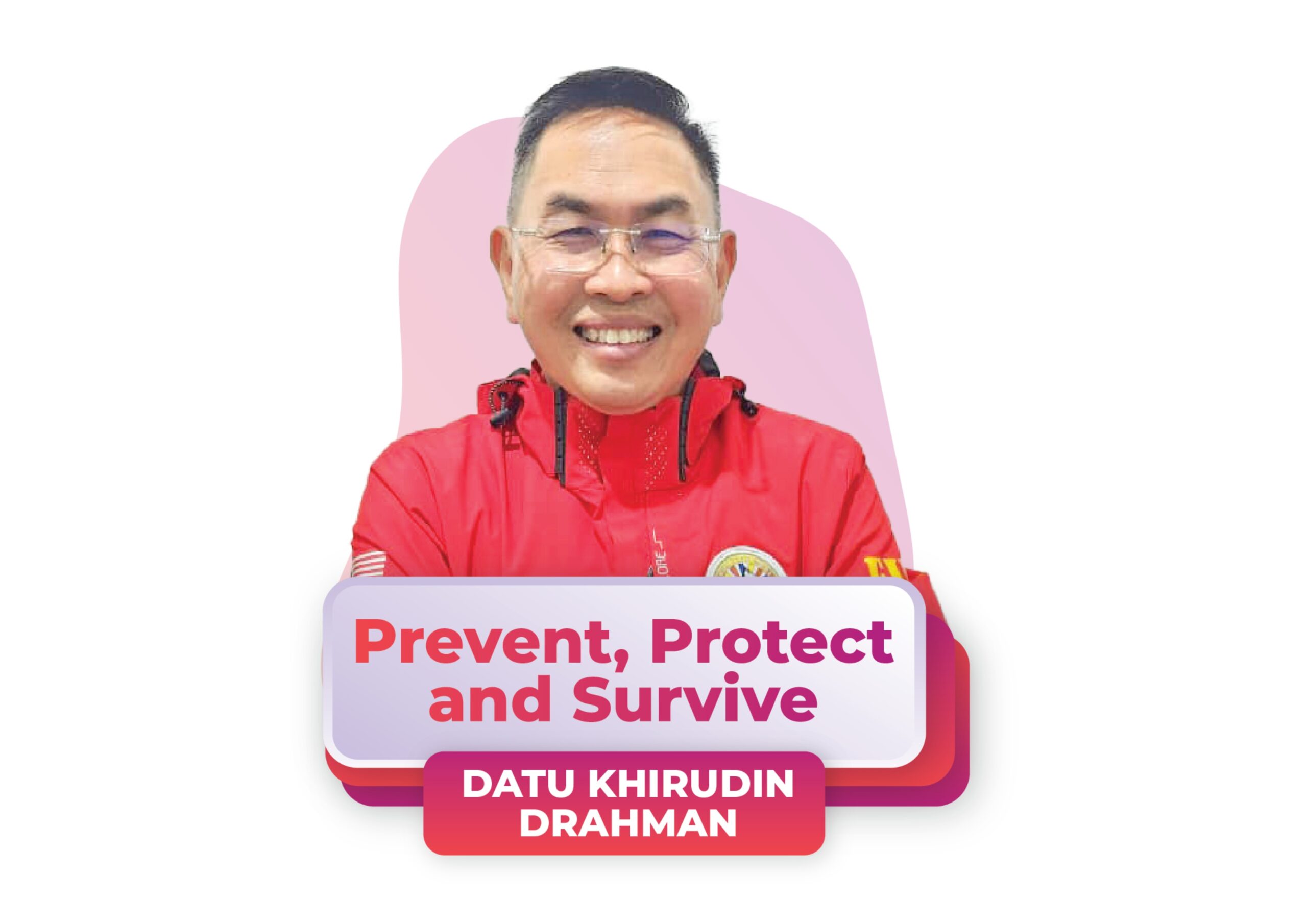
WHEN people speak about fire safety and fire engineering, many are often confused about what the subject truly encompasses.
Some associate fire safety purely with fire extinguishers and emergency exits, while others view it solely from an enforcement perspective. In reality, fire safety is far broader and more comprehensive than many realise.
It covers the entire spectrum of fire safety management – from the responsibilities of authorities and regulators to the roles played by designers, builders, inspectors and occupiers.
This week, I wish to discuss the concept of ‘Total Fire Safety’, an approach that requires the collective commitment of all stakeholders to ensure buildings, workplaces and communities remain safe.
At the core of this approach are five critical pillars – Authorities, Designers, Builders, Inspectors and Occupiers.
Each pillar carries an equally important responsibility.
Authorities establish and enforce laws, regulations and standards. Designers ensure that fire safety considerations are integrated into buildings from the earliest planning stages. Builders must construct in accordance with approved specifications and standards. Inspectors verify compliance and identify weaknesses. Occupiers, meanwhile, play a vital role in maintaining safety awareness and responding appropriately during emergencies.
Fire safety cannot succeed if any one component fails.
The entire system of ‘Total Fire Safety’ is built upon a hierarchy in which Acts and Ordinances provide the legal mandate, regulations and standards detail the requirements, and best practice and technical literature guide implementation.
In Malaysia, fire safety design and compliance are guided by several recognised frameworks accepted by the Fire and Rescue Department Malaysia (JBPM).
The first is the Prescriptive Method, which includes the Uniform Building By-Laws (UBBL) 1984 (Amended 2021), Malaysian Standards and internationally recognised standards.
The second is the Performance-Based Approach (PBA), which involves fire safety engineering design and focuses on achieving specific safety objectives rather than simply following fixed prescriptions.
The third is the Risk-Based Verification Method, whereby fire safety strategies are evaluated through risk assessments tailored to a building’s specific hazards and characteristics.
In simple terms, prescriptive methods tell you what to build, while performance-based approaches focus on the outcomes that must be achieved.
Today, modern buildings often require a hybrid approach.
Standard components such as office wings and common exits may comply through prescriptive requirements, while complex elements such as large atriums, unconventional layouts or extended travel distances may require performance-based justification.
This flexibility allows innovation without compromising safety.
The fire safety engineering approach currently used by authorities, designers and builders is largely guided by BS 7974:2019, which provides a structured framework for fire safety engineering in buildings.
The process generally involves three major stages – Qualitative Design Review (QDR), Quantitative Analysis (QA) and Assessment Against Criteria.
In Malaysia, fire safety engineers, designers and inspectors also refer to standards such as MS 1183:2015 on Fire Safety in the Design, Management and Use of Buildings, as well as MS 2780:2023, which focuses on the application of fire safety engineering principles in building design.
These frameworks enable designers and inspectors to evaluate proposed building plans systematically and anticipate potential risks even before construction begins.
In many ways, we fight the fire before it starts.
Fire safety engineering has evolved tremendously through research on passive fire protection, human behaviour during emergencies, smoke characteristics and fire dynamics.
Passive fire protection includes fire and smoke barriers, compartmentation, structural stability, smoke management systems and escape facilities such as emergency exits and fire lifts.
Beyond physical systems, modern fire engineering also examines human response during emergencies, environmental influences, firefighting accessibility and risk management strategies.
A comprehensive fire safety design requires an understanding of building characteristics, occupancy behaviour, fire hazards, possible consequences and emergency response mechanisms.
This is why fire safety engineering is especially important for large, complex and high-risk buildings.
In some cases, a fire safety engineering approach tailored specifically to a building’s risk profile can provide a more economical and effective solution than relying solely on conventional design codes.
The newly introduced MS 2780:2023 further strengthens this discipline by providing designers with a more structured approach to fire safety design.
Among its benefits are the ability to compare safety levels for alternative designs, select appropriate fire protection systems, encourage innovative solutions and support the management and operation of buildings throughout their lifecycle.
Importantly, the Fire Services Act 341 (Amendment 2025) also empowers the Fire and Rescue Department to regulate fire engineers as competent persons within the field of fire engineering.
At the heart of all these systems lies one simple truth — the safety of building occupants depends heavily on design, construction, use and continuous safety management.
Fire safety regulations must therefore be enforced rigorously, particularly among industry players, to ensure that buildings meet minimum safety standards.
However, ensuring fire safety is not merely about fulfilling legal obligations.
It is about protecting lives, property, the environment and business continuity.
A key aspect of fire management is ensuring that people know how to respond appropriately during emergencies.
The reality is that fire prevention is always a choice.
The best path forward is to prioritise precaution, prevention and protection.
As Sarawak continues to modernise and develop increasingly complex infrastructure, public understanding of fire safety principles must also improve.
At the very least, every Sarawakian should possess a basic understanding of fire prevention and emergency preparedness.
We must remain vigilant and proactive.
Fire safety is a commitment, not an option.
Let us all play our role responsibly and strive to become champions of ‘Total Fire Safety’ within our homes, workplaces and communities.
The views expressed here are those of the writer and do not necessarily represent the views of Sarawak Tribune. The writer can be reached at khirudindrahman@sslborneo.com.my.