Charting its course toward an AI-driven future, the Sarawak government, under the premiership of Datuk Patinggi Tan Sri Abang Johari Tun Openg, aims to build sustainable data centres, digital infrastructure, and human capital to drive innovation and position the state as a regional technology hub.
Empowering AI Growth
As the world races toward AI-powered innovation, the foundation for every intelligent system lies in its data infrastructure. Sarawak’s vision to become a leading digital and green economy depends on the strategic build-out of sustainable data centres, high-performance computing (HPC) capacity, and advanced connectivity that can power AI applications across sectors — from energy and agriculture to smart cities and public services.
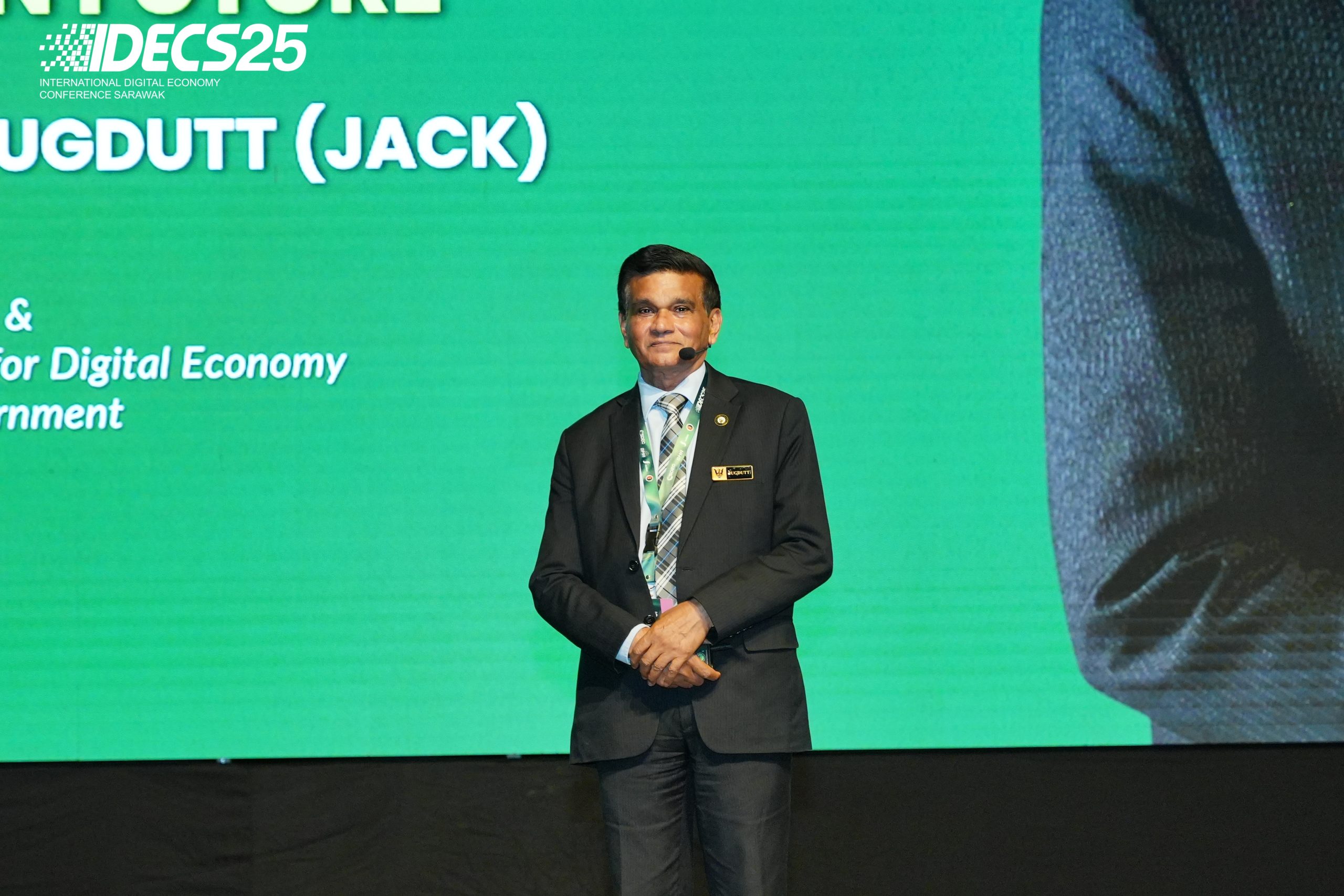
At the recent International Digital Economy Conference Sarawak (IDECS) 2025, chief scientist and chief advisor for the digital economy of the Sarawak government, Professor Jack Singh, highlighted Sarawak’s roadmap for building the next-generation digital backbone — combining renewable energy, world-class connectivity, and AI-ready data ecosystems in his talk.
The session explored how Sarawak’s natural advantages in green energy and policy commitment can attract global data and AI investments, positioning the state as a regional AI infrastructure hub for Borneo and beyond.
Walking towards digitalisation
As the Chief Scientist and Chief Advisor for Sarawak’s Digital Economy, Jack shared a brief outline of Sarawak’s digital roadmap, which moves away from a non-renewable resource-based economy toward a technology-driven knowledge economy.
In accordance with Premier Datuk Patinggi Tan Sri Abang Johari Tun Openg’s Post COVID-19 Development Strategy (PCDS) 2030 blueprint, the digital roadmap focuses on the digital economy, green economy, and circular economy.
“In this particular blueprint, we have five pillars to lead Sarawak’s digital economy and society by 2030,” said Jack. Among the strategic goals of the PCDS 2030 blueprint are:
- Accelerate the digitalisation of economic sectors
- Strengthen economic competitiveness
- Accelerate digital transformation of the public sector
- Create high- and semi-skilled jobs
- Foster high per-capita income & inclusive digital society
- Grow a vibrant tech sector
- Develop a new generation of digital industries
Two of the five pillars focus on “frontier technologies adoption” and “foundation for digital economy”, both of which Jack is working on. But in terms of AI and digital readiness, how prepared are we?
The speaker stressed the importance of ensuring outcome delivery when looking at digital infrastructure and connectivity within Sarawak and across the globe. According to Jack, key areas to address include:
- Digital infrastructure
- Technology adoption
- Human capital and inclusivity
- Ease of doing business
- Investment
- Innovation & start-up ecosystem
- Data
- Cybersecurity
- Basic needs
Accelerating AI in Sarawak
During the talk, he mentioned that AI technology is transformative.
“If you go back 50 years, when the internet technology was introduced, it slowly changed the entire ecosystem and the way we do business. With AI, it’s even more transformative because this technology can reason like a human, and that’s the danger if we are not able to control it.”
To accelerate AI in Sarawak, a strong ecosystem is needed. One of the most important infrastructure components is AI data centres, which serve as the body of the AI. Another essential component is data, added Jack. With data, an AI can learn the right information, increasing its efficiency and performance.
Meanwhile, the third component essential to complete the ecosystem is the brain of an AI — the software, such as learning tools like large language models (LLM).
“So the ecosystem basically includes infrastructure, data, models, software, applications, and finally, the humans required to deliver them effectively.”
Analysing the challenges
However, the road to a digital economy with AI isn’t without challenges. Jack revealed that AI data centres consume gigawatts of power, unlike normal data centres, which consume megawatts.
“And when we train our LLM, there will be a spike in energy demand that causes issues on the grid. So we have to make sure that we can manage the grid effectively when operating AI data centres. Therefore, the cost of having these data centres is high,” he said.
According to the professor, gigawatts of power also require a robust cooling system.
“Because they generate a lot of heat, they have to be cooled. We can’t rely on refrigerated cooling systems; we have to use water. A 100-megawatt data centre will require two million litres per day of cooling.”
Another issue arises: “We have to look at a more circular economy, making sure we can manage this. E-waste is another big concern in these data centres. What happens to this e-waste after we’re done? It has to be recycled.”
“Hardware is difficult to change as processing takes place in parallel. But software can be upgraded. However, hardware limitations can cause lag in software performance.”
Greener digital economy
Nevertheless, the Sarawak government is tackling the problem step by step. Jack revealed that to address the challenges, they are moving forward with the IEA factory, essentially a factory that is part of the clean technology manufacturing sector.
“You start from the ingestion all the way to training reference as well. So you’re processing incoming data and getting the response you want. All the factory training models are included. This is the model being used now, rather than data centres looking at the factory.
“So it’s end-to-end. Some of the components of the factory include a data pipeline, AI training, AI inference, and automation tools.
“And looking at the stack, that’s infrastructure, digital twins, network connectivity, and security and management. So this makes up the whole factory. This is the model we are moving toward in the data centres,” said Jack.
He added that though the IEA data centres require significant energy and water for cooling, they are equipped with an Environmental, Social, and Governance (ESG) framework.
“We consider environmental impact, reducing energy requirements, social impact, noise, heat, electricity, and governance.”
Transitioning into the digital world
As he concluded his talk, Jack disclosed Sarawak’s hyperscale data centre project, with the first phase starting in Samalaju. Comprising 38,000 servers, connectivity is crucial; Jack revealed that a number of underwater cables will connect Sarawak to the world.
This, he said, will support research, training, and skills development, thus creating high-skilled jobs in the region.
“We don’t want to put in data centres just for the sake of it, because they consume a lot of power. Value creation is very important. There is local data monetisation to take place. You can foster high-tech innovation and startups.”
As Sarawak marches toward its PCDS 2030 vision, it’s clear that the journey toward an AI-powered economy isn’t just about technology — it’s about building a sustainable, intelligent ecosystem from the ground up. Jack’s insights reveal that the state’s strategy lies not only in creating digital infrastructure but also in aligning it with renewable energy, human capital, and responsible governance.
From hyperscale data centres in Samalaju to AI “factories” equipped with ESG principles, Sarawak is not chasing digitalisation for the sake of modernity — it’s reimagining progress through balance: between growth and sustainability, automation and human value, innovation and accountability.
If successful, Sarawak could well transform from a resource-based economy into a regional powerhouse of digital intelligence — one that not only powers AI but does so the Sarawak way: responsibly, sustainably, and with foresight for generations to come.