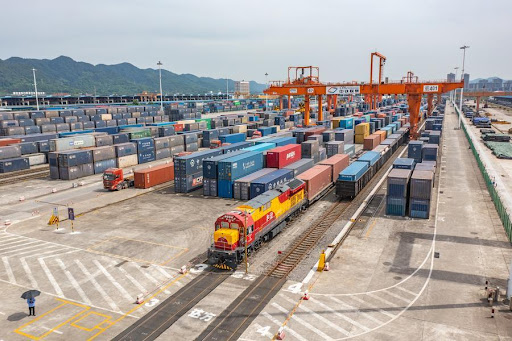
KUCHING: The China-Europe freight trains have brought booming business to the furniture industry in China’s Nangkang district, Ganzhou City in Jiangxi Province, which has an output value of 280 billion yuan (about RM163.8 billion) as the new freight transportation has greatly benefitted furniture manufacturers to “buy globally and sell globally”.
The Ganzhou International Land Port Station accepts China-Europe freight trains with European spruce and fir, Nangkang is neither along the border nor by the sea. In the past, it took three months to transport timber from Russia at a cost as high as RMB4,000 per cubic metre (cu m)
“Today, relying on the China-Europe train, the timber import time has been shortened to 14 days (saving 25 days compared with traditional sea freight) and reducing comprehensive logistics costs by 18 per cent. When the wood arrives in Nangkang, the journey of intelligent manufacturing begins,” according to a senior official of the Nanchang Railway Logistics Centre of the Nanchang Bureau of the State Railway as reported by International Tropical Timber Organisation (ITTO) Tropical Timber Market Report (July 16-31, 2025).
In the Smart Home Industrial Park of Sainteburg in Nangkang district, every intelligent production line runs at high speed, the huge robotic arm cuts, edges and punches the wooden boards, and the logistics trolley automatically shuttles through the three-dimensional warehouse and processing area. The entire production process is orderly and in one go.
“Our whole-house customised intelligent production line can efficiently and quickly meet the personalised needs of consumers, and fully realise personalised customisation, and intelligent management,” said Song Maiwen, general manager of Jiangxi Sainteburg Manufacturing Co Ltd. He said with the help of intelligent production lines, his company can complete an order worth 500,000 yuan in three days.
“Relying on the China-Europe freight trains, a furniture industry with an output value of over RMB280 billion in Nangkang is booming.
“And replying on the ‘port + bonded + cross border linkage model’ of Ganzhou International Land Port, Nangkang furniture has appeared in international markets. It has been exported to countries in Europe, America, Southeast Asia, Central Asia and the Middle East with overseas orders signed exceeding RMB5 billion in 2024,” said the official.
Nangkang has successfully established a complete industrial supply chain integrating wood trading, design and research development, intelligent manufacturing and logistics distribution. There are over 10,000 furniture enterprises and more than 500,000 employees in Nangkang.
In 2024, the Ganzhou International Land Port had operated over 1,600 China-Europe (Asia) freight trains covering more than 100 cities in five Central Asian countries and over 20 European countries.
Meanwhile, in the first half of 2025 (1H2025), China’s plywood industry has recorded a decline in the number of enterprises but there has been an increase in the total production capacity, according to the Industrial Development Planning Institute of the National Forestry and Grassland Administration.
By the end of June 2025, there were about 5,200 plywood product manufacturing enterprises in China, distributed across 26 provinces, down by some 800 from December 2024. But the total production capacity jumped by 12 per cent to 248 million cu m a year during the same period.
On fibreboard industry in China, the number of enterprises and total production capacity continued on a downtrend.
In 1H2025, three fibreboard production lines, including one continuous flat press line, was completed and put into operation, adding production capacity of 520,000 cu m per year. By June this year, 228 fibreboard manufacturing enterprises in China operated 252 production lines across 21 provinces, with a total annual production capacity of 40.64 million cu m. The net reduction in fibreboard production capacity was 1.19 million cu m, down three per cent from end-2024.
Of the factories, there were 122 continuous flat pressure lines with a combined production capacity of 27.42 million cu m per year.
“The fibreboard industry showed a further downward trend in the number of enterprises, production lines and total production capacity. There are five fibreboard production lines under construction across the country with a combined annual production capacity of 1.18 million cu m,” said the ITTO report.
On the particleboard industry, in 1H2025, nine production lines, including seven continuous flat pressing lines, commenced operations, adding production capacity of 3.27 million cu m per year.
As at June 30, 2025 there are, 298 particleboard manufacturing enterprises across China having 323 production lines distributed in 22 provinces, with a total production capacity of 66.76 million cu m, a net annual increase of 1.61 million cu m.
There are 23 particleboard production lines under construction across the country, with a combined production capacity of 7.05 million cu m a year.
“The risk of overheated investment in the particleboard industry still exists,” said the report.