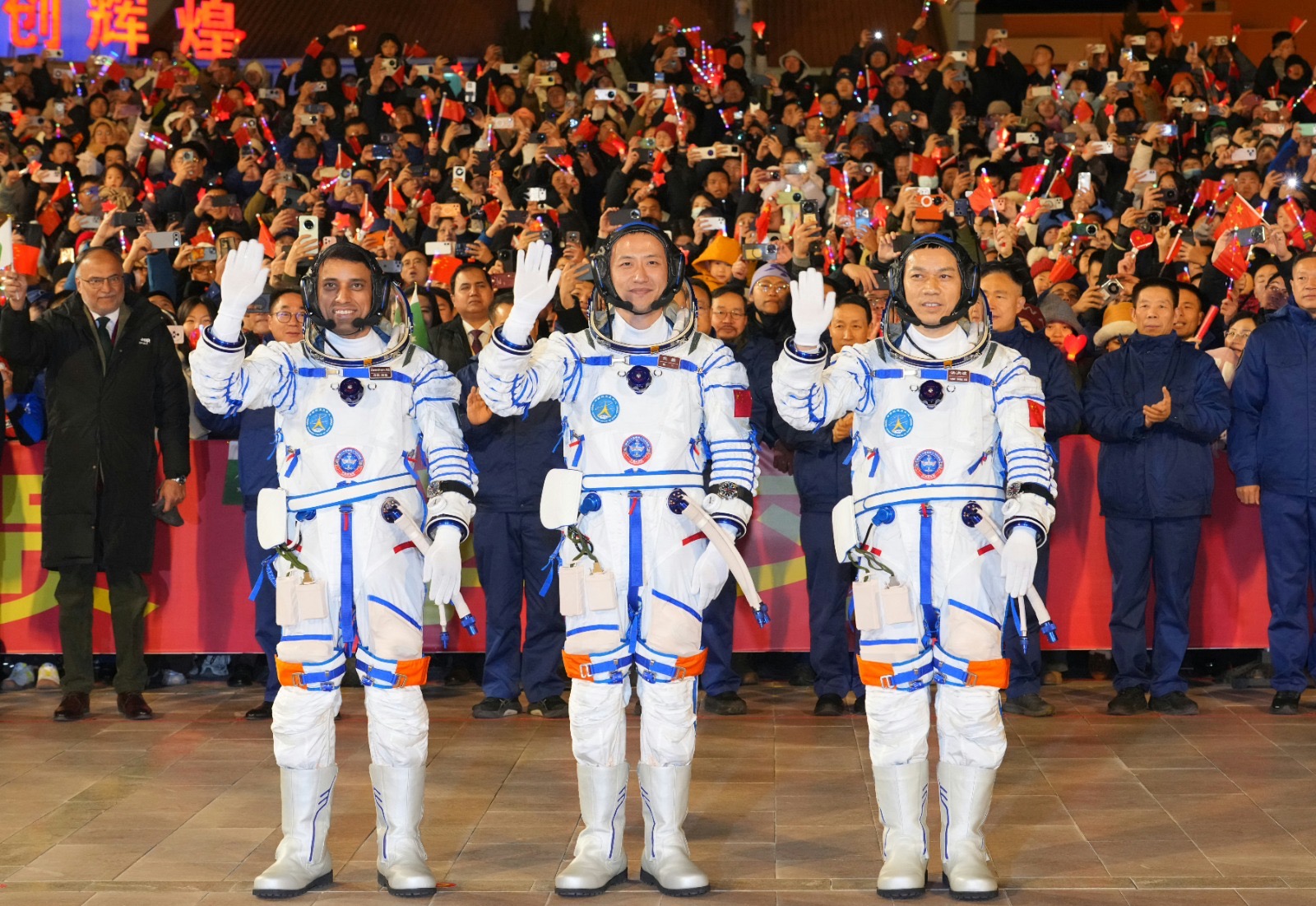
BEIJING, China: China’s space station welcomed its first foreign lodger today as a Pakistani astronaut boarded the Tiangong with his Shenzhou-24 mission crew, Beijing said.
China has poured billions into its space programme as it aims to land astronauts on the Moon before 2030, a race in which the United States is also competing with its Artemis programme.
The Shenzhou-24 crew’s Long March 2-F rocket took off in a cloud of flames and smoke Wednesday morning from the Jiuquan launch centre in northwestern China under a pink sky, video from state broadcaster CCTV showed.
The spacecraft successfully separated from the carrier rocket roughly 10 minutes after blast-off and entered into orbit, the China Manned Space Agency (CMSA) said.
The launch was a “complete success” and the crew was in good condition, the agency said.
After roughly three-and-a-half hours from launch, the Shenzhou-24 spacecraft successfully docked at the Tiangong space station, according to CMSA.
Along with Pakistani astronaut, Muhammad Zeeshan Ali, the latest mission is crewed by Chinese spacecraft pilot, Tang Hongbo, and Chinese flight engineer, Wu Yi.
The three men “successfully moved into” the Tiangong, completing the first “space handshake” between Chinese and foreign astronauts, CMSA said in a statement.
Pakistan and China are close diplomatic and strategic partners, and signed a deal in February 2025 setting up a Chinese government training programme for Pakistani astronauts.
Chinese President Xi Jinping exchanged congratulations with his Pakistani counterpart after the launch, telling Asif Ali Zardari that Beijing stood ready to champion the “peaceful use of outer space” and “improve global space governance”, according to CCTV.
On Monday, NATO chief Mark Rutte said the alliance would defend against threats in space, after reports said Russia may be preparing to launch a nuclear-armed satellite.
Now aboard the Tiangong station, Ali, a Pakistan Air Force pilot and payload specialist, is the first foreign astronaut to fly on a Chinese space mission.
Pakistan’s space agency said he would conduct experiments in orbit, including cultivating microalgae as a potential food and oxygen source for future space missions, and testing the effects of spaceflight on quinoa seeds.
The 40-year-old will join a short orbital flight expected to last around five days before returning with the Shenzhou-23 spaceship, which docked at the Tiangong space station in May.
That ship’s crew includes astronauts Zhu Yangzhu, Lai Ka-ying and Zhang Zhiyuan.
Lai is Hong Kong’s first astronaut and the only woman currently aboard.
Ali is not the first Pakistani in space, with Monaco-based polar adventurer Namira Salim having flown on Virgin Galactic’s Galactic 04 mission in October 2023.
Still, Pakistan’s Foreign Minister Ishaq Dar today called the Shenzhou-24 launch a “historic mission”, marking a milestone in his country’s partnership with China.
“A proud moment for Pakistan, this mission will inspire our youth and advance our aspirations in science and technology,” he wrote on social media.
Pakistani Prime Minister Shehbaz Sharif previously hailed the mission as a testament to their close ties.
“Pakistan-China friendship is surpassing the heights of the Himalayas, in its journey to outer space,” he said.
Ali is scheduled to return to Earth alongside Lai and Zhang.
Zhu will remain on board to complete China’s first full-year stay in space – a key test of endurance critical for future lunar and potentially deep-space ambitions. – AFP