BY NATASHA JEE & SHARIFAH NONG-JASIMA
KOTA SAMARAHAN: Education grounded in facts, civil dialogue, and in-depth academic research on the Malaysia Agreement 1963 (MA63) is vital to ensure society gains a balanced and knowledge-based understanding.
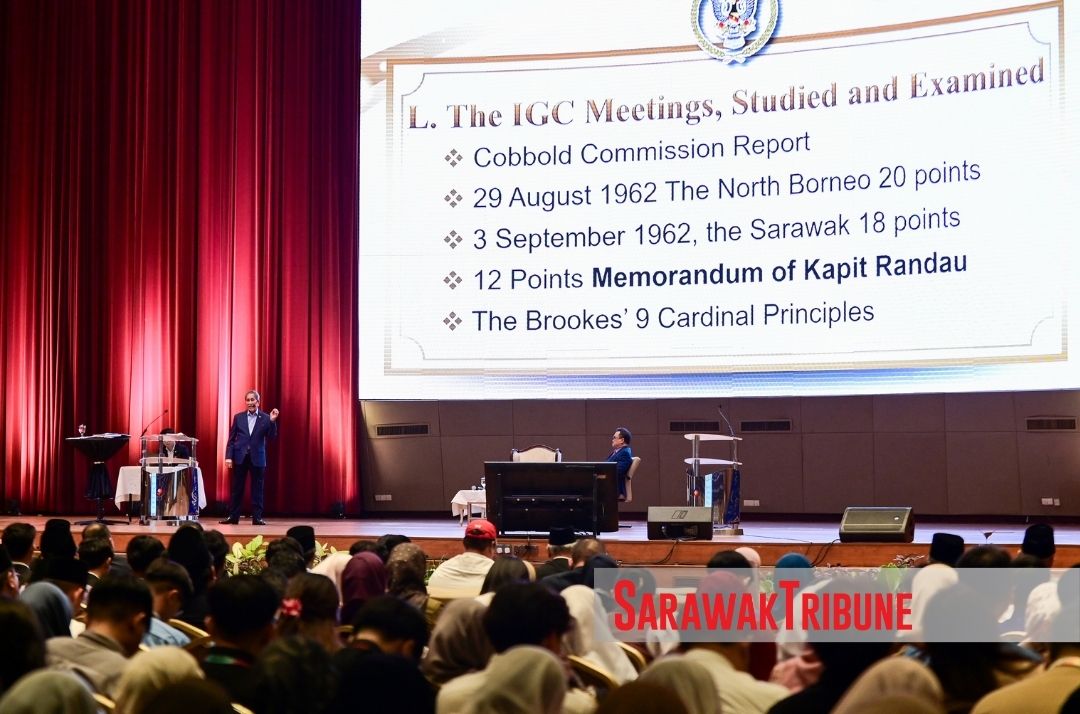
Universiti Malaysia Sarawak (UNIMAS) Vice-Chancellor, Professor Dr Ahmad Hata Rasit, said the importance of such efforts was reflected in the Statesman Speech delivered by Head of State, Tun Pehin Sri Dr Wan Junaidi Tuanku Jaafar, titled ‘Malaysia Agreement 1963: The Key to Federal Harmony’.
“The topic is significant and relevant not only to the academic community, but also to Malaysians as a whole, particularly Sarawakians and the younger generation who must understand the foundation of the nation’s formation and the harmony we enjoy today,” he said at UNIMAS here today.
On the historical importance of MA63, he noted that the agreement was signed on July 9, 1963, in London, with the proclamation of Malaysia’s formation by then Prime Minister, Tunku Abdul Rahman Putra Al-Haj, on September 16, 1963, at Stadium Merdeka, Kuala Lumpur.
“Through MA63, the Federation of Malaysia was formed with the participation of Sarawak, Sabah and Singapore, together with Malaya,” he said, adding that it also outlined the terms, rights and responsibilities of each entity forming Malaysia.
“These included the special position of Sarawak and Sabah in immigration, finance, education, language and religion, as well as provisions recognising their autonomous status.
“Land rights, natural resources, and state revenue were also retained under the control of the state governments,” he said.
Ahmad Hata stressed that MA63 is not merely a historical document but a social contract that continues to be relevant as the foundation of Malaysia’s federal relationship.
He also observed that recent public discourses on social media regarding MA63, particularly on Sarawak’s rights, often included both constructive views as well as inaccurate and provocative statements made without proper understanding of the historical and legal framework.
“This shows why fact-based education, civil dialogue, and in-depth academic research are essential to build informed perspectives,” he said.
He added that UNIMAS remains committed to upholding knowledge, strengthening the understanding of the nation’s history, and fostering civic awareness among students.
“Therefore, lectures such as this align with UNIMAS’ aspiration to produce graduates who are knowledgeable, forward-looking, and patriotic,” he said.
He further expressed confidence that the Statesman Speech by Wan Junaidi, with his vast experience particularly in legal matters and the history of MA63, would provide space for dialogue and enrich academic discussions on the agreement’s role in shaping the nation’s social, economic, and political landscape.
“We hope those present today will take this opportunity to reflect upon the essence of the lecture, thereby strengthening the spirit of unity, loyalty to the nation, and appreciation of our history,” he said.