
The digital world is no longer a destination we visit – it’s the environment we live in. For children, this means growing up in a space where opportunities and dangers exist side by side, demanding not just access but also the wisdom to navigate it. This is part three of a five-part series discussing the effects of children growing up in an era where advancements in digital technology offer opportunities beyond the horizon, yet pose significant threats when left unchecked.
Digital childhood: Opportunity or minefield?
THE implications of digital consumption have both benefits and risks. As with any tool, whether it brings positive changes or negative impacts, we cannot cherry-pick. Rather, we consume it whole.
Sharing an analogy, Dr Tan Jun-E equates the digital platform to fire – an important tool, yet a dangerous one.
“It’s got a lot of positive effects, but it can also cause a lot of damage when misused.”
Therefore, digital literacy is important, especially in an era where technological advancements are becoming essential.
A senior research associate at the Khazanah Research Institute, Tan’s current research interests include digital rights and AI governance in the contexts of Southeast Asia and Malaysia.
As an expert in digital risks, she notes that the issues we face with artificial intelligence (AI) are a continuation and exacerbation of issues previously encountered with digital rights and internet freedom.
“Protection of digital rights will help protect us in the AI era. By focusing on AI readiness, it will help in addressing these risks.”
And with children growing up amidst these digital shifts, it is ever more vital that parents, the community, and the government navigate the uncharted waters to create a safe digital environment for them.
Biggest digital risk faced by children today
Somewhere out there, a teenage girl is constantly groomed by sexual predators; a child is absorbing harmful behaviours through animations in mobile game apps; and viral videos are quietly shaping young minds through content designed to overstimulate and manipulate. These seemingly minor exposures are becoming the cookie crumbs that gradually shape young minds – subtly influencing their values, behaviours, and perceptions of the world.
Highlighting the importance of children as the pillars of tomorrow, Tan stressed the need to recognise and address the digital risks facing today’s younger generation.

“There are existing problems like cyberbullying, grooming, and child sexual abuse materials being online; however, with AI looming, the biggest concerns for online safety are deepfakes (digitally created or altered media that convincingly mimics a real person or event made by AI) and privacy intrusions through surveillance,” she said.
Children are also vulnerable to digital advertising, she added. Irresponsible developers use eye-catching cartoon animation to lure children into believing them, making it harder to monitor children using their own devices.
On a deeper level, she warned about the erosion of children’s digital autonomy. Many parent content creators are leaving their children’s digital trail, often without consent, and this trail follows them for life, whereby their past represents their future identity.
“The presence of young children posted online will stay frozen over the internet; even when they have grown, or have different values in life, the past often gets stuck onto them even when they are no longer the same person,” she added.
“I think a lot of parents are not aware of the risk of letting their children be online,” she further opined.
Furthermore, an individual parent working on online safety for their children can be at a disadvantage, as in schools, the kids are influenced by each other.
“Thus, I believe that a collective group of parents trying to mitigate the problem is a better solution. When the community practices digital literacy and being safe online, it becomes much easier to collectively control the digital access of children.”
To dodge the bullet
Being safe online is crucial. According to the ‘Our Lives Online’ report by UNICEF published in 2020, one in three internet users is a child, and more than 175,000 children go online for the first time every day. In Malaysia, nine in 10 children aged five to 17 are internet users, while 92 per cent of students aged 13 to 17 have social media accounts.
The report also states that two out of five children in their focus group have gone through unwarranted experiences. This includes receiving obscene messages and images on social media, hoaxes and misinformation, and bullying.
The numbers are worrying. Thus, having open communication between parents and children, and between teachers and children, is therefore important, said Tan. Using an analogy to “vaccinate” them before it becomes a viral infection, Tan believes that parents should perform a ‘mass vaccination attempt’ as a proactive step to build immunity before exposure becomes harmful.
“Children are susceptible to what is fed online, whether it is good or bad; they just take it at face value. That’s why it’s important for parents to talk openly about issues like grooming or fake news. When children understand the consequences, they’re better prepared to respond. Conversations about sex, for example, should no longer be taboo,” said the senior research associate.
Communication starts young – hence, Tan advised parents to always allow their children a safe space to discuss issues, and if any suspicious activity arises, to navigate it together in a systematic manner.
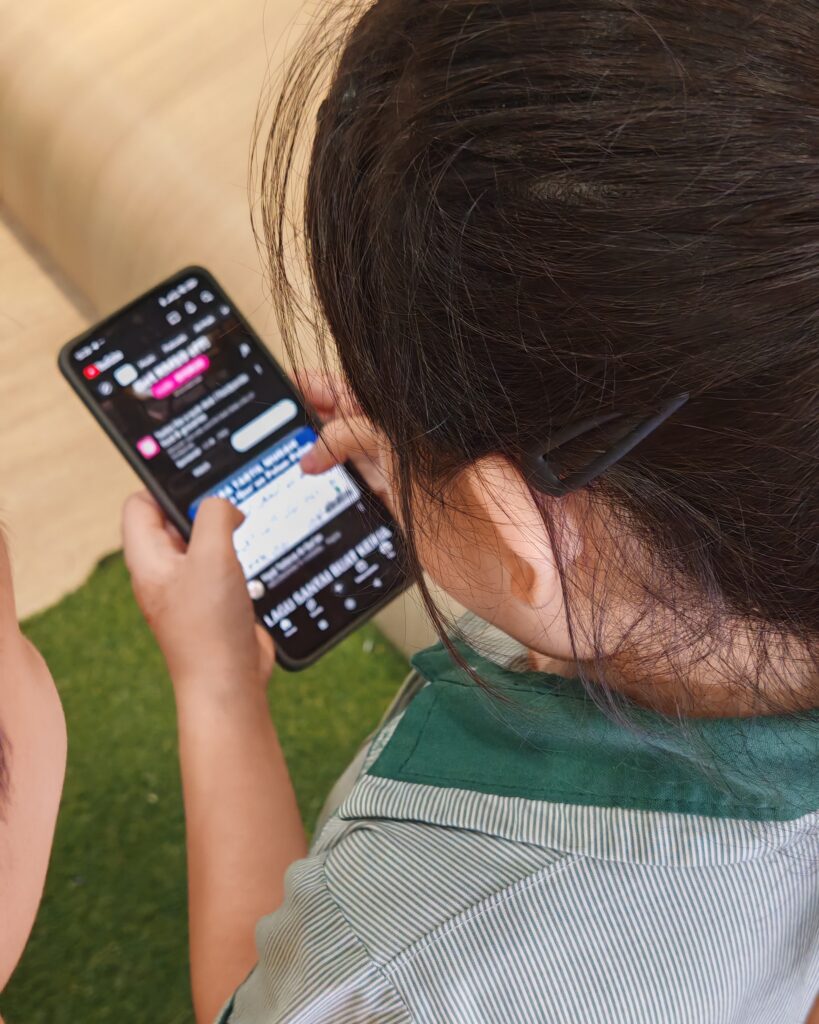
“Children are clever. They will eventually find their way to get there, with or without their parents’ guidance. Thus, I feel that some level of autonomy should be given to children, not to leave them unchecked, but to help them understand digital literacy for themselves. And when the time comes to negotiate boundaries, parents should explain, reason, and guide rather than dictate,” she said.
Most recently, the Ministry of Communications, in collaboration with the Malaysian Communications and Multimedia Commission (MCMC), launched a nationwide “Safe Internet Campaign”. The initiative aims to promote cyber safety and teach the public, especially primary schoolchildren, to become responsible internet users.
In a report by BERNAMA, the module for the campaign focuses on four key areas: cyberbullying, online scams and gambling, child sexual exploitation, and data protection and digital literacy.
In launching the ‘Safe Internet Campaign’, Communications Minister Datuk Fahmi Fadzil pointed out that children are exposed to a borderless world filled with threats and deception.
“We cannot afford to be complacent. Make sure our children are protected from cyber dangers that are ever present. Monitor all their online activities. The digital world must be a safe space – not a trap that destroys our children’s future,” he said.
Understanding children’s digital rights
Just as adults have digital rights, children too have their respective digital rights.
“They have the right to access these digital spaces, and to ensure that these spaces are created with their safety in mind,” said Tan.
Sharing on the digital rights in the age of AI conceptual framework, children are also entitled to the following:
1.Conventional rights in digital spaces: Rights of individuals in digital spaces/on the internet
- Online safety issues – scams, cyberbullying, non-consensual deepfake images
- Mis/disinformation, AI slop, hate speech
- Mental health issues and loneliness
2.Data-centred rights: Protection of digital data that represents physical entities
- Automated decision-making on personal data, with far-reaching consequences
- Urgency in data sharing to unlock insights
- Corporate and state surveillance more powerful than ever
3.Access to the digital: Access to digital spaces and meaningful participation
- Fragmentation of our digital spaces due to geopolitics
- Exacerbation of digital divide – in access, but also literacy in AI
4.Governance of the digital: Participation in digital and internet governance
- Concentration of power
- Global Majority/South struggle to have a seat at the table
- Difficulties in participation in every layer of the tech stack – physical infrastructure, data governance, AI development, application, and deployment
“All these can be adapted to children because they are also humans, and they should be entitled to these rights. They have the right to be safe online, to have a safe digital space, and they also have the right to their privacy,” she said.
Digital literacy important among children
When digital literacy is mentioned, it often refers to the critical understanding of how to use digital technologies confidently, safely, and responsibly. Emphasising proper digital literacy among children is crucial because they can spend a lot of time navigating the digital space.
“They need to know how to protect themselves, how to maximise the time spent digitally – to learn how to be a responsible digital netizen, and to know what is dangerous and what is not. However, they should also know how to balance their digital presence with their real-world interactions,” Tan commented.
Ultimately, in the age of rapid digital evolution, children need more than just access – they need protection, guidance, and empowerment. As technology continues to outpace regulation, the responsibility falls not just on parents but on educators, communities, tech developers, and policymakers to ensure that children are not left vulnerable in an increasingly complex digital world.
With digital literacy being an essential survival skill, we ought to equip the next generation with the right tools and knowledge, not just to protect their present, but also to shape a safer future, navigating the uncharted waters of the shifts in digital evolution.