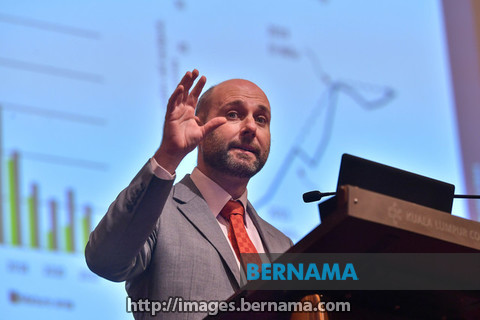
KUCHING: Malaysia must deliver credible reforms with consistency or risk undermining investor confidence, said Swinburne University of Technology Sarawak lecturer Nivakan Sritharan.
He said decades of reform have shown that Malaysia can adapt, but execution often falls short.
“Investors and citizens alike want fewer announcements and more measurable outcomes, higher wages, better job mobility and transparent subsidy targeting,” he told Sarawak Tribune.
He noted that Malaysia Day this year comes against a backdrop of slower global growth, geopolitical rivalry and rising living costs.
Domestically, he said, growth is projected at 4 to 5 per cent, supported by consumer demand, tourism recovery and inflows into semiconductors and services.
He added that the ringgit remains under pressure, but Malaysia’s diversified economy provides a buffer.
“From an investor perspective, Malaysia still enjoys strong fundamentals, political stability compared to peers, a young workforce and a strategic location within ASEAN. That said, investor confidence depends on consistency,” he said.
He pointed out that Budget 2025, anchored in the Madani Economy framework and the final year of the 12th Malaysia Plan, has sent mixed signals.
“Fiscal discipline measures such as a 2 per cent dividend tax on high earners, a global minimum tax and subsidy rationalisation show commitment to sustainability.
“But frequent adjustments, particularly around subsidies and taxation, risk unsettling businesses if not communicated clearly,” he said.
Nivakan identified three reform clusters as critical: productivity and skills, fiscal reforms and governance.
On productivity, he welcomed expanded TVET pathways, Upskill Malaysia and incentives for automation and Industry 4.0 adoption, but said integration between education, training and labour markets must accelerate.
He added that measures such as the abolition of UPSR were steps in the right direction but must be followed through to deliver real productivity gains.
On fiscal policy, he said subsidy rationalisation is fiscally necessary but politically sensitive.
“The transition to targeted subsidies, including RON95 rationalisation in late 2025, must be designed carefully to avoid excluding deserving households.
“Expanding the tax base through SST and introducing a global minimum tax would help fiscal sustainability, though middle-income households must be protected.”
Governance reforms, he added, are just as important.
“Transparent procurement, stronger anti-corruption enforcement and higher corporate governance standards are preconditions for long-term investment,” he said, noting that strengthening Parliament and improving checks and balances would also boost trust.
Nivakan said Malaysia should double down on semiconductors while opening new frontiers in renewable energy, the halal economy, digital health and aerospace.
He also flagged the Johor–Singapore Special Economic Zone as a chance to deepen regional value chains, while urging caution amid US–China trade tensions and Malaysia’s widening trade deficit with China.
For inclusivity, he stressed that growth figures mean little if Malaysians do not feel the benefits.
“While absolute poverty has declined, inequality, wage stagnation and rising urban housing costs remain challenges. Middle-class households in particular are feeling the squeeze,” he said.
Recent measures such as the RM100 cash handout, petrol subsidies and toll freezes, he said, provide short-term relief but are not sustainable.
“The transition to targeted subsidies, including through MyKad verification, is necessary but must be designed carefully to avoid excluding deserving households,” he said.
He noted that initiatives such as SME digitalisation grants, rural development under DPLB 2030 and the People’s Income Initiative are positive steps.
“Policies under Shared Prosperity Vision 2030, youth engagement and women’s re-entry into the workforce can help spread gains more widely,” he said.
He added that structural enablers such as affordable childcare, better access to mental health services and digital infrastructure for rural areas are also needed to make inclusivity real.
“Malaysia Day 2025 is more than a commemoration. It is a reminder of Malaysia’s ongoing economic journey.
“The growth outlook is steady but vulnerable to external shocks. The reform agenda is broad and ambitious, but execution will determine outcomes.
“Above all, inclusivity remains the ultimate test. Growth must translate into tangible improvements in wages, opportunities and quality of life for Malaysians in every region and income group,” he said.