By Nancy Nais
BY the time I had already done a few climbs up Mount Kinabalu, I thought I had experienced everything the mountain could offer, from sunrises at the summit, rain-soaked descents and whatever in between.
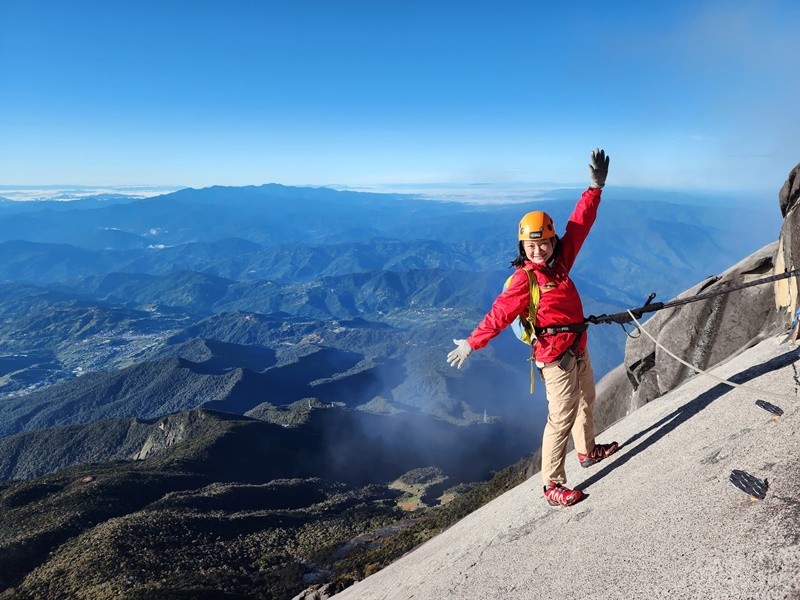
But Mount Kinabalu had another challenge waiting for me. The current Guinness World Record holder for the world’s highest Via Ferrata is located on this mountain. It begins at a height of 3,411 metres above sea level with its highest point at 3,776 metres.
What I can say is, climbing to the summit is one thing, but hanging off the side of the mountain, thousands of feet above, on a cable and metal rung system? That’s an entirely different kind of adventure.
I had the chance to complete two via ferrata routes namely the thrilling and exposed Low’s Peak Circuit; and the slightly shorter but still breathtaking Walk the Torq. Each of them tested a new part of my nerves, my trust in the equipment and my ability to let go of fear over heights.
Via ferrata is a protected climbing route that uses a system of steel rungs, ladders, rails and cables bolted to the rock face. It’s not the traditional rock climbing. Designed for those with an average fitness level, climbers must also be able to focus and have no health issues.
After summiting Low’s Peak early in the morning, climbers will basically descend to the respective starting point, either the 7.5km mark near South Peak or Sayat-Sayat checkpoint where different mountain guides will wait. Here, everyone will gear up with personal protective equipment (PPE) comprising safety helmets, harnesses, dynamic ropes and energy absorber lanyards. All these are certified by the International Climbing and Mountaineering Federation (UIAA), which meet the EN958 standard.


Low’s Peak Circuit: the long route with the best views
My first via ferrata was the Low’s Peak Circuit in 2024. This was longer and much more challenging of the two routes. It begins high up and winds along narrow ledges, across a 3-wire bridge and along exposed cliffs. I got to see an entirely different and immensely beautiful side of the mountain plateau and gorges below which the current summit trail will never have the chance to reveal to me.
On the other hand, this wasn’t just a scenic route, it was an extreme deep mental game. The exposure is real. I can still remember how my heart and brains kept reminding me just how high up I am, of one misstep or moment of panic. Thankfully, the safety system was rock solid. As long as I stayed clipped in and listened to my guide, I knew I would be safe. Still, it’s not something the mind processes immediately. I had to push past the natural fear of heights and keep going, one rung, one carabiner, one breath, one step at a time.
Each time when I paused on a tiny metal foothold, clinging to the cliff face with the wind pushing against my back, I looked out across the clouds. There was no noise. No trail. Just granite, sky and silence. I felt like I was floating.
However, the physical challenge was there. Some sections require a lot of crawling, climbing or balancing but it was the mental clarity that hit me hardest. The route’s thread like tightrope walks and swinging planks actually convinced me that the course designers are sadistic people, but that also made this activity so much fun, by testing my limits without putting my safety in jeopardy.
Walk the Torq: shorter, but still no joke
My second via ferrata experience last month (April 2025) was Walk the Torq, a shorter course often recommended for first-timers but still dramatic enough to get my adrenaline going. This route starts from Sayat-Sayat checkpoint and though it’s not as long as Low’s Peak Circuit, it still features narrow rock ledges, vertical climbs and a two wire cable suspension bridge that made my legs wobble when I looked down too long.
What I loved about Walk the Torq was how accessible it was. It didn’t require as much physical effort as the Low’s Peak Circuit, but it still delivered that surreal, exposed sensation of walking along the sky. The rogimut ladder was easy. For anyone unsure about doing via ferrata, this course is the perfect introduction.
Even though this was my second via ferrata experience, it didn’t feel repetitive at all. In fact, it allowed me to appreciate the technique more, how to move efficiently, how to manage my carabiners smoothly, how to relax even while hanging over empty space.
Both my via ferrata mountain guides William Maldusah and Adrian Jalius were amazing. They talked us through every section, offered encouragement with lots of laughter and made sure everyone were clipped in and moving confidently.
A mix of triumph and peace
Finishing the via ferrata routes gave me a whole new level of appreciation for Mount Kinabalu. Climbing to the summit gave me the altitude achievement, but the via ferrata gave me an edge of the earth perspective. These experiences pushed my comfort zone, opened new perspectives and reminded me that adventure is never just about reaching the top.
It’s a humbling and empowering feeling all at once. After finishing the circuits, returning to the trail back down to Timpohon Gate felt like walking back into normal life from another world. Would I do it again? In a heartbeat. Because once I’ve danced along the granite spine of Mount Kinabalu with the sky at my feet and nothing but courage in my hands, I carry that feeling with me forever.