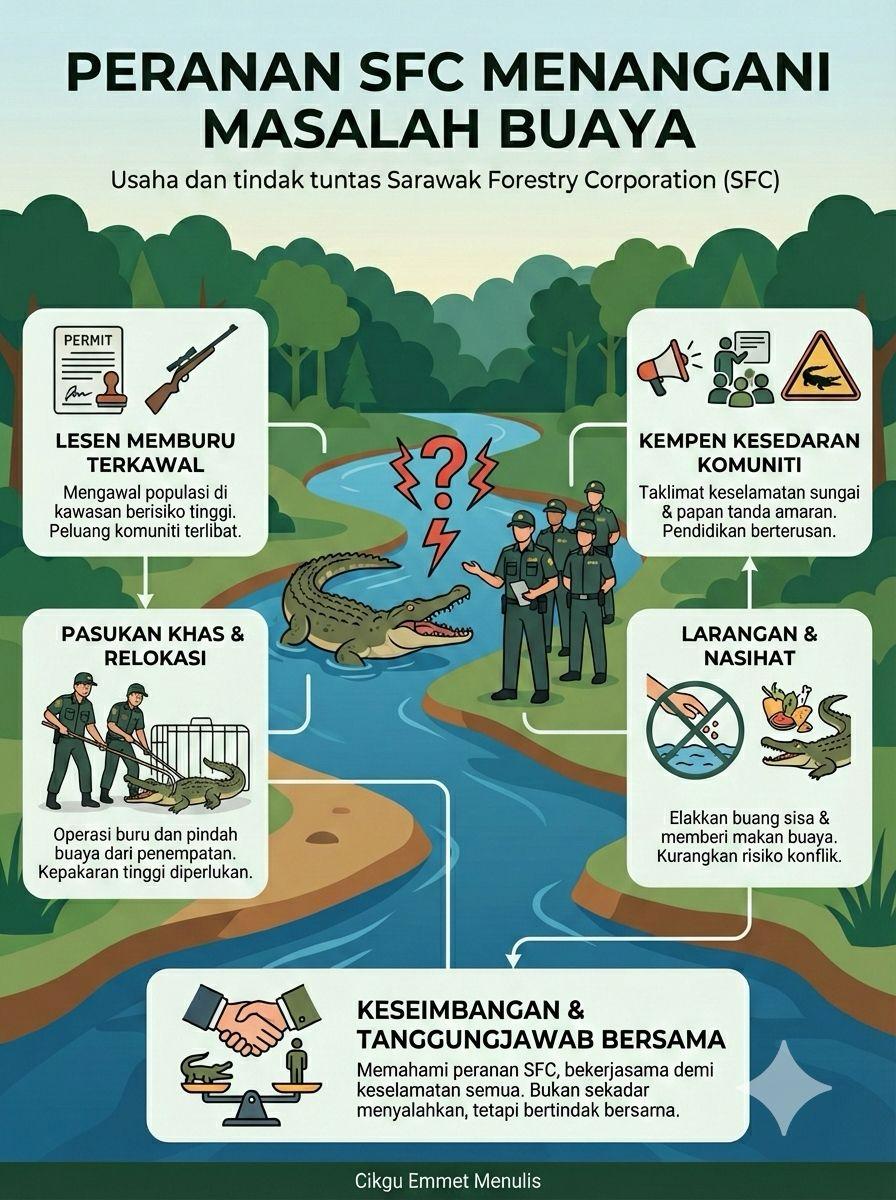
KUCHING: Each time a crocodile attack occurs in Sarawak, the spotlight inevitably turns to the Sarawak Forestry Corporation (SFC).
On social media, criticism comes swiftly and often harshly.
However, Facebook user Cikgu Emmet Menulis has urged the public to take a step back and look at the bigger picture, saying the issue of crocodile attacks in Sarawak is far more complex than simply pointing fingers at one agency.
Cikgu Emmet Menulis, whose real name is Ahmad Faizal Osman, is a community page on Facebook managed by the Sarawak-based educator who shares writings, opinions and reflections on everyday life.
He is also known for his commitment to educating rural students through printed learning materials, a dedication that earned him recognition in national media in previous years.
“Every time a crocodile attack happens in Sarawak, the name Sarawak Forestry Corporation (SFC) will surely become the target of condemnation. On social media, it is easy for fingers to point, as if every incident in the river is solely the failure of one agency.
“The reality is that the crocodile issue is far more complex than just blaming the authorities,” he wrote.
Sarawak is home to a significant population of saltwater crocodiles, particularly along major river systems such as Batang Lupar, Batang Sadong, Sungai Samarahan, Batang Rajang, Sungai Tatau, the coastal stretch of Similajau and Bakam right up to Lawas.
These rivers are not just waterways as they are lifelines and communities continue to depend on them daily for fishing, transport and livelihood.
Cikgu Emmet pointed out that with such vast geographical coverage, manpower and operational constraints inevitably limit SFC’s ability to monitor every stretch of river at all times.
He said crocodiles are territorial and highly adaptive reptiles, when their natural habitat overlaps with human activity whether it is fishing, casting nets for prawns or even disposing of food waste into rivers, the risk of conflict increases.
“In such circumstances, SFC actually plays an active role through awareness campaigns in riverine villages,” he said.
Cikgu Emmet said many may not realise SFC issues crocodile hunting permits as part of population control measures in high-risk areas.
To date, more than 70 permits have been issued but only a small number of licence holders have actively utilised them.
“The licences are meant to provide opportunities for individuals or companies interested in capturing crocodiles, including for commercial purposes such as meat and skin, while ensuring population control is carried out in an orderly manner. However, the response to these licence applications has not been as encouraging as expected,” he said.
Beyond licensing, Cikgu Emmet said SFC also deploys a special task force which is often referred to as a SWAT team to conduct operations involving high-risk crocodiles and to relocate reptiles that stray into residential areas.
“Such operations are far from simple. They require expertise, specialised equipment and strict compliance with wildlife laws,” he said.
At the same time, SFC also has river safety awareness campaigns which remain ongoing.
These include community briefings, installation of warning signboards and repeated reminders not to feed crocodiles or dispose of animal carcasses into rivers.
“River safety is not solely SFC’s responsibility. It requires the cooperation of the local community,” he stressed.
While public frustration is understandable, especially when lives are lost, Cikgu Emmet believes that understanding the agency’s role and limitations brings the conversation closer to solutions.
“I believe SFC staff remain calm and patient when reading every criticism because they are aware that SFC is not perfect. But clearly, they are not sitting idly by.
“Whenever there is a crocodile attack issue, they will go to the ground together with other agencies to assist,” he wrote.
Cikgu Emmet stressed that in issues involving humans and wildlife, balance and shared responsibility must prevail over blame.
“In matters involving humans and wildlife, what is most important is balance and shared responsibility, not blaming one another because each party has a role. The river is the lifeline of the people who earn their livelihood there despite the threat of crocodiles, while authorities such as SFC have also done their best,” he added.