KUCHING: English literacy must go hand-in-hand with Science, Technology, Engineering and Mathematics (STEM) education to ensure Sarawak’s young generation is prepared for global opportunities.
Premier Datuk Patinggi Tan Sri Abang Johari Tun Openg said over 90 per cent of STEM journals worldwide are published in English, and without a strong foundation in English, students will struggle to access global research and innovation.
Malaysia’s goal is to have 60 per cent of students in STEM streams by 2030, but currently enrolment is about 45 per cent, he said.
“Here in Sarawak, we are working hard to build this pipeline through STEM-focused schools, Technical and Vocational Education and Training (TVET) programmes, and the Sarawak Digital Economy Blueprint 2030,” Abang Johari added.
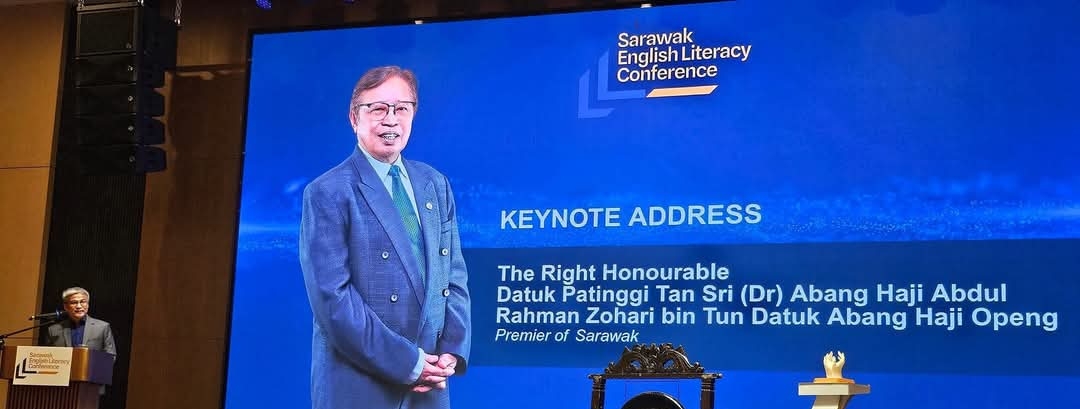
He said this in his keynote address read by Deputy Minister for Education, Innovation, and Talent Development, Datuk Dr Annuar Rapaee, in conjunction with Sarawak English Literacy Conference 2025 (SELC 2025) here today.
“Our young people must be future-ready. They must be able to read scientific papers, write research in English, and collaborate with global experts,” he said.
“English and STEM together will prepare Sarawakians to become innovators and leaders in fields such as renewable energy, digital economy, and biomedical sciences,” he added.
He said English education is not only about language, but also about building confidence, critical thinking, and creativity – qualities sought after by employers in a globalised economy.
Citing the World Bank (2022), Abang Johari noted that improving English and digital skills can raise employability by 20 to 30 per cent.
“However, we also acknowledge the challenge. Students in urban areas often perform better in English compared to those in rural areas.
“That is why the Sarawak Government has committed RM1 billion to repair and upgrade dilapidated schools, improve internet connectivity, and support teachers with better training.
“Our goal is to ensure that every child, no matter where they live, has equal access to quality education,” he said.
He also launched the Sarawak Language Association, which will serve as a platform to promote language development in English, Bahasa Malaysia, and native languages such as Iban, Bidayuh and Melanau.
“This association will bring together educators, linguists, community leaders, and policymakers to advance literacy, strengthen teaching methods, and preserve our linguistic heritage while ensuring our young people are equipped with the global language of English
“Through this initiative, Sarawak will become a centre of excellence for multilingual education, aligning with our goals of social inclusivity and economic prosperity,” he said.
Abang Johari also said education and talent development are among the key enablers of Sarawak’s Post COVID-19 Development Strategy (PCDS) 2030, which aims to make Sarawak a developed, high-income and inclusive region by 2030.
“All six priority sectors under PCDS – agriculture, renewable energy, manufacturing, tourism, forestry, and the digital economy – require a globally competent workforce, skilled in STEM and fluent in English,” he said, noting that the renewable energy sector alone is expected to create more than 90,000 jobs by 2030.
To prepare Sarawakians for these opportunities, he said the state government has rolled out initiatives such as Yayasan Sarawak international schools offering the Cambridge syllabus, expanded 5G internet coverage to 98 per cent of populated areas, and continuous investment in teacher training and scholarships.
“We are not replacing Bahasa Malaysia, which remains our national language and unifying force. Rather, we are complementing it with English so that our young generation will be global citizens with a strong local identity,” he added.