From the first morning in Jolo to tense encounters with kidnappers, Apai navigated armed checkpoints, fragile negotiations, and the delicate human bonds behind the Sipadan hostage crisis — capturing a story few dared to witness firsthand. This is part two of a three-part series on photographer Zulazhar Sheblee’s perilous journey into Abu Sayyaf territory following the 2000 Sipadan kidnappings.
On the edge of danger: Meeting the Sipadan hostages
On the next morning, Apai woke to the pungent aroma of Kopi O Bujang, its bitter warmth barely touching the emptiness gnawing at his stomach after a restless night. Hunger was sharp, but the adrenaline pulsing through him was sharper.
General Mujahid, a stoic figure in loose camouflage, beckoned him and Pok Mei up the hill behind his house. The climb was steep, dusty, and thrumming with anticipation.
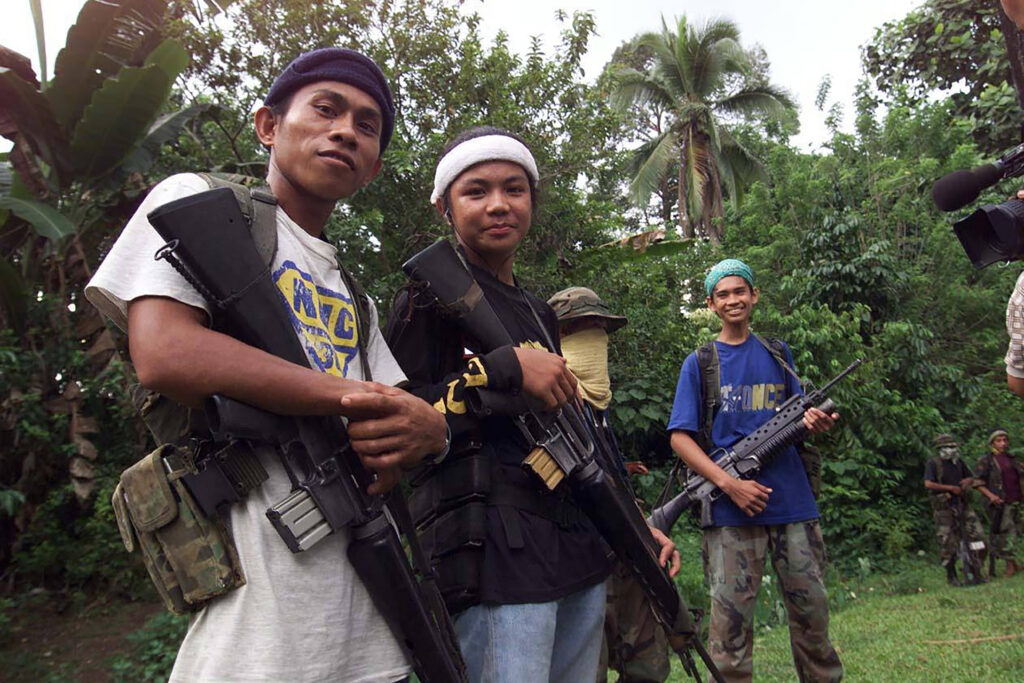
At the summit, the sight stole Apai’s breath. Fighters arranged themselves like living statues, each brandishing weapons of war: AK-47s glinted in the sun, M16s lay across shoulders, and M191 Brownings and M1 carbines rested in steady hands.
RPGs leaned against trees, and M203 grenade launchers gleamed ominously. The raw, lethal arsenal was both beautiful and terrifying.
Apai’s stomach churned — not from hunger this time, but from the weight of being so close to instruments of death.
Then a jackfruit appeared, enormous and dripping sticky white sap. The fighters sliced it without hesitation. It was unripe, its flesh pale and bitter, yet they dipped it in soy sauce and salt and ate as if feasting.
Apai watched silently.
“They’ll eat anything to survive,” he thought, marvelling at their discipline. Survival here was about improvisation, resourcefulness, and nerves of steel.
High-stakes negotiations
That afternoon, representatives from Abu Sayyaf arrived, carrying conditions for the journalists’ access to the hostages.
Many were steep: restricted movement, security checks, and demands for gifts.
General Mujahid, ever cautious, allowed only 10 of his own guards to accompany them and sent his younger brother to show the Abu Sayyaf that their intentions were genuine — they were there solely to interview the hostages and Commander Robot.
Other demands, like monetary payments and offerings for the commanders, were reluctantly met.
Pok Mei’s unease was evident.
“They’ll try to fleece us,” he whispered.
Apai’s instincts were sharper.
“Let me go in alone,” he proposed.
“With my camera and recorder, at least one of us is accounted for. If anything happens, you know where I am and can alert Kuala Lumpur,” Apai added.
The logic was sound. Previous journalists entering Abu Sayyaf camps had often returned stripped bare, robbed of cameras, clothing, and money. But this opportunity was sanctioned by Misuari himself. After brief hesitation, Pok Mei agreed.
The Abu Sayyaf representative then left, informing them that the meeting with the hostages would take place the following day.
Explosions in the night
That evening, Jolo’s uneasy quiet shattered. A grenade exploded at a church roughly 70 metres from Hellen Lodge, followed by the staccato of gunfire.
The journalists dived for cover, lying flat against the floor as bullets hissed past. For half an hour, the town held its breath, then slipped back into eerie silence.
Some even leaned mattresses against the wooden walls of the lodge to stop stray bullets — Apai included, who later confided to me with a laugh that if he were going to die, he’d rather do it lying down than running.
The curfew ran from 6 pm to 6 am, and any movement beyond that risked being shot on sight.

Checkpoint tensions
The next day began with modest breakfasts of egg tarts — sweet relief against a backdrop of exhaustion.
Water was scarce, necessitating baths from single 10-litre mineral drums. Then came the journey to the hostages’ location.
Their convoy of pickups wove through dusty roads, only to be stopped at a military checkpoint. Soldiers, wary after previous media kidnappings, barred their passage.
Mujahid ordered all three pickups to turn back, and they eventually stopped at a small village.
There, an elderly man tended a modest cooking fire in a worn shack, preparing rice and grilling dried fish.
Apai, unabashed, asked the general to request some from him. After a brief discussion in Tagalog, the old man smiled and divided the freshly cooked rice into two small portions, serving it with the grilled dried fish.
Coconut milk was poured over the rice, and coarse salt sprinkled on top — humble fare, yet Apai found it heavenly.
“This is the best meal of the day. If we get caught after this, at least we went out well-fed,” he joked with the general and Pok Mei.
After finishing, Apai asked why the man hadn’t cooked more for others. Mujahid explained there was no more rice; he only had enough for himself.
Seeing the old man take joy in feeding his guests brought Apai to the verge of tears. Before they left, Apai offered 1,000 pesos. The man’s eyes widened, tears welling as he hesitated, then accepted the money with gratitude.
The general said the old man had never held so much money; the shack was his home. Poor and humble, surviving on dried coconut, his quiet faith never wavered. Generosity in such a place was rare, and the emotion left Apai’s throat tight.
The hostage house
They continued along the dusty, uneven roads. Apai lay flat on the floor of the pickup while Pok Mei covered his face, making sure the government soldiers at the checkpoint did not notice them.
The soldiers glanced their way, smiled, and pretended not to see. Finally, the convoy passed through the roadblock unharmed.
After 45 minutes, they arrived at the base of the hill. Apai brushed the dust from his shirt like a character from a cowboy film, his clothes coated in fine powder.
Atop the hill, a man in a black shirt branded LEE awaited, holding an M1 Garand.
“Muslim?” he asked.
“Yes,” Apai answered, relief flooding him.
While chatting and asking about the roads and where people were from, Bong suddenly leaned in and whispered, “That’s Commander Robot,” nodding toward the elderly man.
Confused, Apai blinked and asked aloud, “Where is Commander Robot?”
“I am Commander Robot,” he replied.
Apai froze, stunned. He shook the old man’s hand and kissed it, only then realising he was in the presence of Commander Robot — Ghalib Andang, the fifth man on the FBI’s Most Wanted list.
Commander Robot only smiled at his reaction. He explained that he had been to Sabah before and could understand the Sabah Malay dialect, which made communication with him far easier.
With Commander Robot’s approval, Apai asked their translator to take a photograph of the four of them — himself, Pok Mei, Commander Robot, and Commander Mujib Susukan.
The image would forever freeze a moment of fragile trust in the midst of danger, a rare testament to their encounter deep within the heart of the conflict.
Once the photo was taken, Commander Robot assigned his deputy, Commander Mujib, to escort them.
Dunhill diplomacy
The walk to the hostage site was tense. Fighters, mostly in their early 20s, concealed themselves in bushes, climbed trees, and monitored the surroundings. The air was thick with the scent of dust, sweat, and gun oil. Apai could feel the pulse of danger in every movement.
At the house, they were told to gather in the open yard. Apai and Pok Mei, flanked by 10 of their own guards, were encircled by roughly 50 armed Abu Sayyaf members. The men’s faces were hard, eyes wary, scanning every movement.
“You can go upstairs to meet the Malaysians,” Commander Mujib called out.
Apai’s heart hammered as he hurried up the stairs, half-afraid Mujib might change his mind.
Below, Pok Mei waited anxiously, wary of being deceived or taken hostage by the Abu Sayyaf.
Upstairs, a group of hostages waited.
“Malaysia? Where are the others?” he asked. Their hesitant reply confirmed they were indeed Malaysian.
“Who is the policeman?” he probed next. Silence fell; they exchanged uncertain glances.
Apai explained he was a journalist from Utusan Malaysia, sent from Kuala Lumpur to meet the hostages and report on the kidnapping.
Sceptical, the hostages demanded proof. He handed them his business card, though they requested his MyKad as well.
He said he carried nothing else, fearing confiscation by Abu Sayyaf, who often robbed visiting media, leaving them with only their underwear.
Even after this, they doubted him, questioning his knowledge of Malaysia’s geography and noting his accent wasn’t from Kuala Lumpur.
Apai told them he was from Sarawak, and slowly, their trust began to form.
Then came the human touch that would define the encounter: he offered a Dunhill cigarette at their request. The effect was immediate. They inhaled, eyes widening, visibly affected by the familiar taste.
“Now I believe you’re Malaysian — only Malaysian cigarettes have this kind of kick,” one whispered, laughing softly.
The others followed suit, examining the box: “AMARAN OLEH KERAJAAN MALAYSIA: MEROKOK MEMBAHAYAKAN KESIHATAN”.
Smiles spread across their faces. Some asked for more; Apai obliged, quietly feeling that a simple cigarette had bridged worlds and eased tensions.
One of the hostages whispered a prayer of gratitude: “Alhamdulillah, my prayers are answered … Finally, we meet Malaysian media.”


This was the policeman Apai had enquired about earlier — Abdul Jawat Selawat. He cautioned quietly that the Abu Sayyaf were still searching for him.
Apai reassured them that the Malaysian government was negotiating for their release and that the interviews and photographs could help.
He discreetly handed over some cash — 500 pesos from his sock and 1,000 from his underwear — to be used to buy cigarettes.
He spent the next hour photographing the house: the hostages’ sleeping quarters, the bathroom, and the European captives’ rooms.
At first, the hostages balked at the idea of photographs, afraid they might be traded like commodities. But when Apai explained he was a Malaysian journalist, their fear softened. Soon they were urging him to tell the government to speed up negotiations.
When Commander Robot arrived, Apai requested that the Malaysian hostages come downstairs for easier interviews.
Initially refused, he insisted, claiming fear of the unstable upper floor. Commander Robot consented, acknowledging the modesty of the house.
As the Malaysians hurried downstairs, Pok Mei began his interviews while Apai captured the moment. Unbeknownst to him, a towel draped around Pok Mei’s neck — Good Morning — would become iconic in the resulting photographs.
Apai took the opportunity to meet Abu Sayyaf members, recording their weapons and equipment.
Suddenly, an M16 barrel pressed against his back. He froze, understanding the gravity of the moment.
Commander Robot’s voice cut sharply through the tension: “Let them work. They are our guests.”
Relieved, Apai continued photographing the group, even capturing the once-angry soldier smiling, proudly displaying bullets and mortar bombs.
Behind the house, he spotted Western hostages grilling fish — restless, wary, and insisting on no photographs.
Apai offered chocolate to them, their eyes lighting up with surprise and gratitude. Every gesture mattered; even in a war zone, small kindnesses created bridges.
By 5.30 pm, their translator signalled it was time to stop.
As they descended the hill, Commander Robot thanked them for witnessing the hostages’ treatment firsthand and for listening to their concerns, a rare moment of humanity amid the tension.
The rooftop debrief
Back at Hellen Lodge, Apai and Pok Mei wasted no time. They phoned headquarters: they had seen the hostages with their own eyes.
That night, Apai tried to send the photos. Nothing went through. Calls kept dropping, connections were cut off. Later, the police stationed at the lodge explained why: the military was intercepting all communications.
The next morning, they ditched the deadlines of Jolo and caught a three-hour boat to Zamboanga. In the lodge, Pok Mei locked himself to his keyboard while Apai scouted the streets for a cybercafé.
Inside, every seat was crammed with gamers. He tried uploading his photos by email — 10 minutes, not even one file attached. Time was slipping. Deadlines loomed.
Desperate, he slapped USD100 on the counter. The café owner cleared the room. For once, Apai had the computers — and the connection — to himself.
Fifty photographs went through in one burst. He immediately called his chief, S. Agil S. Jaafar.
The following morning, their story and images screamed across the front page. Relief flooded Apai — their gamble had worked.
But the celebration didn’t last. The next day, around 8 am, an unknown number buzzed his phone. A Malaysian major wanted to see him at noon on the rooftop of the lodge.
An hour later, Agil himself called with congratulations. Even the editor-in-chief had passed on his regards.
“Do you need anything?” Agil asked. Apai admitted the truth: funds were drying up fast. Headquarters promised to wire help.
By midday, Pok Mei was opening a local account while Apai climbed to the rooftop for the meeting. A moustached man waved him over.
“Zul, sit,” the major said, before reciting his background, even his home address. Apai later recalled that what convinced him most was the fact the major even knew his army serial number — it was clear the man already knew everything.
He pressed Apai for details on who they had met, who seemed credible, and what weapons he had seen.
Apai listed them: M16s, mortars, and ammunition. When Pok Mei joined later, they pieced together more names and faces. Their information, the major hinted, could decide which channels Malaysia trusted in negotiating with Commander Robot’s men.
Years later, Apai learned the major’s full identity. A woman messaged him after coming across his story on Facebook, and it was then that he realised the major who had conducted the interview was ASP Azmi Hussain, Semporna Special Branch chief. He had passed away in 2014 while still serving at Bukit Aman.
Living on the edge of crossfire
After receiving additional funds from headquarters, Apai and Pok Mei were directed to head to Jolo and stay there.
The days dragged on, and outside, the town seethed with danger. Abu Sayyaf had begun targeting journalists directly — even killing those who refused to follow orders. One Filipino reporter had already been gunned down.
Every night, Apai and Pok Mei recited the shahadah before lying down.
Gunfire echoed through the streets. Explosions rattled the windows. They stacked mattresses against the glass — flimsy shields against stray bullets. It wasn’t much, but it gave them something to cling to.
A week later, one female hostage walked free. Negotiations had worked. For Apai and Pok Mei, it was proof that the intelligence they’d shared — and the risks they had taken — had made a difference.
Not long after, the major called to thank them, saying their information had been invaluable and that the talks were progressing smoothly.
After weeks of tense negotiations, precarious journeys through armed checkpoints, and careful interactions with both hostages and fighters, Apai and Pok Mei finally completed their mission.
For Apai, the return journey was not just a physical one back to Kuala Lumpur — it was the moment to process the fear, trust, and humanity he had witnessed amidst the chaos.
Every photograph, every handshake, every cautious conversation had left its mark. The mission was over, but the story — the lessons, the courage, and the fragile threads of life and trust — would remain with him forever.
To be continued …