I have repeated this message countless times throughout my career, because it remains one of the most important truths about fire safety.
Fires do not discriminate – they strike when we are unprepared, and often when we are careless.
Today, I want to share a fundamental concept that many may perceive as complex, but is in fact something every Sarawakian should understand – fire safety engineering in our built environment.
When we talk about fire safety, most people think of laws, standards, codes of practice, and technical guidelines.
These are often left entirely to professionals.
While these frameworks are important, they can also create a gap – leaving the public feeling disconnected from their own safety.
In reality, fire safety engineering is not just about technical systems or computer models.
At its heart, it is about time.
It is a race.
A race between the fire and the people.
In engineering terms, we describe this as ASET versus RSET.
ASET, or Available Safe Egress Time, is the fire’s clock.
It represents the amount of time from when a fire starts until conditions become untenable – when heat, smoke, or toxic gases make it impossible to survive.
This depends on factors such as ceiling height, ventilation, smoke extraction systems, and fire-rated construction.
RSET, or Required Safe Egress Time, is the human clock.
It measures how long it actually takes for people to detect a fire, respond, and evacuate safely.
This includes alarm detection, human reaction time, and the speed of movement towards exits.
The golden rule is simple: ASET must always be greater than RSET, with an added safety margin.
If people can escape faster than the fire develops, the building is considered safe.
But here is what I want to emphasise – this is not just an engineer’s responsibility.
Every one of us plays a role in this equation.
When you keep fire exits clear, when you respond immediately to an alarm, when you remain alert – you are reducing RSET.
You are buying time for yourself, your family, and your neighbours.
That is why I have always advocated for a shift away from purely reactive firefighting towards a preventive culture.
This philosophy is built on what I call the ‘3P’ concept.
Precaution begins with awareness.
It is about checking your surroundings and identifying risks before a fire even starts.
Prevention is about taking action.
Install smoke detectors.
Ensure fire blankets are available, especially in kitchens.
Do not wait for something to happen before you act.
Protection is about readiness.
In the first five minutes of a fire, your actions matter most.
Know where your fire extinguisher is, and understand how to use it properly using the PASS method.
These are not complicated measures – but they are lifesaving ones.
Another critical aspect that is often overlooked is fire load.
Many citizens and even business operators do not consider how the amount of combustible material in a space contributes to the size and intensity of a fire.
Fire size is not a static number.
It is influenced by three key variables: fuel load density, fire growth rate, and ventilation – whether a building is open or enclosed.
When these factors are ignored, fires can grow faster and become far more dangerous than expected.
In Sarawak, our landscape presents unique challenges – from modern high-rise buildings in Kuching to traditional longhouses in rural areas.
But it also presents a unique strength: our communities.
I firmly believe that community participation is the most powerful engineering tool we have.
In many areas, especially remote ones, the first five minutes of a fire incident are critical.
During this time, the community is effectively the first responder.
This is why programmes such as Bomba Komuniti and Celik Suri are so important.
They empower the public with the skills and confidence to act before professional help arrives.
We must also embrace the shift towards self-regulation.
Under newer approaches, building owners and occupants are no longer passive. You are the “safety manager” of your own
space.
You cannot rely solely on annual inspections – safety must be a daily responsibility.
This is also the idea behind initiatives such as ‘One Home, One Fire Extinguisher’ – a simple but powerful step towards making every home more resilient.
However, despite all systems and technologies, one factor remains the most significant – human behaviour.
From my observations, most fires are not accidents.
They are caused by what I call the ‘3L syndrome’: lupa (forgetfulness), leka (carelessness), and lalai (negligence).
If we can address these behaviours, we can prevent many fires before they even begin.
That is why we must move beyond awareness and towards empowerment.
I advocate the ASKED approach – Awareness, Skills, Knowledge, Empowerment, and Determination.
Awareness means understanding the risks around us.
Skills involve learning basic firefighting and first aid.
Knowledge is about understanding building layouts and fire systems.
Empowerment ensures that communities have access to tools such as fire extinguishers and fire points.
Determination is what sustains all of this – making safety a daily habit, not a one-time effort.
As I always say, “We want to see you before the fire, not after.”
By understanding the race between ASET and RSET, by eliminating the 3L syndrome, and by taking ownership of our safety, we are not just following rules.
We are engineering a safer Sarawak.
And that responsibility belongs to all of us.
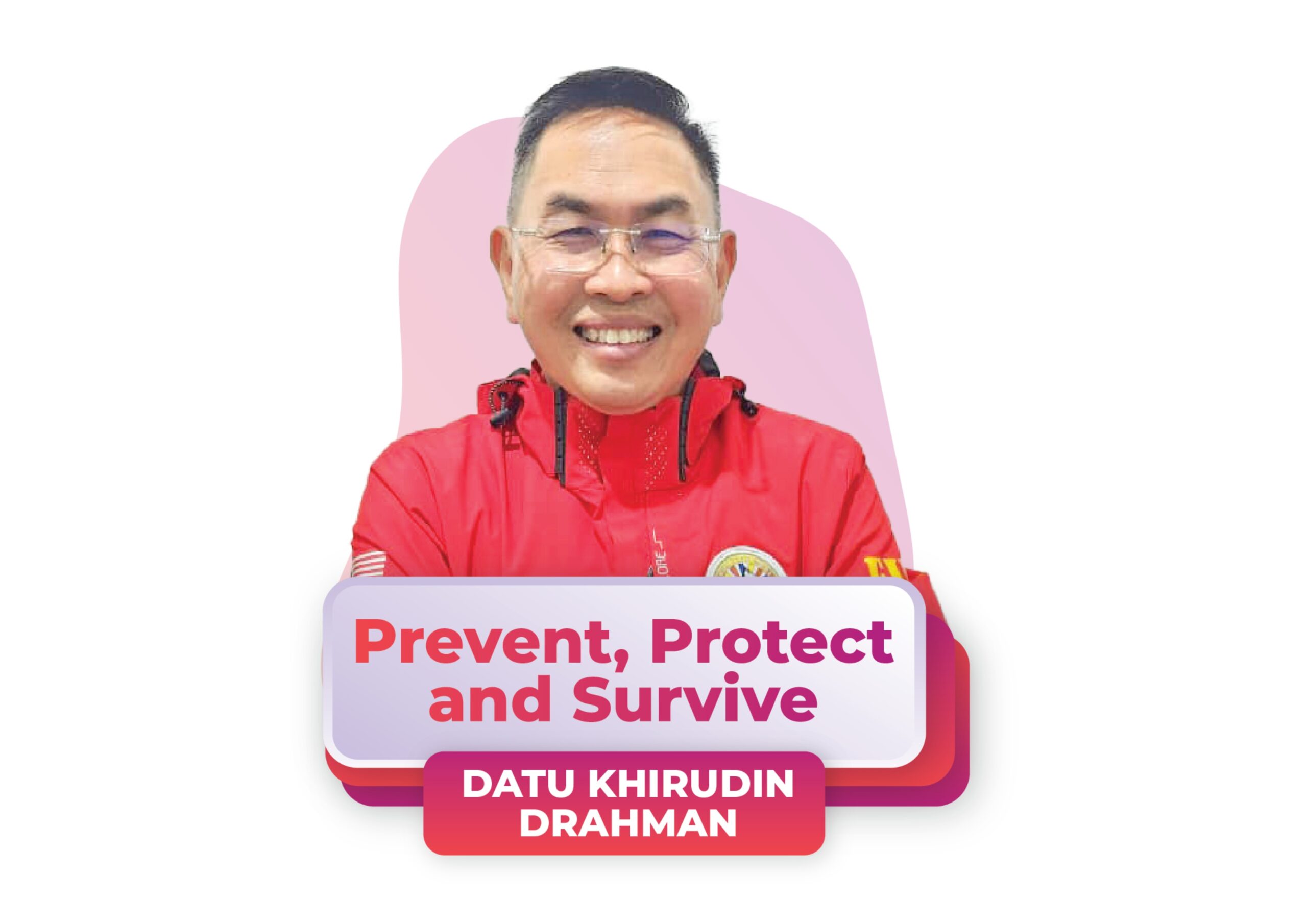
The views expressed here are those of the writer and do not necessarily represent the views of Sarawak Tribune. The writer can be reached at khirudin.drahman@bomba.gov.my.