KUCHING: Leaders across Sarawak’s main economic sectors have been urged to take a more proactive and structured role in developing the state’s workforce by forming sectoral councils to plan strategically for future talent needs.
Education, Innovation and Talent Development Minister Datuk Seri Roland Sagah Wee Inn said the leadership in the five key sectors, namely Agriculture, Manufacturing, Forestry, Tourism, and Services, under the Post Covid-19 Development Strategy (PCDS) 2030 should emulate the collaborative model set by PETROS Petroleum Sarawak Berhad (PETROS).
“I now challenge the leadership in our other five main economic sectors Agriculture, Manufacturing, Forestry, Tourism, and Services under PCDS 2030 to follow PETROS’s example.
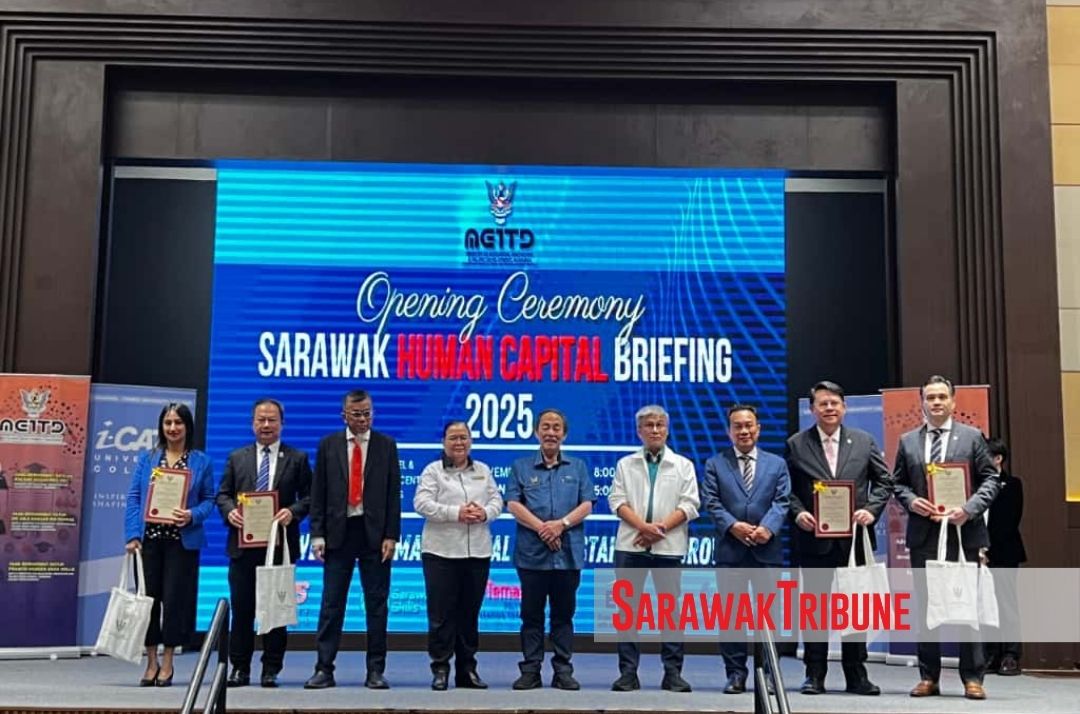
“Step up, form your sectoral councils, and take the lead in strategically planning the future workforce for your respective industries,” he said during the opening ceremony of Sarawak Human Capital Briefing 2025 held at Raia Hotel and Convention Centre here today.
He commended PETROS for its proactive role in chairing the Sarawak Oil and Gas Industry Capabilities Council, which he described as a model of sectoral leadership that ensures talent supply aligns with industry demand.
Sagah said such collaboration between government, industry and academia is vital to sustain Sarawak’s transformation into a high-income, advanced and inclusive economy by 2030.
He said a skilled, innovative, and adaptable workforce remains the foundation of PCDS 2030, which aims to make Sarawak’s economy globally competitive and people-centred.
Sagah also called on industry players to become active partners in shaping the state’s human capital agenda by leading the upskilling of workers, providing continuous professional development, and offering more internship and apprenticeship opportunities to young Sarawakians.
He urged companies to work closely with Technical and Vocational Education and Training (TVET) institutions and universities to co-design training programmes that meet industry needs, especially in the fast-growing digital economy and green energy sectors.
“The changes brought by the Fourth Industrial Revolution are rapid and relentless.
“To avoid skills mismatches and labour shortages, we must act strategically and this calls for greater participation from industry,” he said.
Sagah also cited the collaboration between Sarawak Skills and Sarawak Energy Berhad through the Handicraft Development Programme in Balingian and Batang Ai as an example of how traditional skills can be integrated with modern training to empower local communities.
He urged all stakeholders to stay united in building a future-ready workforce that can meet the challenges of an evolving global economy.
“This human capital briefing is not merely a platform for discussion; it is a point of mobilisation.
“Let us, together, transform Sarawak’s workforce into one that is truly future-ready, innovative, and resilient as we move towards 2030,” he said.