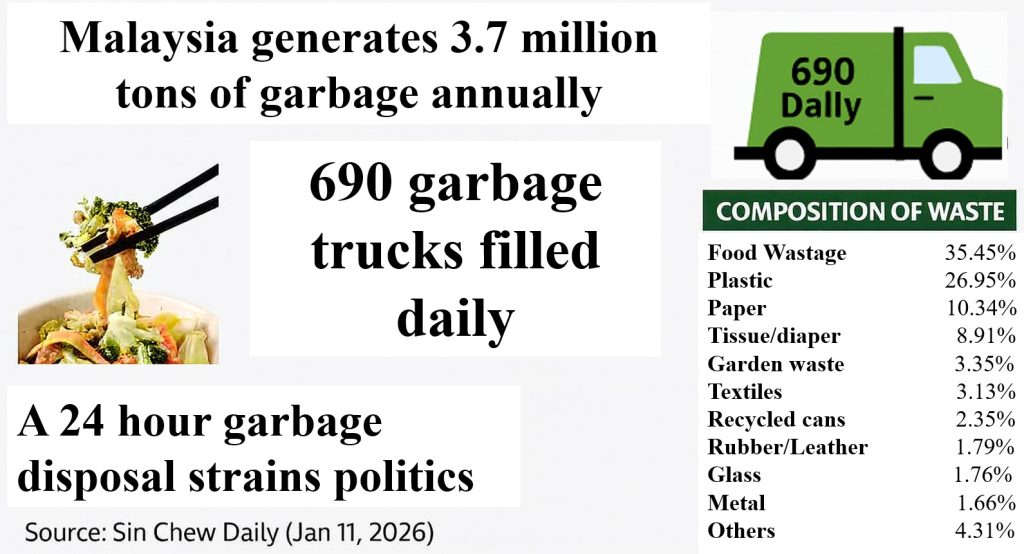
EVERY single day, Malaysia fills up 690 garbage trucks – amounting to a staggering 3.7 million tonnes of waste each year. But the most alarming figure is this: more than 10,000 tonnes of food are thrown away daily. These numbers, published by Sin Chew Daily on January 11, 2026 (national edition), are not just statistics. They reflect our everyday habits, our policy gaps and the opportunities we’ve let slip by.
This is a wake-up call for all of us – individuals, families, businesses and local authorities. We must take responsibility to manage and reduce waste, especially food waste, so that our environment remains clean, healthy and resilient. It’s time to rethink how we consume, how we discard and how we care for the spaces we share.
The Anatomy of Our Waste
The breakdown of Malaysia’s garbage reveals a troubling pattern. Food waste tops the list at 35.45%, followed by plastics (26.95%), paper (10.34%), tissue/diaper 8.91% garden waste 3.35%, textiles (3.13%), recycled cans 2.35%, rubber/leather 1.79%, glass 1.76%, metal 1.66% and others 4.31% (Sin Chew Daily – national edition, January 11, 2026).
This composition tells us two things. First, our waste is largely preventable. Second, we need a multi-pronged strategy that goes beyond collection and disposal. We must rethink how we consume, discard and repurpose.
Minimising Waste: A Community-Centred Approach
Reducing waste starts with awareness – but it must end with action. Here are three practical strategies Sarawak communities can adopt:
Food Rescue and Redistribution Networks
Local councils can partner with NGOs, supermarkets and eateries to collect surplus food and redistribute it to vulnerable groups. Apps and community fridges can facilitate this process, ensuring edible food doesn’t end up in landfills.
Composting at Source
Households and schools should be encouraged to compost organic waste. Local governments can provide subsidised compost bins and training workshops. Community gardens can use the compost to grow vegetables, creating a circular system of nourishment.
Smart Waste Segregation
Clear, colour-coded bins for food, plastics, recyclables and general waste should be standard in public spaces. Incentives – such as rebates or community points – can motivate households to sort waste properly.
Public Education: Shifting Mindsets, Not Just Behaviours
To change habits, we must first change hearts. Public education must be bold, creative and rooted in local culture. Here’s what Sarawak’s local government can implement:
Waste Warriors’ School Programmes
Embed environmental literacy into the curriculum. Let students lead zero-waste campaigns, design posters and audit their school’s garbage. Empowering youth creates ripple effects in families and neighbourhoods.
Community Roadshows and Mobile Exhibits
Bring interactive exhibits to kampungs, markets and town halls. Use visual storytelling to show the journey of waste – from bin to landfill – and the impact on rivers, forests and health.
Faith-Based and Cultural Messaging
Collaborate with churches, mosques, temples and community leaders to frame waste reduction as a moral and spiritual duty. In Sarawak, where community values run deep, this approach resonates powerfully.
Social Media Challenges and Local Champions
Launch monthly challenges like ‘Plastic-Free July’ or ‘Leftover Makeover’. Feature local heroes – teachers, hawkers, elders – who model sustainable habits. Visibility breeds inspiration.
Professional Waste Management: From Burden to Resource
Garbage is not just a problem – it’s a potential asset. Here’s how Sarawak can professionalise waste management and unlock economic value:
Decentralised Recycling Hubs
Establish mini recycling centres in every district, equipped to process plastics, paper and metals. These hubs can be run by cooperatives or social enterprises, creating jobs while reducing transport emissions.
Upcycling and Green Entrepreneurship
Encourage local startups that transform textiles into reusable bags, repurpose rubber into playground surfaces or convert food waste into eco-friendly bio-enzymes. Offer them access to grants, skills development, and market opportunities. With the right support, waste becomes a powerful resource for innovation and sustainable enterprise.
Digital Waste Tracking Systems
Use QR codes and apps to track household waste generation. This data can inform policy, identify hotspots and reward low-waste communities. Transparency drives accountability.
24-Hour Disposal Reform
The current practice of round-the-clock garbage disposal strains municipal systems. Introduce scheduled collection windows and enforce penalties for illegal dumping. This allows for better planning and resource allocation.
A Shared Responsibility
Managing waste is not the sole responsibility of government. It is a shared civic duty. Businesses must reduce packaging, schools must teach sustainability, and households must embrace mindful consumption. But leadership matters. Sarawak’s local councils must lead with vision, urgency and empathy.
Imagine a Sarawak where food waste feeds gardens, plastics become art and communities compete not in consumption, but in conservation. This is not a distant dream – it is a choice we can make today.
Let us turn our garbage into gold – not just economically, but morally and ecologically. Because in every banana peel, plastic bottle and paper scrap lies a story of who we are – and who we aspire to be.
The views expressed here are those of the writer and do not necessarily represent the views of Sarawak Tribune. The writer can be reached at drjohnlau@gmail.com.