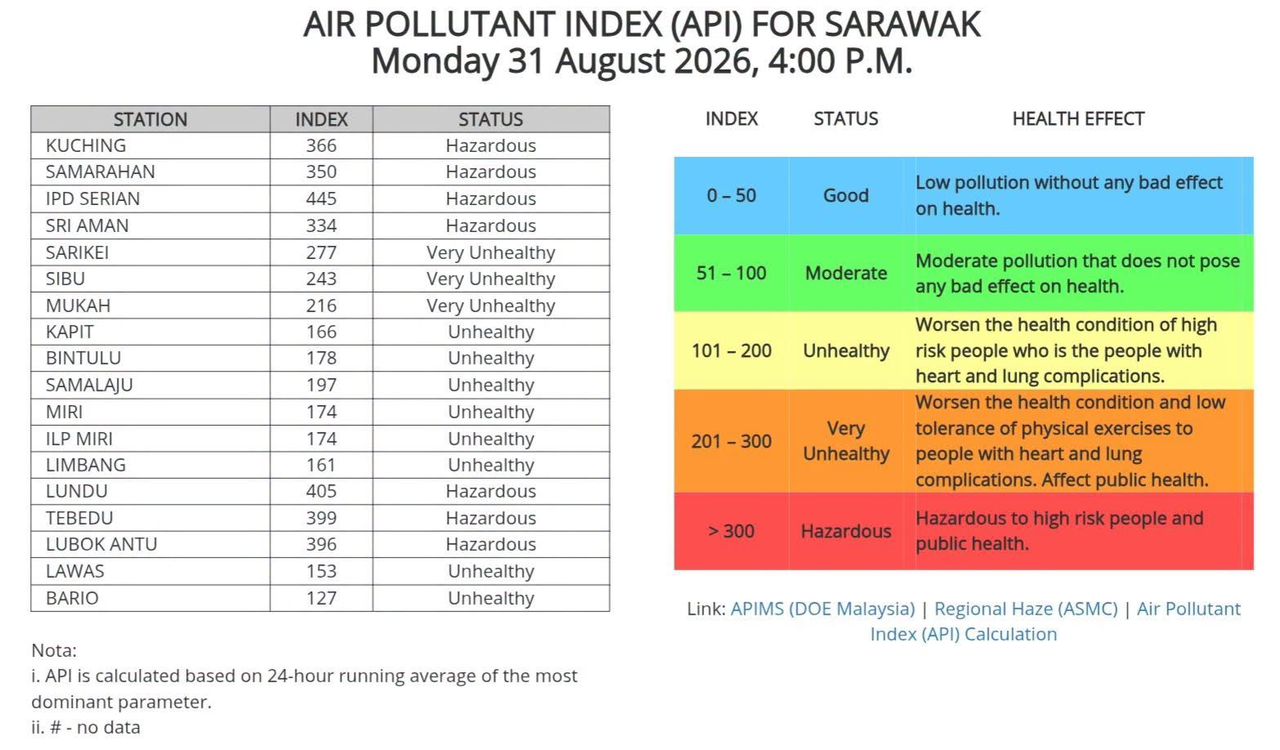
KUCHING: The Sarawak Health Department (JKNS) is closely monitoring a recent rise in haze-related illnesses as deteriorating air quality continues to affect public health across the state.
Public Health, Housing and Local Government Minister Datuk Amar Dr Sim Kui Hian said surveillance had detected an increase in some haze-related conditions in recent weeks, while reassuring the public that healthcare facilities remained prepared and adequately supplied.
“The Sarawak government, through the Ministry of Public Health, Housing and Local Government and JKNS, is closely monitoring the health impact of the current haze situation across Sarawak.
“The health of all people in Sarawak remains our priority,” he said in a statement today (Aug 31).
JKNS tracks haze-related illnesses via 15 sentinel health facilities located across the state, specifically monitoring upper respiratory tract infections (URTI), asthma, and conjunctivitis.
Between January and August, these 15 facilities recorded approximately 694,800 patient visits, which included 64,688 cases of URTI and 6,156 cases of asthma.
Following the deterioration in air quality observed since early August, surveillance shows a slight uptick in URTI cases and a more noticeable rise in conjunctivitis, while asthma activity has remained relatively stable statewide.
According to Dr Sim, average URTI cases rose from approximately 1,717 per week earlier in the year to 1,752 per week recently. Conjunctivitis cases also increased from an average of 17 to 21 cases per week.
The Deputy Premier urged the public—especially high-risk groups—to take necessary precautions.
“Poor air quality can affect everyone, but certain groups are more vulnerable, particularly infants and children, the elderly, pregnant women, outdoor workers, and individuals with existing respiratory or cardiovascular conditions,” he advised.
He recommended that the public reduce outdoor activities, stay indoors with doors and windows closed, remain well-hydrated, and wear well-fitting masks, preferably N95 respirators, when heading outside.
“I would like to assure the public that Sarawak’s health facilities are adequately prepared,” Dr Sim added.
“Current stocks of essential medical supplies, including 3-ply masks, N95 respirators, and oxygen cylinders, are sufficient based on current usage.
“The public should not be alarmed, but the risks of prolonged exposure to poor air quality must not be underestimated.”