
“The green leaves of dumplings wrap up luck… The fragrance of sweet dumplings airily floats, have a happy life many years long.”
– Lawrence Wong, Prime Minister of Singapore
THE Chinese all over the world celebrated the Dumpling Festival (also known as the Dragon Boat Festival or Duanwu Jie) last Friday (June 19).
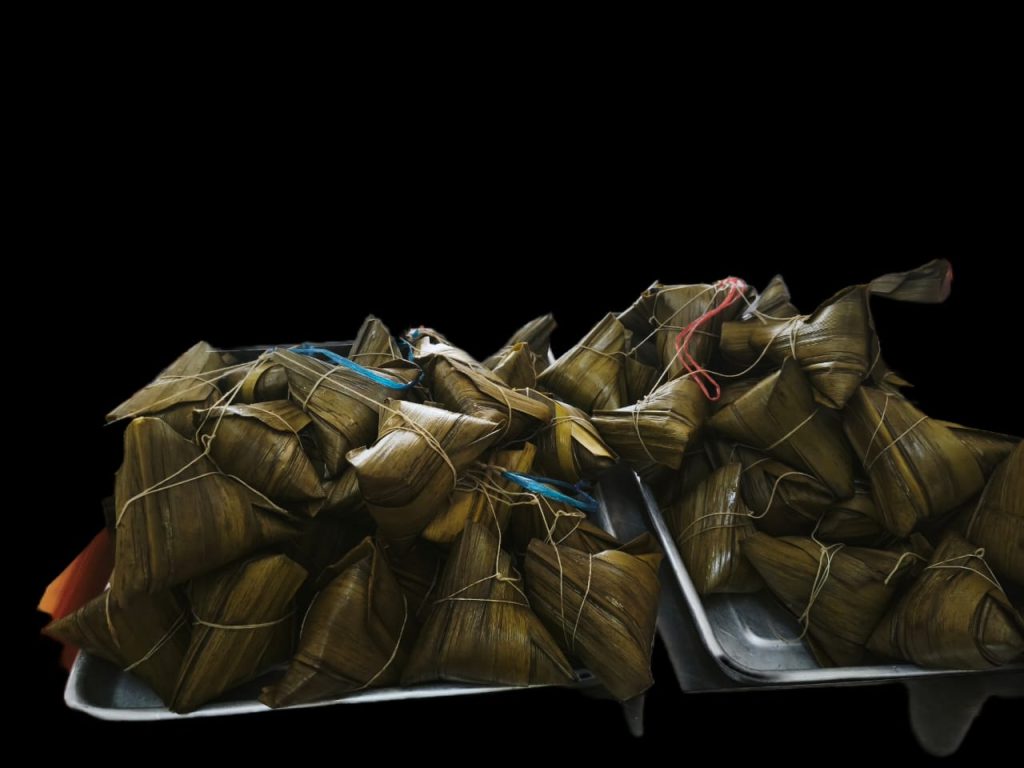
The highly significant event is usually marked by athletic boat races, vibrant festivals, and eating of the traditional sticky rice dumplings (‘zongzi’ or ‘bak chang’).
Although traditional rice dumplings are available at hawker stalls in Kuching almost all year round, a few days before the festival, big bundles of the hefty, leaf-wrapped pyramids could be seen almost everywhere.
The festival commemorates ancient Chinese poet, Qu Yuan. The legendary court official threw himself into the river as an art of protest against the leaders of the day during the Warring States period (475-221 BC).
Subsequently, his friends and supporters had to toss rice dumplings from dragon boats as baits to draw fish away from his body.
Rice dumplings are delicious to eat but making them, alas, is a deeply tedious, labour-intensive and multi-day process. It requires significant patience.
The time-consuming stages of the process are as follows:
1. Ingredient preparation
You need to prep and season many different components and you need to do this the day before.
The leaves: Bamboo and lotus leaves need to be scrubbed, soaked overnight and boiled.
The rice: Glutinous rice has to be soaked, drained and stir-fried with spices.
The fillings: Each filling – such as pork belly, mushrooms, salted egg yolks, and chestnuts – needs individual marinating, cooking and preparation.
2. Wrapping and tying
This is the hardest part for beginners. Folding the stiff bamboo leaves into a tight cone, packing the rice and fillings without tearing the leaves and sealing it into a perfect pyramid requires a lot of practice. You must also tie them securely with strings, so they don’t burst open while boiling. This can take anywhere from one to three hours, depending on your speed and batch size.
3. Long cooking times
After they are wrapped, the dumplings must be submerged and simmered or pressure-cooked for two to four hours (or even longer for certain recipes) to make sure the rice and meats inside cook through perfectly.
People traditionally make rice dumplings in the days leading up to the Dumpling Festival. The actual festival fell on June 19 this year but preparation in the kitchen would start a few days to a week in advance so families could enjoy them on the day and share them with friends or relatives.
A few days before the festival, Amelia, my daughter-in-law, was treated to a rice dumpling made by a colleague.
As for me, I could not resist buying a big rice dumpling filled with pork and chestnuts for RM6.50 at the MBKS Stutong Market near my housing estate and two small alkaline water dumplings, better known as ‘kee chang’ in Hokkien, for RM1.80 each.
The alkaline glutinous rice has a translucent amber hue and firmer yet springier texture, thanks to the alkaline water. ‘Kee chang’ is traditionally eaten with ‘kaya’ or dipped in ‘gula Melaka’ syrup. But I ate my ‘kee chang’ by dipping them in sugar.
On the day of the Dumpling Festival, Amelia gave me two yummy rice dumplings filled with minced pork.
“The ‘chang’ size is small, just the right size for small eaters like us,” she whatsapped me.
I agreed wholeheartedly with her. She had ordered them from someone in Poh Kwong Park in Kuching. Each ‘chang’ cost RM2.50.
That day, there was no family dinner for us because we were all working.
That morning, however, I managed to fry some yellow egg noodles with chicken meat and green vegetables and cook some fried chicken just to mark the festival. Later, I ate the food I cooked for lunch and dinner in the office.
That evening, as my son, Tzen, was sending me home, I told him I could make rice dumplings if I had helpers.
His reply surprised me. “Why waste your time making them? You can just buy one or two from the market. After all, you don’t eat much. It is better to use your time to do something useful instead.”
I guess my son is right. In these modern times, I am not surprised if many families do not make their own rice dumplings anymore because it is such a deeply tedious, labour-intensive and multi-day process.
Do you know that China mass-produces millions of rice dumplings, primarily centred around Jiaxing City in Zhejiang province?
The factories produce over one billion rice dumplings annually and ramp up their operations especially for the Dragon Boat Festival by utilising highly efficient production lines, vacuum–sealing and high-temperature sterilisation.
Modern mass production now extends far beyond traditional red bean paste or fatty pork. Top companies are working hand-in-hand with Michelin-starred chefs to create experimental flavours such as French-style ‘zongzi’ made with boletus broth and mushrooms or eel.
Well, my Chinese friends, how was the Dumpling Festival for you this year? How many rice dumplings did you eat before the festival, during the festival, and after the festival?
The views expressed here are those of the writer and do not necessarily represent the views of Sarawak Tribune. The writer can be reached at adelinel888@gmail.com.