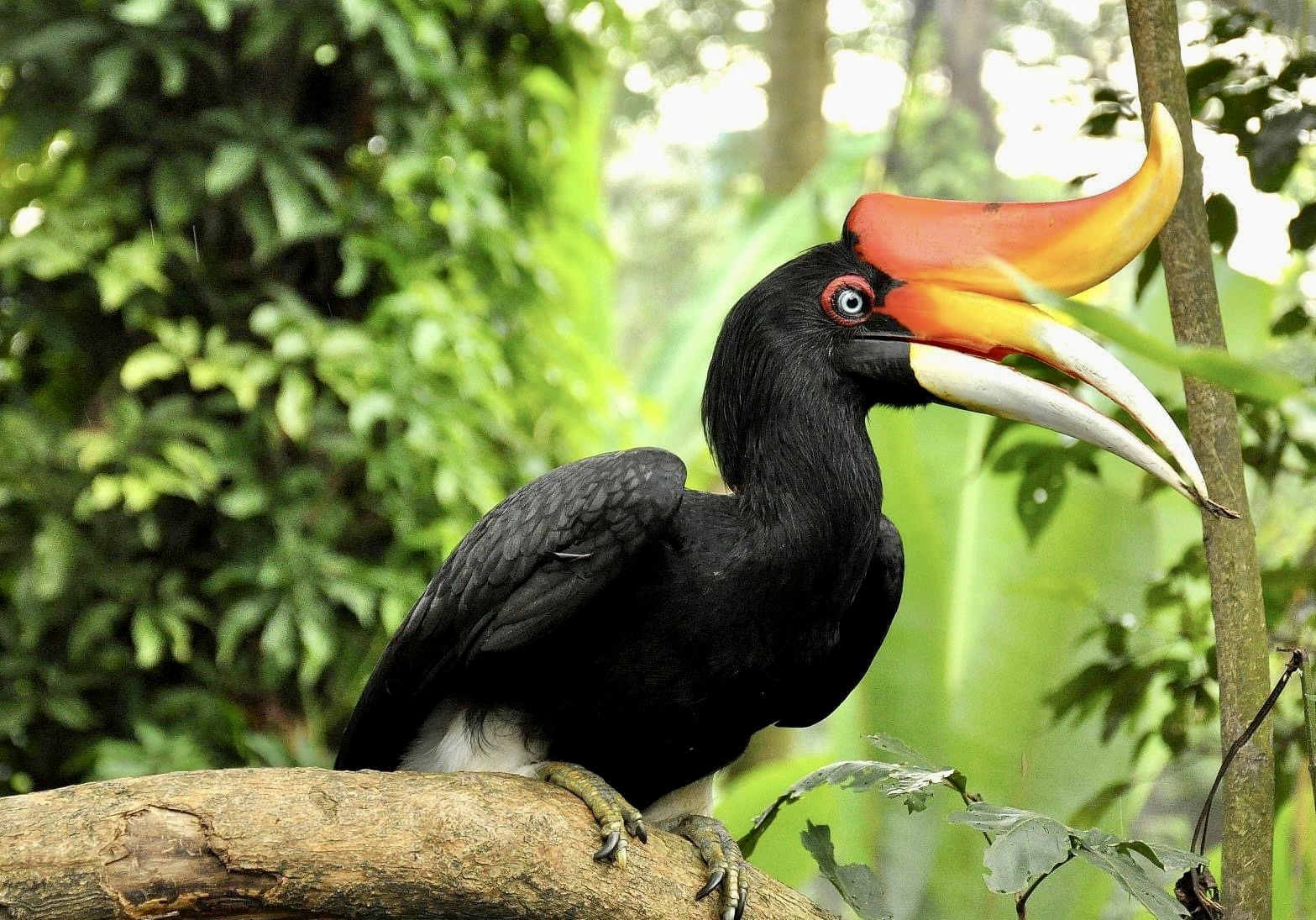
They soar through Sarawak’s forests, legends and state symbols. But as the real birds face an uncertain future, how much do we truly know about the hornbills we proudly call our own?
Bumi Kenyalang — But Do We Really Know Our Hornbills?
Hornbills are inseparable from Sarawak.
The majestic bird adorns the state crest, spreads its wings across tourism campaigns and government buildings, and gives Sarawak its proud nickname — Bumi Kenyalang, the Land of the Hornbills.
For generations, hornbills have lived not only in our forests, but also in our legends, ceremonies, carvings and identity.
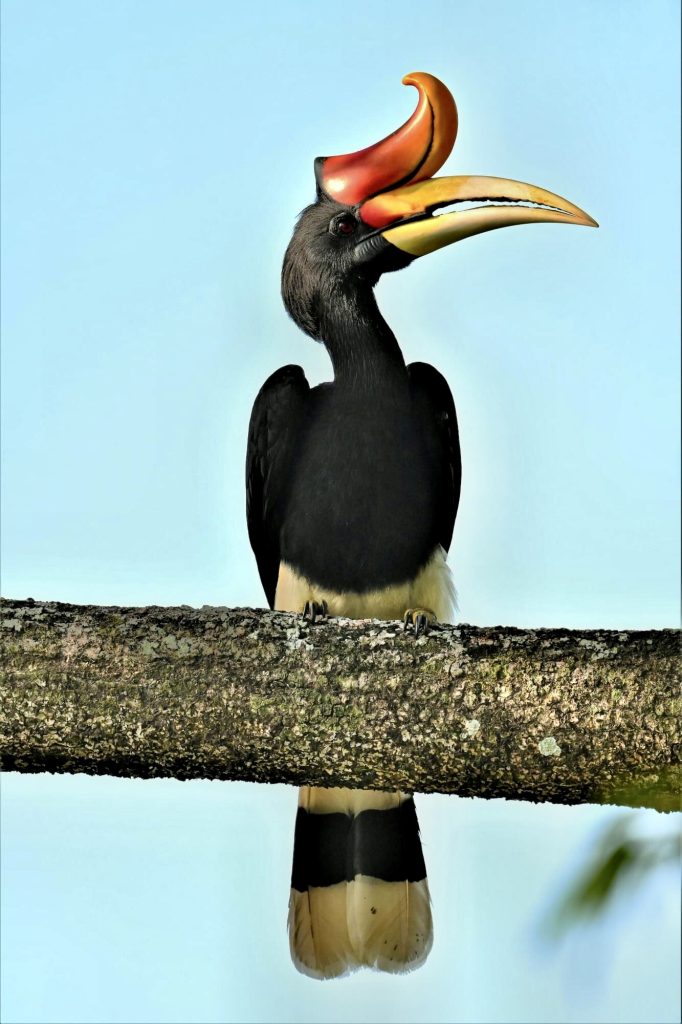
Yet for a state that proudly calls itself the Land of the Hornbills, many of us can barely recognise the birds behind the name.
That contradiction became increasingly difficult to ignore.
Scrolling through social media, passing roadside billboards and listening to everyday conversations, I noticed the same mistake repeated time and again.
The term Kenyalang was often used to describe almost every hornbill species, while images of the Great Hornbill — a species found only in Peninsular Malaysia — were sometimes used to represent Sarawak’s iconic Rhinoceros Hornbill.
At first glance, the mistake may seem trivial.
After all, a hornbill is a hornbill. Or is it?
Behind that confusion lies a larger question: how well do we truly know the bird that has become the symbol of our state?
And more importantly, what happens if the real hornbills disappear while their image continues to survive only as logos, carvings and souvenirs?
A master’s research project by Philovenny Pengiran at Universiti Malaysia Sarawak (UNIMAS), conducted in collaboration with the Sarawak Forestry Corporation (SFC), found that many respondents referred to all hornbills simply as Kenyalang, while others called them burung Sarawak, reflecting how deeply the bird is embedded in Sarawak’s identity.
Understanding that distinction matters because the birds behind the symbol are facing mounting threats in the wild.
The forest’s silent gardeners
Sarawak is home to eight of the world’s 62 hornbill species, making it an important stronghold for hornbills in Southeast Asia.
Among them is the Rhinoceros Hornbill — known to the Iban as Kenyalang — the species most closely associated with Sarawak’s identity. Easily recognised by its striking orange-red, upward-curving casque, it is the bird immortalised on the state crest.
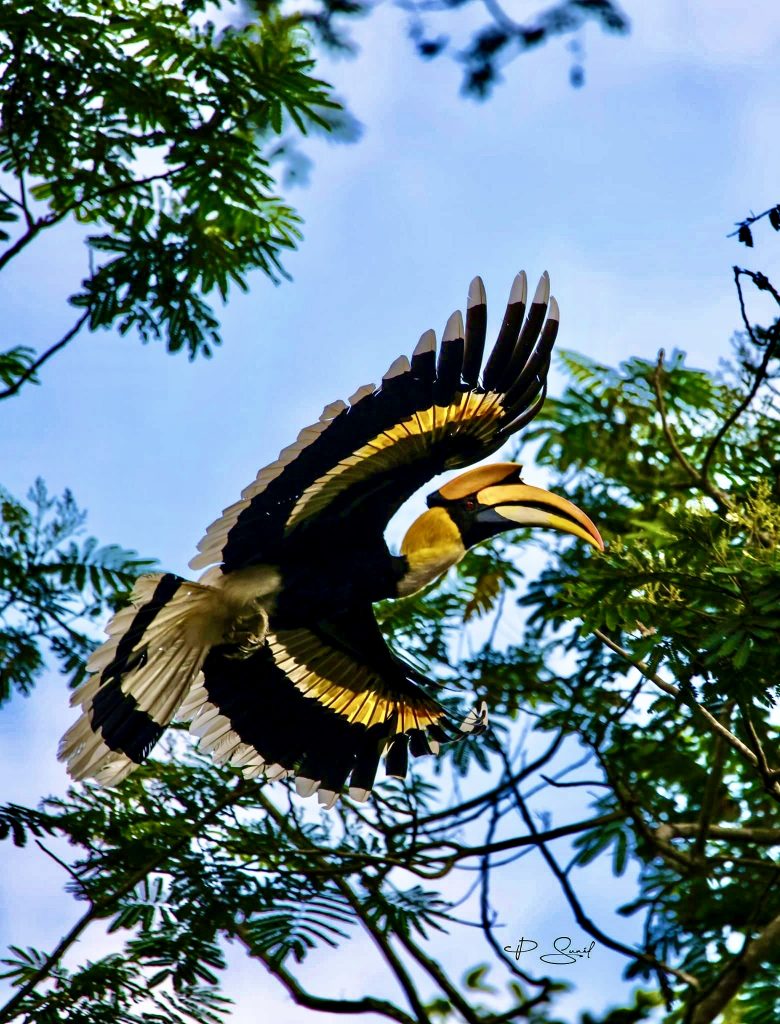
The Great Hornbill, although remarkably similar in appearance, does not occur naturally in Borneo.
Yet confusing the two reveals how easily a familiar symbol can become disconnected from the living bird it represents.
To understand why hornbills have become such enduring symbols, one must first understand the role they play in the rainforest itself.
Long before they became emblems of a state, hornbills were quietly shaping the forests of Borneo. Conservationists often describe them as the “farmers of the forest”, and for good reason.
Flying across vast stretches of rainforest in search of fruit, hornbills disperse seeds over great distances, helping forests regenerate naturally.
Their presence also tells another story: a healthy hornbill population can be an indicator of a healthy rainforest, as these birds rely heavily on mature forests rich in fruiting trees and large nesting cavities. Where hornbills thrive, ancient trees usually still stand.
Perhaps no behaviour illustrates this dependence better than the way they raise their young. Unlike many birds, hornbills do not construct conventional nests, instead relying on natural hollows found in old, towering trees.
When breeding season arrives, the female chooses a suitable tree cavity before sealing herself inside using mud, fruit pulp and droppings, leaving only a narrow slit facing the outside world.
For weeks — sometimes months, depending on the species — she remains sealed inside the cavity while incubating her eggs.
Outside, the male becomes her sole lifeline, returning day after day with fruit and other food, carefully passing each meal through the tiny opening.
Yet this extraordinary parenting strategy also makes hornbills uniquely vulnerable.
Without old-growth forests, there are no tree cavities. Without tree cavities, there are no nests. And without nests, there can be no next generation of hornbills.
Protecting hornbills is ultimately about protecting entire forests. Because wherever hornbills disappear, something much larger is usually being lost alongside them.
A bird woven into identity
Long before the Rhinoceros Hornbill became the face of Sarawak, it had already earned a place in the beliefs and traditions of many indigenous communities across Borneo.
Among the Iban, the bird is closely associated with Gawai Kenyalang, one of the community’s most significant traditional ceremonies.
According to Dr Victor Luna Amin, who now serves as chairman of the Gunung Lesong Community-Based Ecotourism Development Committee, carved wooden hornbill effigies once stood at the heart of the ritual, symbolising courage, prestige and spiritual power.
“The Rhinoceros Hornbill itself has no ritual significance, but its carved wooden icon was perceived to possess significant ritual meaning,” he said.
Beyond the Iban community, Helmeted Hornbill casques were once carved into earrings worn by Orang Ulu aristocrats, while hornbill feathers adorned ceremonial attire among several indigenous communities.
For generations, the bird represented honour, protection and identity.
Yet admiration sometimes came at a cost.
Research by Bennett et al. (1997), later supported by Amin and Ripot (2017), estimated that supplying enough tail feathers for the ceremonial hand displays of a single Orang Ulu dancer could require four Rhinoceros Hornbills to be killed.
Fortunately, traditions have evolved.
Today, many communities have replaced real hornbill feathers with synthetic alternatives, preserving the beauty and symbolism of their cultural attire without taking birds from the wild.
That shift shows culture and conservation can evolve together.

When a casque becomes ‘red ivory’
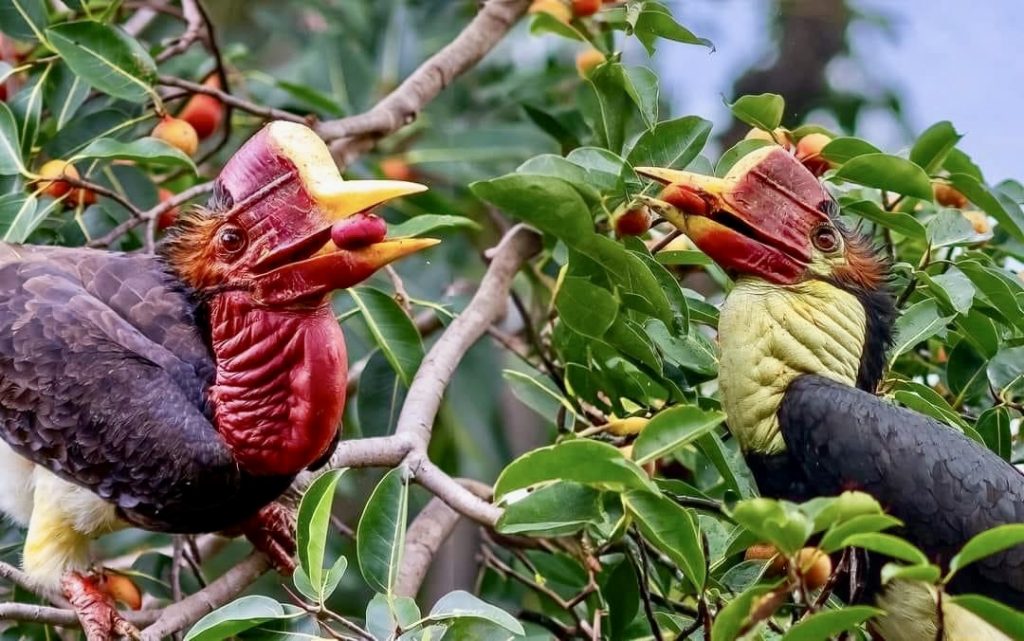
Among Sarawak’s eight hornbill species, none has paid a heavier price than the Helmeted Hornbill.
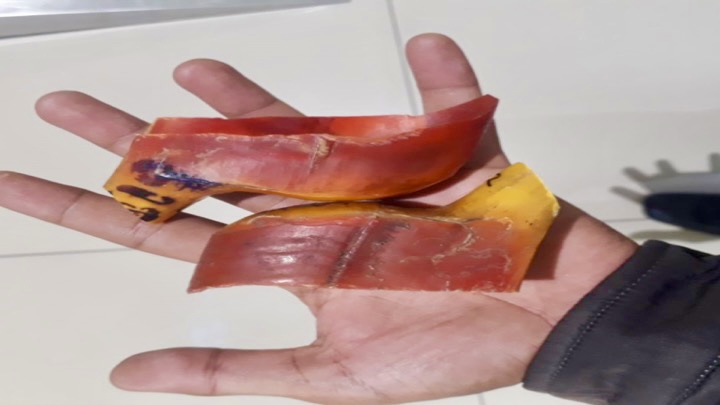
Unlike those of other hornbills, the Helmeted Hornbill’s casque is dense and solid. Known internationally as “red ivory”, it can be intricately carved into jewellery, figurines and luxury ornaments.
According to Dr Victor, the trade in Helmeted Hornbill ivory dates back centuries, when Borneo maintained flourishing trade links with China.
“The Chinese carvings of hornbill ivory were exquisite,” he said, explaining that the material was crafted into belt buckles, seals, bracelets, snuff boxes and other luxury items.
Today, although international wildlife laws and the Convention on International Trade in Endangered Species of Wild Fauna and Flora (CITES) have greatly reduced legal trade, illegal demand continues to threaten the species.
Conservation organisation TRAFFIC has documented that much of the demand for Helmeted Hornbill casques remains concentrated in China and parts of Southeast Asia, where the carvings are sold on the black market.
Some reports have even suggested that hornbill ivory has, at times, commanded prices higher than elephant ivory.
Behind every carved ornament lies a bird that never returned to the forest.
The Helmeted Hornbill’s plight shows how even iconic wildlife can disappear when demand outweighs protection.
Statistics from SFC’s Enforcement and Protection Division illustrate the scale of the challenge.
Between 2019 and the second quarter of 2023, authorities opened 16 investigation papers involving hornbill-related wildlife crimes. Enforcement officers seized more than 1,100 hornbill feathers, 184 hornbill casques and one live hornbill.
More recent figures suggest that enforcement efforts may be making an impact. According to the corporation, only one hornbill-related case has been recorded so far in 2026.
While a single case does not necessarily indicate that the threat has disappeared, it may reflect stronger enforcement, increased public awareness and growing recognition of the need to protect one of Sarawak’s most iconic species.

Saving the birds behind the symbol
Illegal hunting is only part of the story.
The greatest long-term threat to hornbills remains the steady disappearance of the forests they call home.
Logging, land clearing and forest conversion continue to remove the mature trees that provide food and nesting cavities. Roads built into once-remote forests also create easier access for poachers.
For a bird that depends entirely on old-growth forests, every lost tree is more than timber.
It is a lost home.
In response, SFC has strengthened conservation through habitat protection, enforcement, community partnerships and public awareness programmes.
Philovenny agrees that public engagement is central to those efforts. She believes education will ultimately determine the future of hornbill conservation — starting with something as simple as helping people recognise the birds behind one of Sarawak’s most enduring symbols.
Her research found strong public support for greater engagement through talks, awareness campaigns and social media to improve understanding of hornbills and their ecological importance.
Perhaps conservation begins not only with stricter laws or larger protected areas, but with something far simpler — recognising the birds we proudly claim as our own. Because if we fail to know them, we may one day be left with only the symbol, and not the living bird itself.
Sarawak proudly calls itself Bumi Kenyalang.
If one day the forests fall silent, the hornbill may still soar from the state crest. It may still appear in carvings, murals, souvenirs and tourism campaigns. Children may still grow up hearing the words Bumi Kenyalang.
For a land that proudly bears the hornbill’s name, that would be the greatest loss of all.