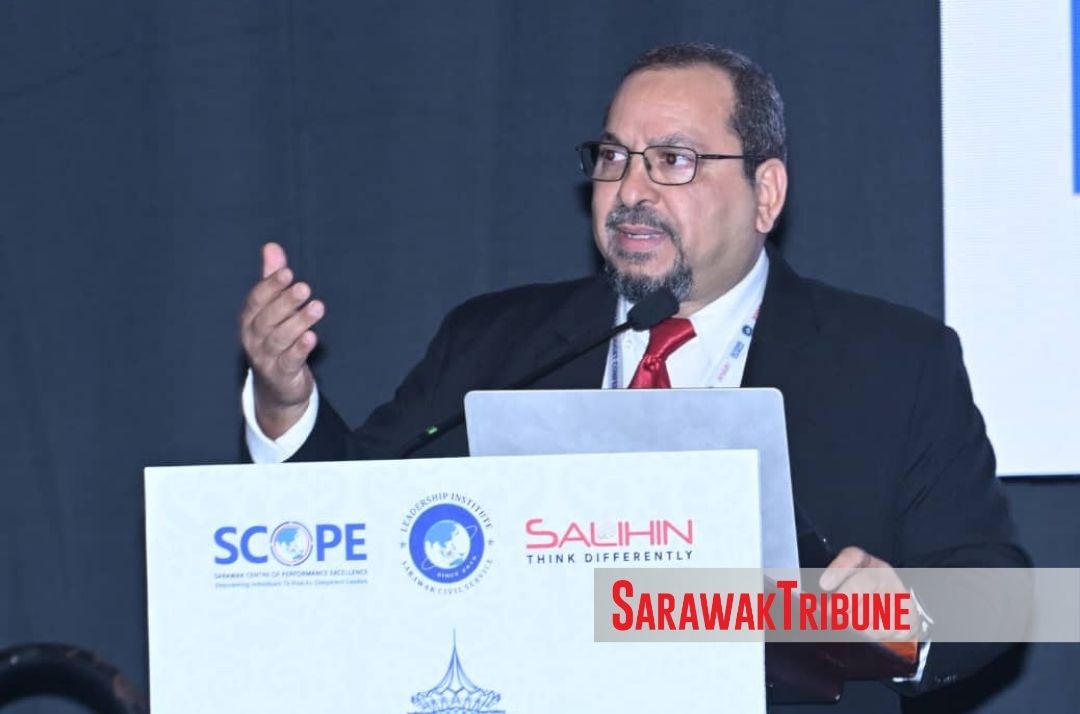
KUCHING: Islamic finance should be viewed as an ethical and substance-driven financial system, rather than a framework tied solely to religion, says SALIHIN Shariah chief executive officer (CEO) Dr Ahcene Lahsasna.
He said as Sarawak explores sustainable and inclusive economic growth aligned with the Sustainable Development Goals (SDGs), Islamic finance instruments such as sukuk were widely adopted by conventional financial institutions and non-Muslim countries, reflecting their appeal beyond faith considerations.
“Islamic finance is not about faith or religion. When a sukuk is issued, it is subscribed more by conventional banks than Islamic banks,” he explained.
Dr Ahcene said this during a speaker session titled ‘Sustainable Ethical Economic Growth in Sarawak through SDGs and Social Finance’ at the 2026 Sarawak Budget Conference (SBC) here today (Dec 16).
Sukuk are Shariah-compliant financial instruments similar to Islamic bonds, structured to avoid riba (interest) by giving investors ownership in underlying assets or projects rather than lending money for interest-based returns.
In Malaysia, sukuk structures are endorsed by the Securities Commission Malaysia’s Shariah Advisory Council and generate income through asset performance, such as rental income or profit-sharing.
Dr Ahcene said non-Muslim countries were among the dominant sukuk subscribers, including China, Japan, South Korea, Singapore and Hong Kong, noting that the Hong Kong government had issued sukuk on two occasions.
He also said Islamic finance education in Malaysia ranked second globally, behind the United Kingdom, which is a non-Muslim country.
“This shows it is not about religion or race, but about substance, content and ethics,” he said.
Dr Ahcene added that Malaysia’s first sukuk issuance was by Shell, a non-Muslim entity, showing that Islamic finance was driven by ethics rather than religion.
On implementation, his presentation outlined several enablers to support ethical and sustainable finance, including government support through policy incentives and regulatory sandboxes, as well as alignment with Sarawak’s Post Covid-19 Development Strategy (PCDS) 2030.
The framework also highlighted the importance of partnerships involving Islamic financial institutions, non-governmental organisations, cooperatives and local communities, alongside Islamic capital market and wealth management infrastructure to finance renewable energy projects, sustainable roads and eco-housing, particularly in remote areas.
It further pointed to digitalisation, including the use of blockchain to enhance transparency in waqf, zakat and social finance disbursement, as well as capacity building through financial literacy programmes and skills training for rural communities.