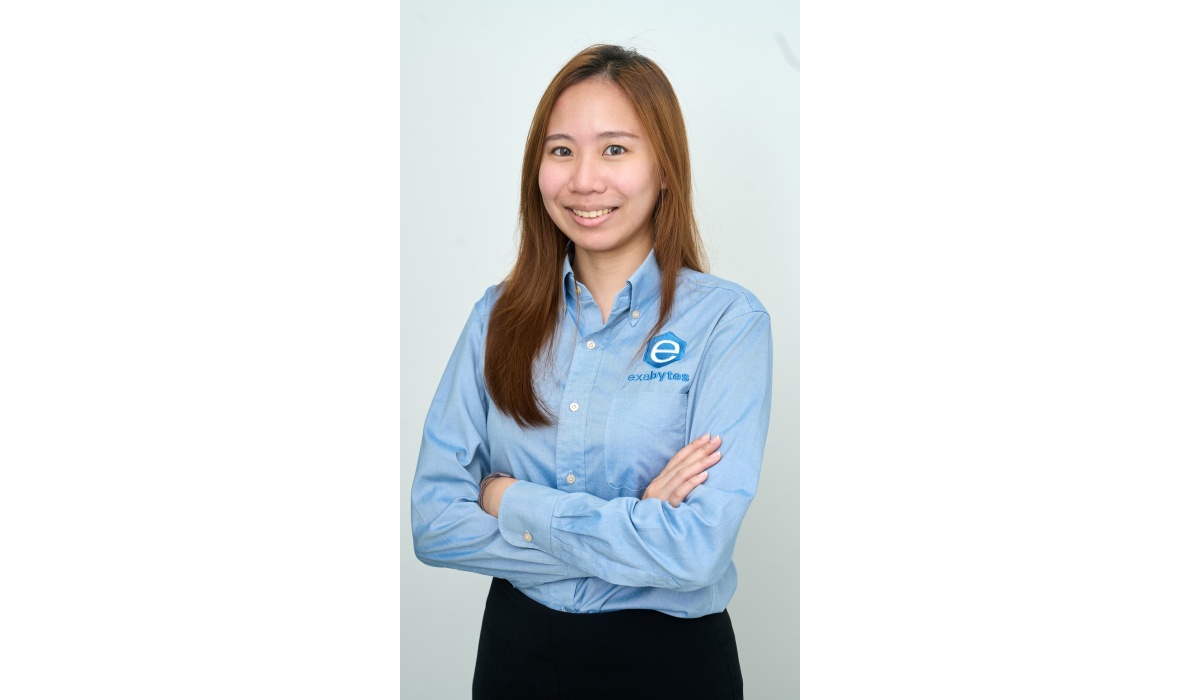
As Malaysia’s demand for cloud talent grows, technical skills and certifications alone aren’t enough. Exabytes technical specialist Khoo Sher Lyn explains what it truly means to be “job-ready” in live cloud environments — from troubleshooting systematically to building confidence, fostering fundamentals, and supporting women in tech.
Why fundamentals and confidence matter more than credentials
As Malaysia’s demand for cloud talent continues to grow, conversations often focus on certifications and technical skills. But in real production environments, the definition of “job-ready” can look very different.
For Exabytes technical specialist Khoo Sher Lyn, readiness is less about memorising tools and more about habits — troubleshooting systematically, understanding how systems connect, and operating responsibly when real clients and live systems are involved.
She shares with Sarawak Tribune what fresh graduates often struggle with first, why fundamentals still matter in today’s cloud landscape, and how better support can help strengthen Malaysia’s future cloud workforce.

Q: When you say someone is job-ready for cloud work, what does that actually mean in a live production environment?
In production, job-ready means you can contribute safely. You don’t need to know everything, but you must have the habits that protect reliability: understand fundamentals, follow security basics, troubleshoot methodically, document clearly, and communicate what you’re doing.
Fresh graduates often struggle first with operating under uncertainty:
- translating theory into real workflows
- reading logs and alerts to narrow down causes
- knowing what’s safe to change
- documenting what they did and why
- escalating issues with the right context
For me, the most relatable struggle is learning to ask “Why?” instead of just saying “Yes.” Fresh graduates are often eager to prove they are helpful. If a client says, “I need this complex workaround,” their instinct is to build it immediately. They struggle to hit the brakes and ask investigative questions such as, “What is the actual goal here?” or “Is there a simpler way to do this?” They mistake “doing exactly what is asked” for “doing a good job.” It takes time for them to learn that sometimes, the best way to help a client is to challenge their request, not just fulfil it.
Q: What’s the biggest misconception juniors have about cloud roles?
That cloud work is mostly about memorising services or spinning up resources. In reality, cloud work is about responsibility: reliability, cost, security, and recovery. It’s closer to operations and systems thinking than “just build and deploy.”
Q: Are fundamentals weaker today compared to five years ago?
Not weaker, but different. There’s more access to tools and tutorials now, so people can build quickly.
What I see most often is that, because modern tools are so intuitive, people learn “how to click” rather than “how it connects.”
In my line of work, it is very easy to build a workflow or a database without writing code. The gap in fundamentals usually appears when things break. I often see people struggling to troubleshoot because they don’t understand the underlying logic — like how permissions inherit or how data flows between tables. They know the feature, but they lack the system thinking to understand why it works (or doesn’t).
Q: How important is structured troubleshooting compared to memorised commands?
Structured troubleshooting is far more important. Commands change. Interfaces change. But the ability to form a hypothesis, test it using evidence (logs/metrics), and isolate the problem is what makes you reliable in production. It also earns the trust of your team sooner.
Q: Can you describe a situation where strong fundamentals made a difference during an incident?
Yes. Strong fundamentals often decide whether an incident is a 10-minute fix or a multi-hour escalation.
A great example happened during a Day 1 rollout for a retail client. We had just onboarded their frontline staff, and immediately received a flood of reports from users unable to “Clock In” because the app said they were “Out of Range.”

The Signal: The error message was identical for everyone: “Location not verified.”
The Fundamental: Understanding Mobile Device Permissions vs. Application Logic was crucial. A generic “Out of Range” error can mean two things: either the user is physically at the wrong place, or the phone’s operating system is blocking the app from reading GPS data. Because the error messages look the same, experience is needed to know where to look first.
What I Did: Instead of wasting hours re-mapping backend coordinates, I immediately suspected the OS-level Location Services. Most staff had likely clicked “Don’t Allow” on the location pop-up during installation. I listed the exact steps to solve it: go to Settings > Privacy > Enable Location “While Using the App”, then force quit and reopen the app to refresh location data.
Outcome: The issues were resolved within minutes. In retail operations, time is money, and knowing that a simple app refresh was the missing link saved the client a morning of lost productivity.
Q: Did seeing women in technical roles influence your confidence?
Yes. It signals “this is possible.” It reduces the feeling that you’re an exception. Representation matters because it makes it easier to ask questions and learn without feeling judged. It’s not about inspirational quotes; it changes everyday confidence and participation.
For me, inspiration comes from the community at our Lark events. Whenever I see women speakers take the stage to share their digital transformation journeys, I am drawn to their confidence and clarity. It’s not just technical skill; it’s about vision and execution. Seeing that reminds me that technical leadership requires both and motivates me to define my own path with intent.

Q: Does representation affect retention more than hiring?
It affects both, but it is especially important for retention. Hiring gets you through the door. Retention depends on whether you feel you belong, whether your growth is supported, and whether you can see a clear pathway forward. Representation helps create that environment and reduces self-selection when challenges arise.
Q: What practical steps help women stay in cloud teams?
- Three practical measures:
- Early ownership with guardrails (not just shadowing forever)
- Structured mentorship (milestones and feedback, not “DM me anytime”)
- Progression visibility (what skills define the next level and how to achieve them)
Culture also matters: whether questions are welcomed, whether mistakes become learning opportunities, and whether time for learning is protected.
Q: If Malaysia wants to avoid a cloud skills bottleneck by 2026, what must change in the next 12 months?
We need faster conversion from learner to contributor:
- Employers must design structured exposure (shadow → guided tasks → ownership)
- Teams must value fundamentals, troubleshooting, and documentation as core skills
- Candidates must build proof of work (projects and write-ups), not just collect certificates
- A stronger ecosystem pipeline must link to measurable outcomes (completions, certifications, placements)
As mission-critical workloads move into local cloud regions, the demand for operationally ready talent will only increase.
As cloud adoption accelerates, technical capability will depend on more than credentials. According to Khoo, building a reliable cloud workforce requires strong fundamentals, structured troubleshooting skills, and the confidence to operate responsibly in live environments.
For Exabytes, this means helping newcomers move beyond theory into real-world problem solving through mentorship, early ownership, and clear growth pathways. As businesses shift mission-critical workloads into the cloud, the ability to convert learners into capable contributors will be key to strengthening Malaysia’s long-term digital capacity.