SMOKING remains a significant public health and economic challenge in Malaysia, with tobacco-related illnesses contributing to countless preventable deaths each year and placing immense pressure on the country’s healthcare system.
The global tobacco epidemic has forced governments to adopt varying approaches to reduce smoking prevalence, ranging from traditional cessation campaigns to innovative harm reduction strategies.
While Malaysia has made strides in tobacco control, there is much to learn from other countries that have implemented more progressive policies.
Japan, New Zealand and Thailand offer valuable case studies that highlight both the successes and limitations of different approaches to reducing smoking rates.
A growing body of evidence supports the role of harm reduction in accelerating declines in smoking prevalence.
Tobacco harm reduction is a pragmatic approach that recognises the addictive nature of smoking and seeks to minimise its harm by providing smokers with less harmful alternatives to traditional cigarettes.
This strategy stands in contrast to conventional cessation-only methods, which often focus on quitting entirely and may not be feasible for adult smokers who chooses not to quit smoking.
Countries like Japan and New Zealand have demonstrated how embracing harm reduction can lead to significant public health benefits, while Thailand’s restrictive policies serve as a cautionary tale of what can happen when smoke-free alternatives are excluded from the equation.
Japan’s Success with Heated Tobacco Products (HTPs)
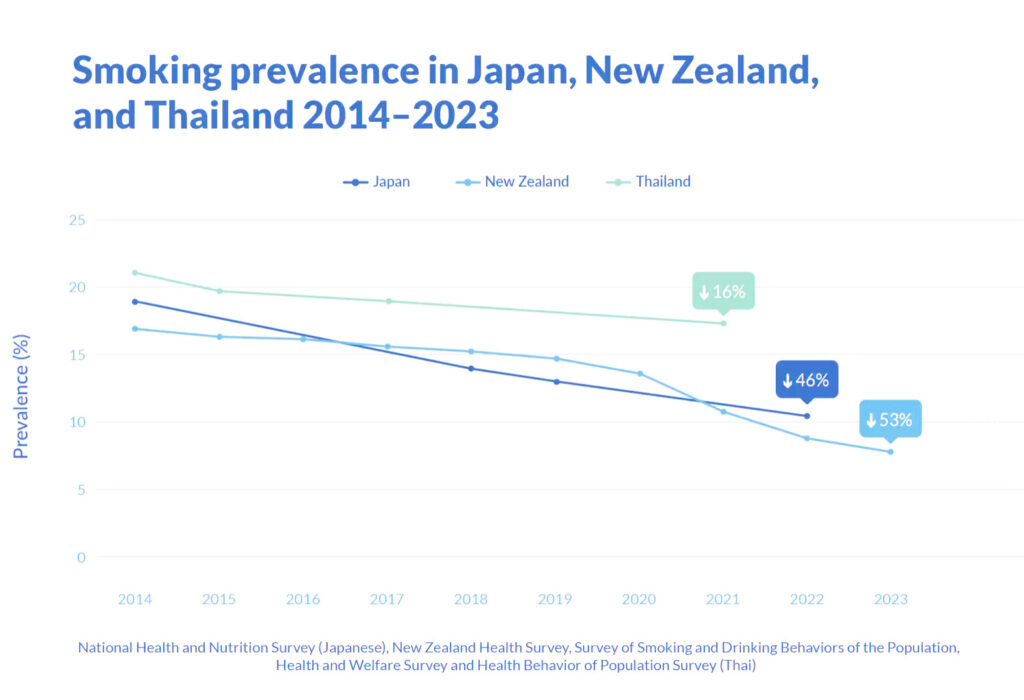
Japan has emerged as a global leader in tobacco harm reduction, achieving a remarkable 46 per cent decline in smoking rates between 2014 and 2022.
This success is largely attributed to the introduction and widespread adoption of heated tobacco products (HTPs), which have transformed the country’s tobacco market.
Unlike traditional cigarettes, HTPs heat tobacco to release nicotine without burning it, significantly reducing the levels of harmful chemicals produced.
The availability of HTPs in Japan offered smokers a viable alternative to combustible cigarettes, enabling them to transition to a less harmful option without the need for abrupt regulatory changes.
This approach complemented the country’s existing tobacco control measures, which include public smoking bans and educational campaigns, by providing smokers with additional tools to reduce harm.
The success of HTPs in Japan demonstrates the importance of innovation in tobacco control, proving that smoke-free alternatives can coexist with traditional policies to accelerate declines in smoking prevalence.
New Zealand’s Comprehensive Tobacco Control Framework
New Zealand has gone even further in integrating harm reduction into its tobacco control strategy, achieving a 53 per cent reduction in smoking rates between 2014 and 2022.
This impressive achievement can be attributed to the country’s comprehensive approach, which combines traditional tobacco control measures with access to smoke-free alternatives such as e-cigarettes and HTPs.
New Zealand’s policies reflect a deep understanding of the challenges faced by smokers and the need for a supportive environment that encourages behavioural change.
By regulating e-cigarettes and HTPs, the government ensured that these products were available to adult smokers who needed them, while also implementing strict measures to prevent misuse among youth.
Public education campaigns further reinforced the message that switching to less harmful alternatives could significantly reduce the risks associated with smoking.
The success of New Zealand’s approach highlights the potential of harm reduction to complement cessation programmes and enhance public health outcomes.
By creating a policy framework that prioritises the needs of smokers while addressing broader public health concerns, New Zealand has set a global example of how progressive policies can drive meaningful change.
The Limitations of Bans: Lessons from Thailand
While Japan and New Zealand have embraced harm reduction, Thailand provides a contrasting example of the limitations of prohibitionist approaches.
Despite implementing some of the strictest tobacco control measures in the region, Thailand achieved only a modest 16 per cent decline in smoking rates between 2014 and 2021.
This slow progress can be attributed in part to the country’s decision to ban all smoke-free alternatives, including HTPs and e-cigarettes.
By restricting access to less harmful products, Thailand effectively limited the options available to smokers who might otherwise have switched to alternatives with lower health risks.
This policy not only pushed many smokers to continue using combustible cigarettes but also fuelled the growth of illicit markets for tobacco and smoke-free products.
The situation in Thailand emphasises the risks of relying solely on traditional tobacco control measures without incorporating harm reduction strategies.
Real-World Evidence Supporting Tobacco Harm Reduction
According to Dr Patrick Picavet, who is the Chief Medical Officer at PMI, real-world evidence can illuminate the human health consequences of regulatory inaction on tobacco harm reduction.
Dr Picavet explains that while real-world analyses come with limitations, they can supplement pre-clinical and clinical studies – and offer early insights into the potential impacts when governments fail to embrace harm reduction measures.
He points to Sweden as a clear example: since the introduction of oral tobacco products like pouched snus (launched in 1973) and tobacco-free nicotine pouches (introduced in 2016), cigarette sales have declined, and smoking prevalence has dropped from about 35 per cent in 1980 to around 6 per cent today.
This shift has been accompanied by reductions in ischemic heart disease and lung cancer among Swedish men, who now experience some of the lowest rates of tobacco-related mortality in the EU.
Dr Picavet emphasises that there are sufficient data to justify pragmatic actions to reduce cigarette use – and that regulatory inaction carries significant costs to human health.
Moreover, he warns that neglecting tobacco harm reduction limits adult smokers’ opportunities to transition to less harmful alternatives.
Why Harm Reduction Matters for Malaysia
Malaysia’s tobacco control efforts have largely focused on conventional measures such as taxation, public smoking bans, and health awareness campaigns.
While these strategies have yielded some success, the country continues to grapple with high smoking prevalence and the associated health and economic costs.
Based on the 2023 Global Adult Tobacco Survey (GATS), it is noted that 19.5 per cent of the overall total adult population of Malaysia (4.8 million adults) use tobacco products.
Smoking-related diseases remain a leading cause of preventable deaths in Malaysia, placing a significant burden on families, communities, and the healthcare system.
Adopting harm reduction as a core component of Malaysia’s tobacco control strategy could help the country achieve faster and more substantial declines in smoking prevalence.
By providing smokers with access to regulated smoke-free alternatives such as HTPs and e-cigarettes, Malaysia could create a supportive environment that encourages smokers to transition away from combustible cigarettes.
The benefits of harm reduction extend beyond individual health outcomes.
Reducing smoking prevalence could lead to significant cost savings for Malaysia’s healthcare system, which currently spends billions on treating smoking-related illnesses.
Furthermore, addressing the black market for cigarettes through regulated harm reduction measures could enhance enforcement efforts and reduce the economic losses associated with illicit trade.
Lessons from Global Success Stories
The experiences of Japan, New Zealand and Thailand offer valuable insights into how Malaysia can improve its tobacco control policies.
Japan’s success with HTPs demonstrates the importance of innovation and consumer choice in reducing smoking rates.
By offering smokers a less harmful alternative to traditional cigarettes, Japan created a pathway for gradual change that complemented existing policies.
New Zealand’s comprehensive approach shows how integrating harm reduction into a broader tobacco control framework can yield even greater results.
The country’s emphasis on regulation, public education, and support for smokers highlights the importance of creating a supportive environment that facilitates behavioural change.
On the other hand, Thailand’s experience highlights the risks of exclusionary policies that fail to account for the needs of smokers.
By banning smoke-free alternatives, Thailand limited the options available to smokers and inadvertently slowed progress in reducing smoking rates.
This highlights the importance of striking a balance between regulation and accessibility to achieve meaningful public health outcomes.
References:
1. PMI Science. Smoke-free alternatives helped Japan and New Zealand halve smoking in a decade—but Thailand’s ban has stalled progress. https://www.pmi.com/our-progress/smoke-free-products-in-japan-and-the-uk-help-accelerate-a-decline-in-smoking-rates-beyond-that-of-australia-where-they-are-prescription-only
2. Tobacco Reporter. Thailand: Despite Ban, Vaping Surges with Teens. https://tobaccoreporter.com/2025/02/04/thailand-despite-ban-vaping-surges-with-teens/
3. The Nation. E-cig users push for legalisation after ban proves ineffective. https://www.nationthailand.com/news/general/40038434
4. GATS 2023. https://iku.nih.gov.my/images/gats2023/gats-factsheet1-2023.pdf
5. PMI.Q&A with Dr. Patrick Picavet, PMI’s Chief Medical Officer. https://www.pmi.com/our-science/assessing-product-health-impacts/questions-answers-patrick-picavet-chief-medical-officer-philip-morris-international