Once a thriving gold-mining settlement, Maw San in Bau, Sarawak, is now a quiet reminder of the past. From the remnants of miners’ communities and Liu Shan Bang’s memorial to the tranquil waters of Tasik Biru, the area preserves stories of ambition, rebellion, and resilience, while plans for a museum aim to share its history with visitors.
Remembering Maw San
Two centuries ago, the area rang with the clanging of chisels, the rumble of earth, and the restless hopes of thousands of gold miners.
Today, the same land sits quiet beneath the sun, its past whispered only through memorials, lake reflections, and the memories of an industrious community.
This is Maw San, once a thriving gold haven, now a modest, reflective corner of Bau and Sarawak’s heritage.
In present-day Bau, the name “Maw San” still lives on, not through bustling markets or mining pits, but through preserved remnants and a growing appreciation for local heritage.
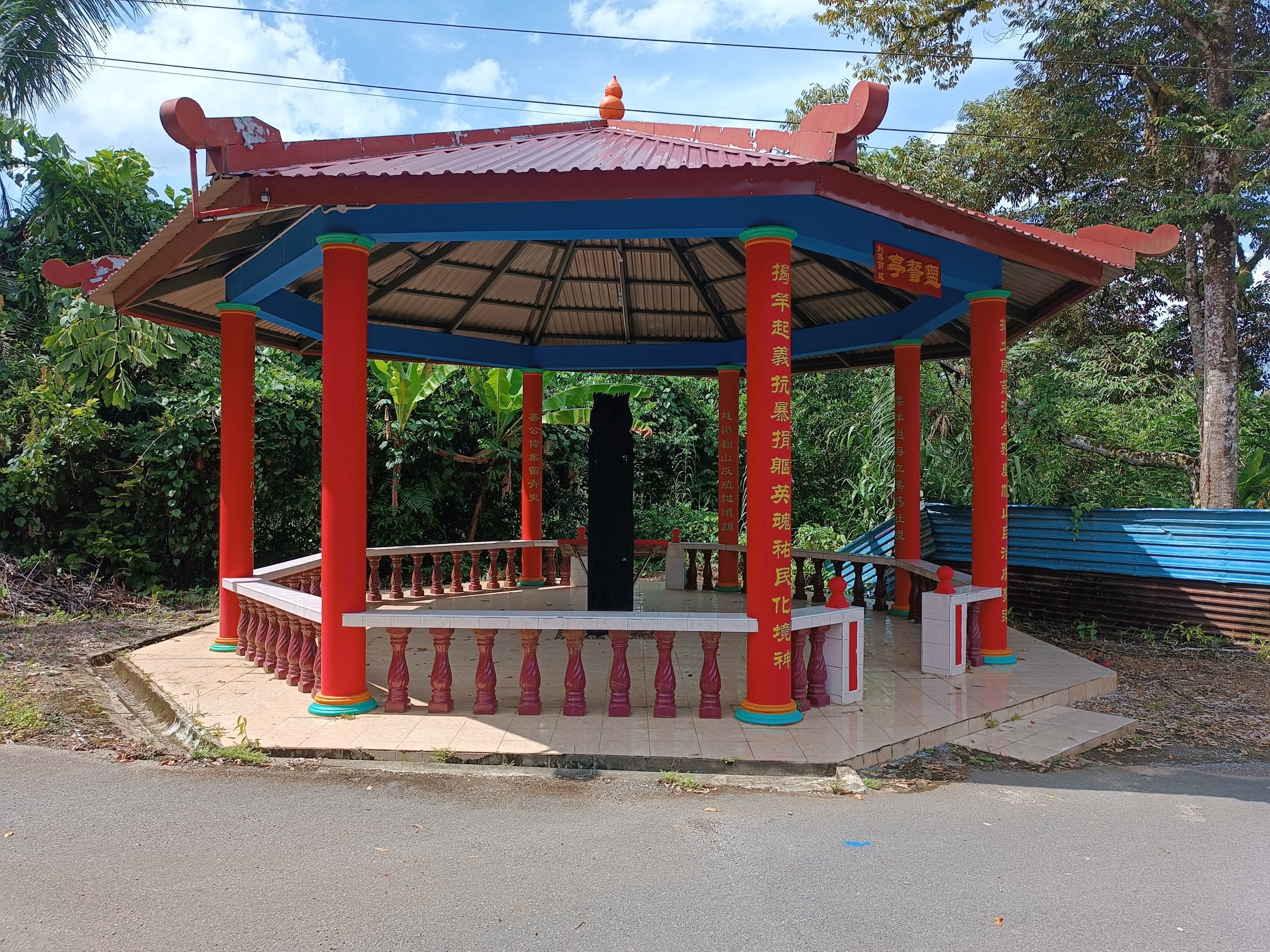
One of the few tangible artefacts of Maw San is a black wooden pillar at a small Chinese pavilion on Lorong Bau Lama 1.
Thought to be the remains of a Kongsi flagpole, it symbolises the authority and unity of the miners who once called this settlement home.


Charred by time yet stubbornly intact, it stands as a testament to a people who built community amid hills and hardship.
Nearby, a modest shrine to Liu Shan Bang receives incense and prayers from descendants and visitors.
Perhaps, for many Hakka families, he is not merely a rebel leader but a folk hero — a symbol of struggle, sacrifice, and identity.
In 1993, Liu was formally recognised as a hero of Sarawak, and a Heroes’ Monument Park was established in his honour.
The gesture marked a turning point: the story of Maw San shifted from a forgotten conflict to a chapter of pride and remembrance.
To the south of the old settlement lies Tasik Biru, one of Bau’s most beautiful reminders of Maw San.
After mining operations ceased, the pit filled with rainwater, transforming into a serene blue lake.
Today, it is a recreational spot for locals and tourists, its serene waters belying a turbulent past.
Visitors enjoy scenic views along the banks; adults and children paddle across the surface where miners once laboured, while hikers journey along trails skirting the limestone hills on the other side of the lake, seeking both history and natural beauty.
The landscape has softened, but its history still echoes beneath.
While physical remnants anchor Maw San’s history, the town’s cultural memory continues to preserve its legacy.

Deputy Minister for Transport and Tasik Biru assemblyman Datuk Henry Harry Jinep said the Sarawak government has approved plans for a Bau Goldmining Museum, aimed at interpreting Maw San’s history for visitors.
He said they are now waiting for the State Building Committee to approve the building, which will be located near Le Papa, towards the end of the small pond by Tasik Biru.
“The museum is going to display exhibits and written history about mining. The study has been done by a consultant, so the storyline will be based on what the consultant has prepared.
“Combined with the proposed Bau Tourism & Cultural Park, linking Bukit Young ruins, Ghost Cave, Tasik Biru and other landmarks, the initiative seeks to preserve authenticity while providing educational and tourism opportunities.
“Except for the museum, we emphasise stabilising and interpreting what remains, allowing visitors to experience history in its weathered, natural form,” he said.
For many Sarawakians, Maw San is a story only partly remembered — often overshadowed by larger narratives of the Brooke era.
But within the quiet lanes of Bau Lama, the wooden relics, the memorial shrine, and the enduring shape of “Hat Mountain”, the past sits patiently.
Two centuries separate the roaring Maw San of old from the peaceful Maw San of today.
Yet in the stillness, one can almost hear the echoes — the clink of metal, the murmur of miners, the pulse of a settlement that helped define modern Bau.

In the early 1800s, long before Bau became a recognisable town on Sarawak’s map, the Maw San area is said to have been buzzing with activity.
Hakka miners, believed to have migrated from Sambas in present-day Kalimantan, set up a tightly organised mining settlement.
At its height, Maw San was said to be home to about 4,000 miners and their families, forming one of the most sophisticated early mining communities in Borneo.
Its backbone was said to be the famed Twelve Kongsi Company, a federated system of self-governed clans that handled everything from security and taxation to dispute resolution, food supplies and trade.
Led by the charismatic yet uncompromising Liu Shan Bang, the settlement became an economic power in its own right. Gold and antimony flowed out of the earth, and trade flowed in.
For a moment in history, Maw San was a centre of wealth, ambition and cultural resilience. But the independence and organisation that made Maw San successful eventually brought it into conflict with the expanding authority of the Brooke administration.
Legend has it that tensions simmered over taxation, land control and political legitimacy, escalating until 1857 — the year that forever changed Bau’s history.
It is claimed that Liu Shan Bang and roughly 600 miners launched a daring march to Kuching, attacking the Astana and reshaping the political landscape.
The retaliation was devastating. Brooke’s forces — aided by Iban allies — pursued the miners back to Bau.


The battle that followed razed Maw San to the ground. Liu Shan Bang was killed. The thriving settlement was left in ashes, and survivors were scattered.
From a roaring centre of industry, Maw San became a ghost of itself overnight.
Yet the land was too rich to remain abandoned. By the 1870s, the Brooke government reopened the mines, this time under direct administration.
New waves of Hakka miners were brought in, breathing life once more into the hills of Bau.
Pekan Bau — today’s modern Bau town — began to take shape during this period, drawing traders, families and new opportunities.
But the original Maw San never recovered its former prominence. Instead, it slowly transformed into what it is today — a quiet settlement mainly along Jalan Bau Lama, overshadowed by the larger Bau Township but carrying a history deeper than its silence suggests.
Maw San may no longer sparkle with gold, but its spirit endures — etched into the enduring shape of “Hat Mountain”, the hills, the stones and the collective memory of Bau.
As Bau’s tourism sector grows, Maw San’s story deserves recognition not only as the site of a dramatic rebellion, but as a symbol of migration, enterprise and the endurance of Sarawak’s multicultural roots.
By preserving remnants that offer a chance to reconnect with a past defined by ambition, struggle and resilience, Bau ensures that Maw San is remembered — not as a lost kingdom, but as a living story, speaking quietly yet insistently from the hills.