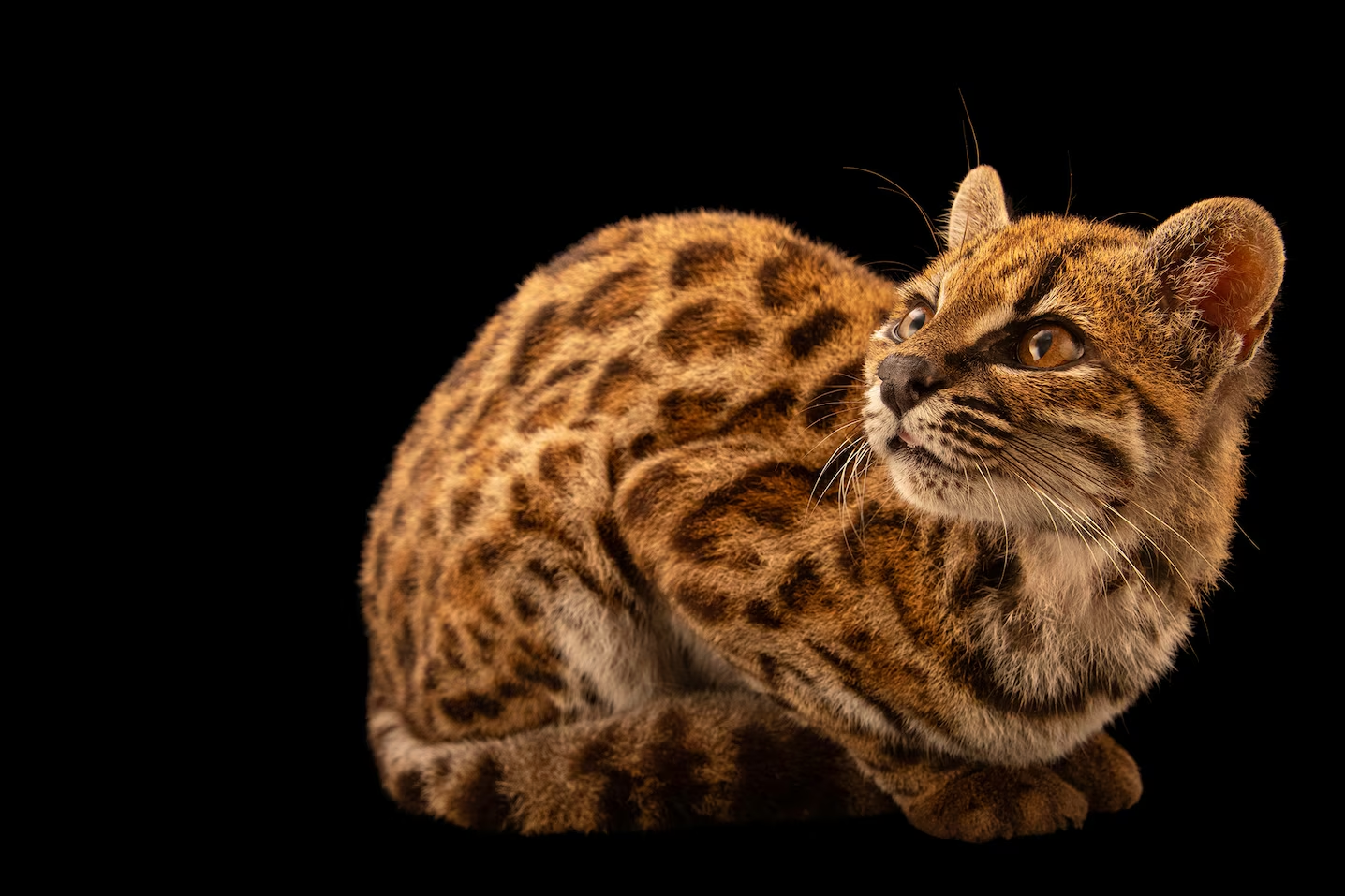
KUCHING: A small spotted cat first brought to a Bolivian wildlife sanctuary a decade ago has been identified as a species previously unknown to science – the first newly discovered felid in more than 100 years.
The animal, now proposed as Leopardus tilcayo, was first encountered in 2016 after a local man found it as a kitten near a forest and initially mistook it for a domestic cat.
After about a year, he realised the animal was clearly wild and brought it to the Senda Verde wildlife sanctuary on the subtropical slopes of the Bolivian Andes.
Biologist and National Geographic Explorer Paola Nogales-Ascarrunz, founder of the Bolivian Felids Research Program, was called in to examine it.
Its appearance immediately stood out – a compact face, short rounded ears, long whiskers and large leopard-like rosettes.
At first, Nogales-Ascarrunz believed it was a member of Leopardus tigrinus, one of several small spotted cats found across Central and South America.
But in 2019, while preparing material on Bolivia’s wild cats, she noticed that the animal’s markings differed markedly from reference specimens in neighbouring Brazil.
That discrepancy eventually led to years of genetic research with Eduardo Eizirik of the Pontifical Catholic University of Rio Grande do Sul and Jonas Lescroart of the University of Antwerp.
Their genomic analysis placed the cat on a distinct branch of the felid family tree.
The researchers have proposed the name Leopardus tilcayo, drawing from the traditional name used by local communities in Bolivia.
The species is currently known from the Yungas forest ecoregion on the eastern slopes of the Andes, although much about its ecology remains unknown, including its diet, reproductive behaviour and population size.
The discovery is particularly significant because it is not simply the reclassification of a known subspecies or the revival of an older taxonomic proposal.
Instead, researchers say L. tilcayo represents a genuinely distinct species, making it the first new member of the cat family described since the pampas cat in 1923.
The finding also reshapes scientists’ understanding of tiger cats.
What was once thought to be a single widespread species is increasingly recognised as a complex of genetically distinct lineages, with the latest study bringing the number of recognised tiger cat species to five.
Researchers say the discovery highlights how much remains unknown about the world’s smaller wild cats, many of which are elusive and difficult to distinguish by appearance alone.
Advanced genomic analysis is now proving crucial in revealing differences that photographs, physical measurements and even museum specimens may fail to detect.