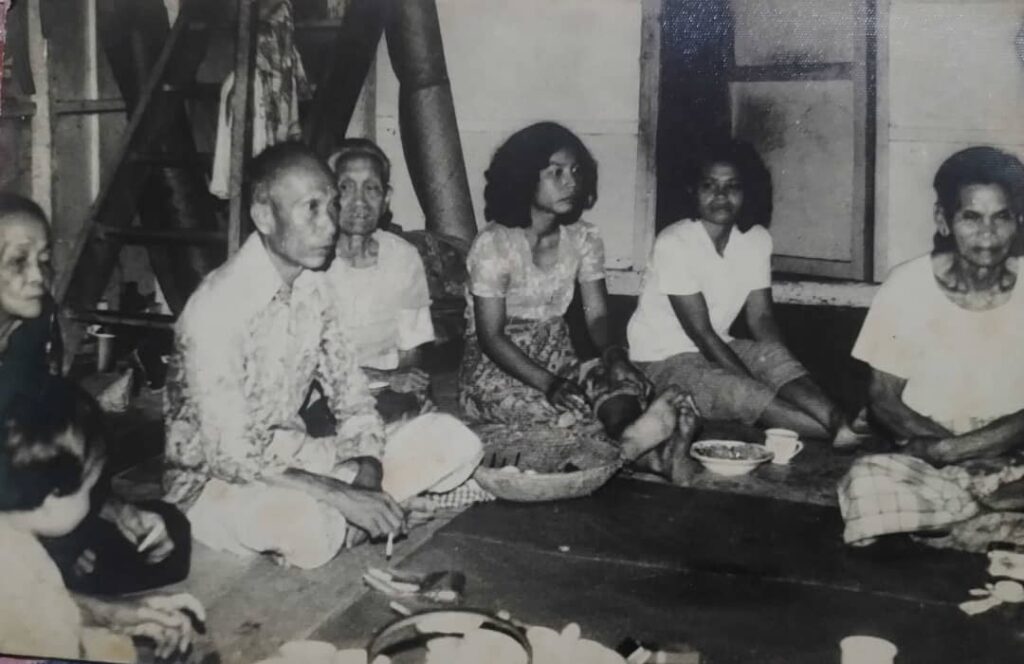
Our Gawai Antu in 1973 concluded with a visit to the Burui Cemetery, where all the ‘sungkup’ — small huts containing woven hats and other accessories — were placed above the graves of the relatives commemorated during the festival.
This trip to the cemetery was regarded as a final tribute to our departed loved ones, serving as a unifying and everlasting memory of those honoured during the celebration.
Later that evening, another event was held in some of the longhouse galleries to mark the festival’s end. At the far end of the Kedap longhouse, in Michael Abunawas’ gallery, a special contest took place: drinking Chap Langkau, a locally brewed liquor.
The contest, open to a handful of teenagers, challenged each of us to finish a bottle of Chap Langkau as quickly as possible. I participated, already a bit tipsy from other drinks but not yet fully intoxicated.
There were eight of us in total. The first to finish his bottle would win a cash prize of RM10, with RM7 and RM5 awarded to the first and second runners-up, respectively. These prizes were sponsored by the Gawai Main Committee, led by Michael Abunawas.
About thirty longhouse residents gathered to watch as the event began with the sound of a gong. I didn’t realize I had finished my bottle until a few minutes had passed, but my first cousin, Chendang (also known as Bujang Ampoi), beat me by a few seconds, leaving me in second place.
Chendang, ten days my senior, was sober at the start and drank his bottle with ease.
Our nephew, Endawie Anggun — two years younger than us — came in third, earning RM5. By the end, all of us were a bit intoxicated. We continued drinking other spirits and lemonade, and by midnight, we were thoroughly inebriated and slept in our respective galleries.
My last stay at the longhouse before starting work with RASCOM (Rajang Area Security Command) was probably in December 1974, after completing my Higher School Certificate (HSC).
By February 1, 1975, I had joined RASCOM as deputy editor for the Iban newspaper Berita Rayat in its Information/Psywar Section.
Later, on June 27, I travelled to Kuching to sign an agreement for a federal scholarship to study Humanities with Education at Universiti Sains Malaysia (USM) in Penang.
I later heard that the Kedap community had a grand Gawai Dayak celebration that year. Among those invited was Krian assemblyman Datuk (later Datuk Amar) Dunstan Endawie Enchana — my third cousin — as the guest of honour. He told my father he would try to help me if he had the chance. He visited me at USM in Penang with Leo Moggie Irok (now Tan Sri Datuk Amar) on August 25 and left me with RM150.
I visited Kedap again at the end of 1976 during our university break and learned that Julung Endawie had succeeded Limbing Untan as headman. My father, Salok Jembu, continued as assistant headman, having declined the headman’s role. After more than a week, I returned to Penang to continue my studies.
Fast forward to early April 1979: Kedap celebrated the wedding of Brownie Abunawas to a girl from Betong, who happened to be Benedict Sandin’s niece.
I was reunited with Sandin at the event, having not seen him for several months since he left USM, where he had been a senior fellow at the Centre for Policy Research.
I had just finished my final exams at USM and was preparing for the next chapter of my life. An appointment was scheduled with Encharang Agas, Principal of Rajang Teachers College in Bintangor, on April 26. This meeting held great promise.
True to my hopes, on April 26, 1979, I was hired as a lecturer at the college, teaching Philosophy and Psychology of Education. As the year progressed, I made several trips to Kedap by bus, but in early 1980, after acquiring my first car — a Ford Cortina 2.0L — I began visiting Kedap almost once a month.
On my first trip with the car, I found it too large for the narrow feeder road at Bansu Stream, about a kilometre from the longhouse. I called on several men, led by Uncle Ganti Ligong, to quickly widen the road. Their prompt help was a great relief, and I was deeply grateful.
Each time I returned, I brought drinks for the men and longhouse residents, who would gather in our room in the evenings. My father’s younger brother, Uncle Ampoi Jembu, was always especially delighted to lead the others in enjoying the drinks.
The Kedap community was tightly knit then, and everyone was eager to gather for free drinks, cookies, and pancakes. I saw it as a way to give back to a community that was still struggling.
Our television set was one of only two in the longhouse—the other belonged to Michael Abunawas. Thanks to the promise of drinks and snacks, our room quickly became the favoured gathering spot.
Wrestling from Great Britain was the most popular show, and our room would fill to the brim with our longhouse mates, all eager for entertainment and camaraderie.
Between 1979 and 1983, my visits to the longhouse were always eagerly anticipated. I cherished seeing the happy faces of our relatives and neighbours. These gatherings played a vital role in fostering unity and togetherness among all the longhouse residents.
The views expressed here are those of the writer and do not necessarily represent the views of Sarawak Tribune. The writer can be reached at tawisalok@yahoo.com.