KUCHING: The atmosphere at Boulevard Shopping Mall here took on the intensity of an epic chess match with 100 opponents yesterday, not with physical strength, but with mental prowess.
The sound of Xiang Qi (Chinese chess) pieces clicking on 100 boards echoed simultaneously, creating a thrilling and focused ambiance.
At the centre of attention was Calvin Tay Yelin, 35, the Sarawak Xiang Qi champion, who took on the 1-on-100 challenge in an exhibition match organised by the Kuching Xiang Qi Association.

It was not just a demonstration of skill – it was also a celebration of the game’s cultural heritage, its educational value, and its growing popularity across all walks of life.
“This is my first time playing 1-on-100, and I’m really excited. I hope all the players give it their best – I’ll certainly do the same,” said Calvin.
Calvin, who started playing at the age of 13, is now active in both local and international tournaments.
His enthusiasm was evident among the participants, ranging from children to adults, including social media personalities.
Across Generations
Among those who participated was 11-year-old Steve Giam Choong Ming, who has been learning to play for just a year.
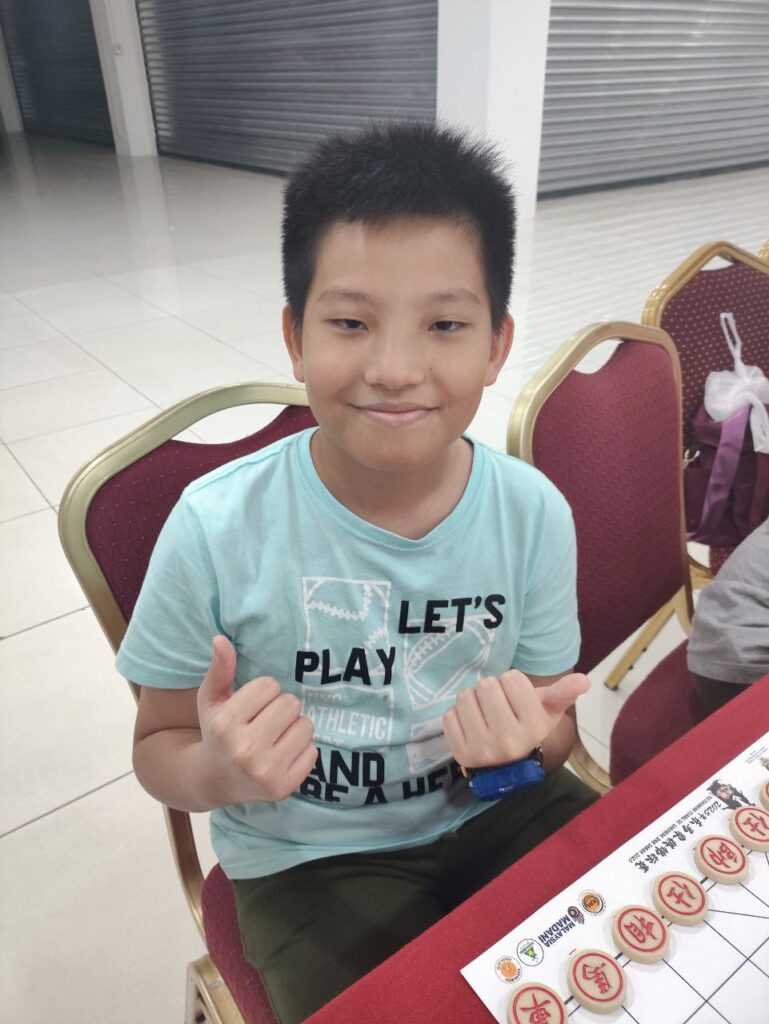
“I like it because it challenges the mind,” he said.
Giam’s main strategy in a challenging match is defence, acknowledging that many of his opponents are more experienced.
Also taking part was Florence Kee, 35, a Key Opinion Leader for the Xiang Qi Association.
“I’m not an expert, but I want to give it a try. Who knows, maybe Calvin will be tired by the time it’s my turn!” she joked.
Despite her playful tone, Kee expressed a deep appreciation for the game.
“Xiang Qi trains your mind – it’s not just entertainment. I’ve even taught my children how to play. Even if you lose, you still learn. It encourages both critical and creative thinking,” she said.
Though the competition was intense, the atmosphere remained relaxed.
Many families and spectators gathered, taking photos and cheering on the participants.
From Hobby to Commitment
For participants like Geoffrey Tay, 19, Xiang Qi began as a casual pastime.

“I started playing when I was 11, but back then, I was just playing for fun,” he shared.
It was not the challenge of the game that drew him in, but the influence of his classmates.
“Actually, it was because everyone in my class was playing, so I decided to learn too,” he explained.
Though he stopped playing after two years, his interest in the game resurfaced during his teenage years.
“When I was around 16 or 17, a friend really encouraged me to join a competition. He would practise with me and push me to enter,” Geoffrey recalled.
Now, with more experience, Geoffrey has a deeper understanding of Xiang Qi’s complexities.
“The most challenging part is the strategy. Strategy is crucial in this game,” he said.
For Geoffrey, Xiang Qi is more than just a game – it’s a test of mental sharpness and the ability to think and adapt quickly.
A Test of Strategy and Endurance
According to Sim Yip How, Kuching Xiang Qi Association Vice-Chairman and Calvin’s teacher, the event was organised to promote the upcoming East Malaysia Xiang Qi Championship, which will be held from May 1 to 3.

“This is the first time we’ve held such an exhibition in Kuching,” he said.
Sim noted that Xiang Qi, which dates back around 2,000 years, originated as a simulation of military strategies used by soldiers.
Over time, it evolved with more pieces and rules, making it more engaging.
For this particular event, each sparring session had a time limit.
Calvin spent roughly 10 seconds on each move, with a complete round taking about 16 minutes.
With an average of 30 to 40 moves per match, the 100 matches would extend into the evening.
The Significance of the Match Duration.
“It’s not just about skill – it’s also about endurance. Calvin has to keep moving non-stop, and the players must remain patient and focused,” he said.
Participants were selected through school visits and social media promotions.
The event was primarily promoted via Facebook, with Sim hosting a live broadcast to engage the wider community.
Participants did not leave empty-handed; each received a certificate and a small angpow worth RM10, with additional recognition for anyone who managed to beat Calvin.
“Their names will be published in magazines and recorded in the official records of our association. It’s our way of acknowledging their efforts,” Sim added.
Traditional or Online Platform?
Sim, who teaches Xiang Qi both in person and online, mentioned that interest in the game is growing, including among non-Chinese players.

“For me, I prefer online teaching. After class ends, I can immediately move on with my day. Also, online sessions are recorded, so if a student misses class due to exams, they can always review the lesson later,” said Sim.
For Calvin, this exhibition is more than just a game – it’s a mission to reignite interest in Xiang Qi.
“I hope more people, especially young people, will start playing this game,” he said.